Snake Plant (Dracaena trifasciata)
Also called Mother-in-law's Tongue, Viper's Bowstring Hemp
Formerly Sansevieria trifasciata, Sansevieria craigii, Sansevieria jacquinii
Give this plant bright, indirect light and let the soil dry out between waterings, and it will do well with little else. It also tolerates low light, making it a good fit for a dim corner. In spring and summer, water once the soil has dried; in winter, water far less often. This plant is toxic to both cats and dogs.
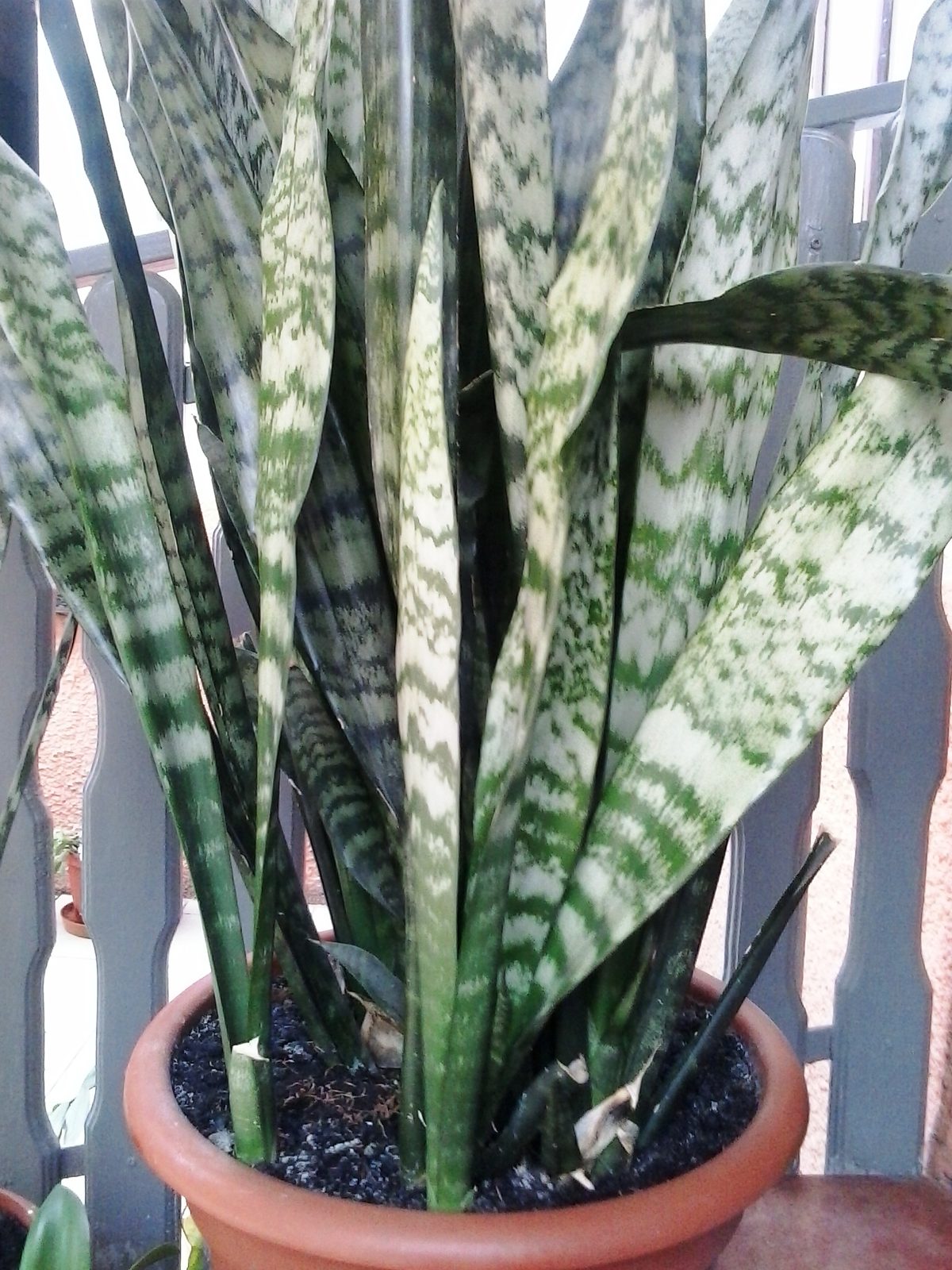
Photo: Ujlak, CC BY-SA 3.0 via Wikimedia Commons

Quick facts
| Light: | Bright, indirect light; tolerates low light11 source |
|---|---|
| Water: | Dry to medium11 source |
| Soil: | Well drained; pH 6–811 source |
| Minimum temperature: | 50 °F (10 °C)11 source |
| Growth rate: | Moderate11 source |
| Bloom: | White and green19 |
| Cats: | Toxic to cats Severity reported: Mild 67 |
| Dogs: | Toxic to dogs 67 |
| Native range: | CAF, CMN, CON, EQG, GAB, NGA, TAN, ZAI10 |
| Family: | Asparagaceae |
How much light does a Snake Plant need?
This plant does best with 2 to 6 hours of direct sun a day, filtered through a curtain or given by a bright window. It still tolerates very low light indoors, so a spot away from any window will not kill it. Outdoors, give it partial shade rather than full sun. It is also rated for heavy shade, so deep shade outside will not harm it either. This plant's native range covers Nigeria, Tanzania, and several other countries in tropical Africa. It also grows at a moderate rate.
- Light: Bright, indirect light; tolerates low light1
How often to water a Snake Plant
From spring through autumn, let the top of the soil dry out fully before you water again. In winter, cut back and water only once every one to two months. This plant prefers dry to only lightly moist soil, never soggy. Overwatering is the main risk, since wet soil left standing can lead to root rot. This plant is also classed as a succulent. It also tolerates drought well. Its soil should drain well to avoid standing water.
- Water: Dry to medium1
Best soil for a Snake Plant
Use a potting mix that drains fast, since standing water is the main risk to the roots. Good drainage matters more than the exact ingredients in the mix. Soil pH between 6 and 8 suits this plant, a fairly wide range that covers most potting soils. You rarely need to adjust pH for this plant, since it tolerates mildly acidic to mildly alkaline soil. Whatever mix you choose, make sure water can pass through it and out of the pot's drainage holes. As a succulent, it stores water in its leaves, so it does not need rich, water-retentive soil to thrive.
Temperature and humidity
Indoors, this plant tolerates temperatures down to about 50 °F (10 °C). It also prefers low humidity over damp, humid air. It is rated for strong resistance to heat as well as humidity. Outdoors, it is only hardy in USDA zones 10a to 12b. This plant needs only low maintenance. Its native range covers several countries in tropical Africa, including Nigeria and Tanzania. This plant is also classed as a succulent. Its growth rate is moderate.
Fertilizing a Snake Plant
A monthly feeding through spring and summer suits this plant best, since that is its main growing season. Use an all-purpose fertilizer at half the strength the label suggests. Outside of spring and summer, this plant does not need any fertilizer. This plant overall needs only low maintenance. This plant also tolerates drought well. It grows at a moderate rate overall.
- Fertilizer: Monthly in the growing season (Mar–Aug)3
Pruning a Snake Plant
If a leaf gets damaged, cut it off at the soil line. Beyond removing dead or damaged leaves, this plant does not need regular pruning. It grows as an erect, clumping perennial. This plant also grows at a moderate rate overall. This plant also tolerates heavy shade and drought well.
- Pruning: Remove dead growth only3
Repotting a Snake Plant
Repot this plant with fresh potting soil about every five years. Choose a well-drained mix each time you repot. This plant grows as an erect, clumping perennial. It also grows at a moderate rate. Keep the soil pH near neutral, between about 6.0 and 8.0, when you refresh it. This plant also tolerates drought well between waterings.
- Repotting: Every 5 years3
How to propagate a Snake Plant
You can propagate this plant by division, by stem cuttings, or by leaf cuttings. All three methods are documented ways to start new plants from it. The parent plant grows as an erect, clumping perennial. This plant grows at a moderate rate overall. Once potted, give it a well-drained soil mix. This plant also tolerates low humidity well indoors.
Step-by-step propagation for Snake Plant
Common problems
Common pests on this plant include spider mites, mealybugs, scale insects, and thrips. Other species on the list include fern scale, longtailed mealybugs, and the banana moth. The spiral nematode and the agave weevil are also recorded as pests of this species. Root rot and anthracnose are the two diseases reported for this plant. Root rot usually follows soil that stays too wet, so good drainage helps prevent it.
- Common pests: banded greenhouse thrips, fern scale insect, longtailed mealybug, spider mites, opogona sacchari, rotylenchus buxophilus, scyphophorus acupunctatus, fern scale, banana rust thrips, banana moth, white peach scale, mealybugs, spiral nematode, agave weevil, thrips and scale insects1555131115115551
- Common diseases: root rot and anthracnose113
| Problem | Kind |
|---|---|
| Banded greenhouse thrips | Pest |
| Fern scale insect | Pest |
| Longtailed mealybug | Pest |
| Spider mites | Pest |
| Opogona sacchari | Pest |
| Rotylenchus buxophilus | Pest |
| Scyphophorus acupunctatus | Pest |
| Fern scale | Pest |
| Banana rust thrips | Pest |
| Banana moth | Pest |
| White peach scale | Pest |
| Mealybugs | Pest |
| Spiral nematode | Pest |
| Agave weevil | Pest |
| Thrips | Pest |
| Scale insects | Pest |
| Root rot | Disease |
| Anthracnose | Disease |
All Snake Plant problems, symptom by symptom
Is Snake Plant toxic to cats and dogs?
- Toxic parts
- Flowers, fruit, leaves, roots and bulbs, sap and stems17
- Toxic principle
- Saponins and saponins671
- Reported signs
- Vomiting, sometimes with blood, Diarrhea, Nausea, Reduced appetite, Excessive drooling, Dilated pupils, seen in cats, Unsteady gait, seen in cats, Lethargy or depression, Skin irritation from contact with the sap, vomiting, sometimes with blood, diarrhea, nausea, drooling, reduced appetite, lethargy, dilated pupils in cats and skin irritation on contact with the sap6181
Cats can be poisoned by this plant. Dogs can be poisoned by it too. The toxic parts include the flowers, fruit, leaves, roots, sap, and stems. The toxic principle is a group of compounds called saponins. Signs in pets include vomiting, drooling, reduced appetite, and diarrhea. Cats may also show dilated pupils or an unsteady gait, and the sap can irritate skin on contact. One source lists the severity of its toxicity to cats as mild. These records do not give a severity rating for dogs; if your pet eats this plant, contact your vet or a pet poison line. It also grows at a moderate rate.
Signs, toxic parts and what to do
Pet-safe alternatives
Recommended supplies
- Light: bright, indirect light, such as near an east window; a full-spectrum grow light substitutes where no window does.
- Soil: a free-draining mix, and a pot with a drainage hole.
Questions and answers
- Is a snake plant toxic to cats and dogs?
- This plant is toxic to both cats and dogs if they chew or eat it. The toxic principle is a group of compounds called saponins, found in the leaves, stems, sap, and other parts. Watch for vomiting, drooling, and a reduced appetite, and call your vet or a pet poison line if this happens.
- How often should I water a snake plant?
- In spring through autumn, let the soil dry out fully before you water it again. In winter, water it only once every one to two months. This plant also tolerates drought well. This plant also prefers low humidity. It is classed as a succulent.
- Can a snake plant survive in low light?
- It tolerates very low light indoors, though bright, indirect light with a few hours of direct sun works best. Outdoors, it does best in partial shade rather than full sun. It is also rated for strong resistance to heavy shade. This plant also grows at a moderate rate.
Sources
- NC State Extension Gardener Plant Toolbox. https://plants.ces.ncsu.edu/plants/dracaena-trifasciata/. Accessed 23 September 2026.
- Iowa State University Extension and Outreach (Yard and Garden). https://yardandgarden.extension.iastate.edu/how-to/easy-low-maintenance-houseplants. Accessed 12 October 2026.
- Penn State Extension. https://extension.psu.edu/snake-plant-a-forgiving-low-maintenance-houseplant. Accessed 23 September 2026.
- Brooklyn Botanic Garden. https://www.bbg.org/article/how_to_propagate_houseplants. Accessed 23 September 2026.
- EPPO Global Database. https://gd.eppo.int/taxon/SAHTR/pests. Accessed 23 September 2026.
- ASPCA. https://www.aspca.org/pet-care/aspca-poison-control/toxic-and-non-toxic-plants/snake-plant. Accessed 23 September 2026.
- Pet Poison Helpline. https://www.petpoisonhelpline.com/poison/sansevieria/. Accessed 23 September 2026.
- Pet Poison Helpline. https://www.petpoisonhelpline.com/poison/mother-in-laws-tongue/. Accessed 23 September 2026.
- Chicago Botanic Garden. https://www.chicagobotanic.org/plant-information/plant-finder/sansevieria-trifasciata-mother-laws-tongue. Accessed 23 September 2026.
- Royal Botanic Gardens, Kew (World Checklist of Vascular Plants). https://sftp.kew.org/pub/data-repositories/WCVP/wcvp.zip. Accessed 4 June 2026.
How this page was made
- Written with AI assistance from the sources listed on this page. AI is never the source of a fact.