Parlor Palm (Chamaedorea elegans)
Also called Parlour Palm
Formerly Neanthe elegans, Collinia elegans, Nunnezharia elegans
Parlor palm does well in bright, indirect light, and it tolerates low light. Its water need runs from dry to medium, and it can tolerate drought and dry soil for short periods. The ASPCA lists it as non-toxic to cats and non-toxic to dogs.
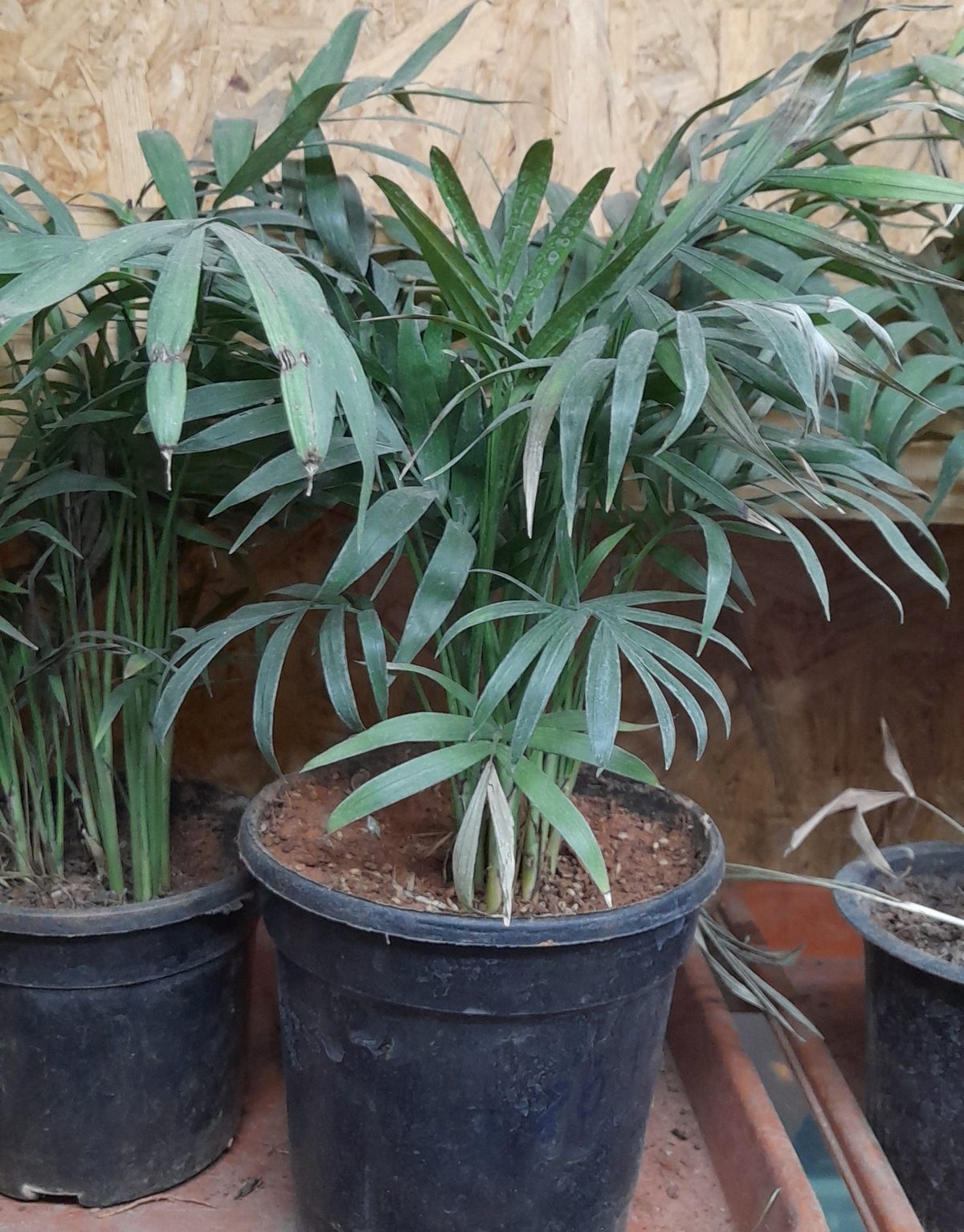
Photo: Yercaud-elango, CC BY-SA 4.0 via Wikimedia Commons

Quick facts
| Light: | Bright, indirect light; tolerates low light12 |
|---|---|
| Water: | Dry to medium11 source |
| Soil: | Well drained and moist; pH 6–6.5341 source |
| Minimum temperature: | 60.8 °F (16 °C)31 source |
| Size: | 2–7.5 ft (0.61–2.29 m) × 2–3 ft (0.61–0.91 m)15 |
| Growth rate: | Slow11 source |
| Bloom: | Yellow, orange, red and green11 source |
| Cats: | Non-toxic to cats 71 |
| Dogs: | Non-toxic to dogs 71 |
| Native range: | BLZ, GUA, HON, MXC, MXE, MXG, MXS, MXT8 |
| Family: | Arecaceae |
How much light does a Parlor Palm need?
Indoors, this palm needs bright, indirect light, though it can tolerate low-light conditions. It also tolerates very low light. Outdoors, it prefers part shade, and full shade is listed as another option. The outdoor listing describes dappled sunlight, meaning shade through the upper canopy all day.
How often to water a Parlor Palm
Water needs run from dry to medium. The plant can tolerate drought and dry soil for short periods, but it grows more lushly in moist soil. Its soil is listed as well drained and moist, so the pot should be porous with plenty of organic matter to give both adequate moisture and excellent drainage.
- Water: Dry to medium1
Best soil for a Parlor Palm
Soil for this plant should be well drained and moist. The mix must be porous. It needs plenty of organic matter to ensure both adequate moisture and excellent drainage. Dry soil is tolerated for short periods, but the plant grows more lushly in moist soil. Maintain soil pH between 6 and 6.5. The soil facts on this page are moist and well drained, with a pH of 6–6.5.
Temperature and humidity
The minimum winter temperature is 60.8 °F (16 °C). Indoors, keep the plant above that winter minimum. Parlor palm prefers high to moderate humidity but is adaptable. A second listing says it does well with low to medium humidity levels. Outdoors, it is listed for USDA zones 10a to 12b. That hardiness range spans six half-zones, from 10a up to 12b.
Fertilizing a Parlor Palm
A light feeding schedule suits this palm, at about once a year. Use a liquid fertilizer diluted to one-third of the recommended rate. Apply it during the growing season. At one-third strength, the fertilizer is diluted well below the full rate.
- Fertilizer: Light, once a year2
Pruning a Parlor Palm
Pruning is limited to removing dead growth. Trim off dead leaves only when they are brown and crispy. Wait until a leaf is brown and crispy before you trim it. Dead growth is the only thing the listing says to remove.
- Pruning: Remove dead growth only2
Repotting a Parlor Palm
Repotting every 2 to 3 years may be needed. The reason given is to refresh the potting mix, at the least. The interval is a range, from a minimum of 2 years to a maximum of 3 years. When you refresh the potting mix, choose one that is well drained and moist.
- Repotting: Every 2–3 years5
How to propagate a Parlor Palm
Propagation is by seed. Most palms are propagated from seed, and this palm is recorded with seed only. No cited fact records cuttings or division for this palm. Seed is the one method listed. Its flowers are small and range from light yellow to orange-red. That makes seed the method to look for when you want more plants.
- Propagation: Seed3
Common problems
Potential insect problems include red spider mites and mealybugs. Other pests listed include banded greenhouse thrips, greenhouse thrips, fern scale and root mealybugs. The pest list also names Aleurothrixus trachoides, Brevipalpus hondurani and Euwallacea fornicatus. Tomato spotted wilt virus is the disease listed for this palm.
- Common pests: spider mites, mealybugs, banded greenhouse thrips, greenhouse thrips, fern scale, root mealybugs, aleurothrixus trachoides, brevipalpus hondurani, euwallacea fornicatus, opogona sacchari, paraleyrodes minei, radopholus similis and rhynchophorus palmarum1
- Common diseases: tomato spotted wilt virus6
| Problem | Kind |
|---|---|
| Spider mites | Pest |
| Mealybugs | Pest |
| Banded greenhouse thrips | Pest |
| Greenhouse thrips | Pest |
| Fern scale | Pest |
| Root mealybugs | Pest |
| Aleurothrixus trachoides | Pest |
| Brevipalpus hondurani | Pest |
| Euwallacea fornicatus | Pest |
| Opogona sacchari | Pest |
| Paraleyrodes minei | Pest |
| Radopholus similis | Pest |
| Rhynchophorus palmarum | Pest |
| Tomato spotted wilt virus | Disease |
Is Parlor Palm toxic to cats and dogs?
For cats, the ASPCA lists this plant as non-toxic. For dogs, the ASPCA also lists it as non-toxic. The ASPCA entry reads Non-Toxic to Dogs, Non-Toxic to Cats. NC State Extension says it is not hazardous for pets. Both entries are recorded as non-toxic, and neither is left undocumented.
Recommended supplies
- Light: bright, indirect light, such as near an east window; a full-spectrum grow light substitutes where no window does.
- Soil: a free-draining mix, and a pot with a drainage hole.
Questions and answers
- Is parlor palm toxic to cats and dogs?
- The ASPCA lists it as non-toxic to cats and non-toxic to dogs. NC State Extension says it is not hazardous for pets. Both positions are recorded separately for each animal.
- How much light does a parlor palm need?
- It needs bright, indirect light indoors. It can also tolerate low-light conditions, and very low light is listed as tolerated. Outdoors it prefers part shade.
- How often should I repot a parlor palm?
- Repotting every 2 to 3 years may be needed. The purpose is, at the least, to refresh the potting mix. Use soil that is well drained and moist.
Sources
- NC State Extension Gardener Plant Toolbox. https://plants.ces.ncsu.edu/plants/chamaedorea-elegans/. Accessed 23 September 2026.
- Brooklyn Botanic Garden. https://www.bbg.org/article/palms_in_the_parlor. Accessed 23 September 2026.
- Clemson Cooperative Extension Home & Garden Information Center. https://hgic.clemson.edu/factsheet/indoor-palms/. Accessed 24 September 2026.
- Penn State Extension. https://extension.psu.edu/palm-diseases. Accessed 12 October 2026.
- Penn State Extension. https://extension.psu.edu/palms-as-houseplants. Accessed 28 October 2026.
- EPPO Global Database. https://gd.eppo.int/taxon/CMDEL/pests. Accessed 23 September 2026.
- ASPCA. https://www.aspca.org/pet-care/aspca-poison-control/toxic-and-non-toxic-plants/parlor-palm. Accessed 24 September 2026.
- Royal Botanic Gardens, Kew (World Checklist of Vascular Plants). https://sftp.kew.org/pub/data-repositories/WCVP/wcvp.zip. Accessed 4 June 2026.
How this page was made
- Written with AI assistance from the sources listed on this page. AI is never the source of a fact.