Pothos (Epipremnum aureum)
Also called Devil's Ivy, Centipede Tongavine
Formerly Pothos aureus, Scindapsus aureus, Rhaphidophora aurea
Give this plant bright, indirect light, though it also tolerates low light for long stretches. Let the potting mix dry out between waterings, from dry to lightly moist. This plant is toxic to both cats and dogs, and the reaction in cats is rated moderate in severity.
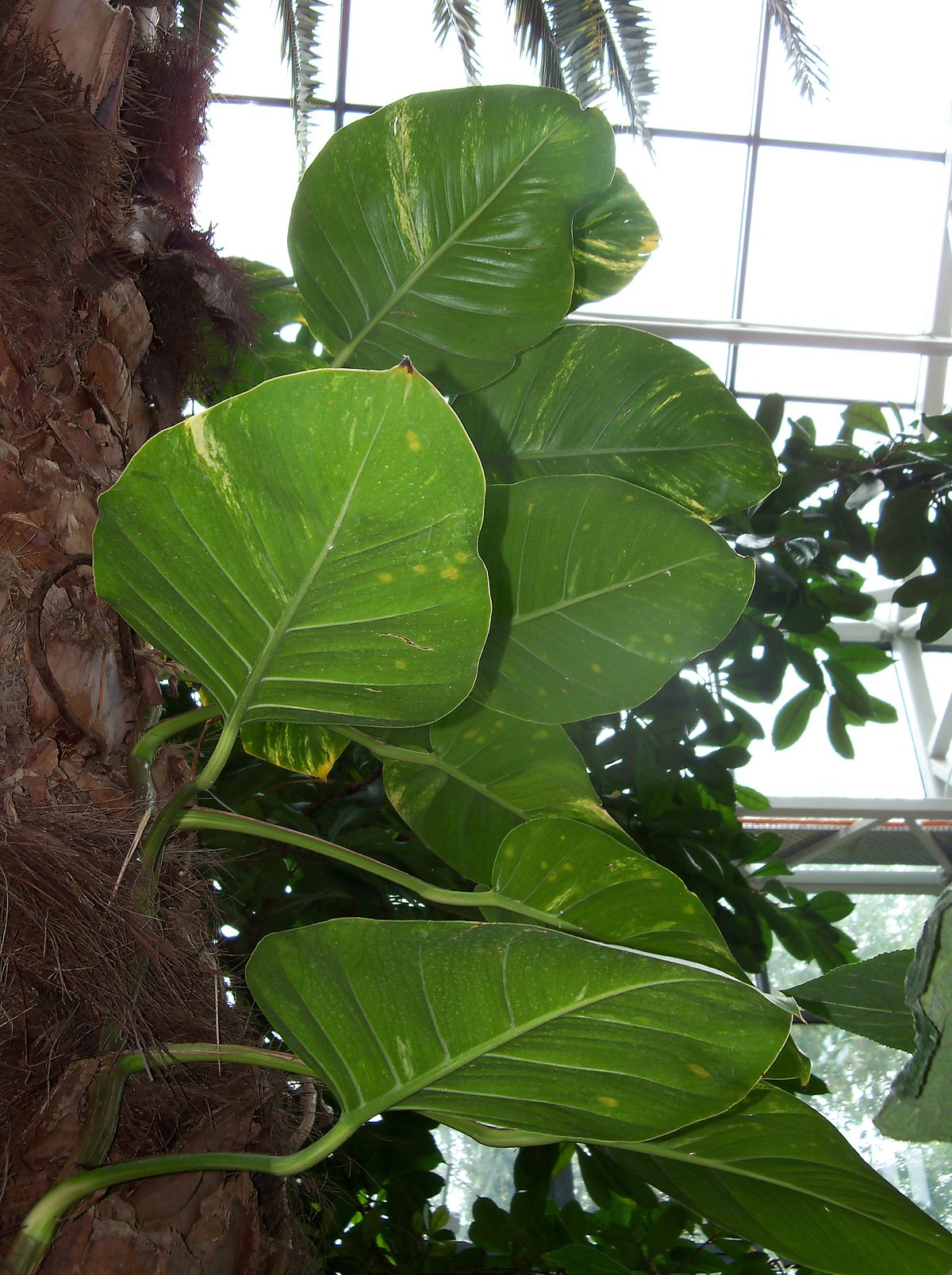
Photo: Marek Argent (Abrimaal), CC BY-SA 3.0 via Wikimedia Commons

Quick facts
| Light: | Bright, indirect light; tolerates low light11 source |
|---|---|
| Water: | Dry to medium11 source |
| Soil: | Well drained and occasionally dry; pH 6.5–7231 source |
| Minimum temperature: | 33.8 °F (1 °C)31 source |
| Size: | Sources differ: NC State Extension Gardener Plant Toolbox × 8–10 ft (2.44–3.05 m)12Sources differ |
| Growth rate: | Moderate111 source |
| Bloom: | Yellow, green and purple11 source |
| Cats: | Toxic to cats Severity reported: Moderate 718 |
| Dogs: | Toxic to dogs 718 |
| Native range: | SCI9 |
| Family: | Araceae |
How much light does a Pothos need?
Indoors, pothos does best in bright, indirect light, though it survives for long periods even in low light. If you grow it outdoors, give it part shade to full shade rather than direct sun. Shade levels between 63 and 80 percent suit it well in a shaded bed or patio. Even deep shade, with less than two hours of direct sun, is tolerated outdoors. As a climbing, spreading vine, pothos can trail 8 to 10 ft (2.4 to 3 m) or more. Its leaves stay evergreen throughout the year.
- Light: Bright, indirect light; tolerates low light1
How often to water a Pothos
Between waterings, let the potting medium swing from fully dry to lightly moist. Let it dry out completely before you water again, rather than keeping it constantly damp. A mix that drains well keeps the soil from staying wet around the roots. It also tolerates soil that occasionally runs dry. This vine's habit is climbing and spreading, and it keeps its leaves year-round as an evergreen plant. A soil pH between 6.5 and 7.0 also suits it.
- Water: Dry to medium1
Best soil for a Pothos
A well-drained, soilless potting mix, of good quality, suits pothos best. It also tolerates a mix that runs dry between waterings rather than staying wet. Aim for a soil pH between 6.5 and 7.0, in a medium with good aeration and moisture-holding capacity. Overwatering can bring on root rot and blackened leaf margins in this plant, according to extension sources. The spathe ranges from yellow to green or purple.
Temperature and humidity
Keep pothos above about 34°F (1°C). Exposure to 33-40°F (1-4°C) for several hours, or a sudden swing in temperature, can injure it. It does best in high humidity, in the range of 50 to 70 percent. Outdoors, it is winter-hardy only in USDA zones 10a to 12b; in colder regions, it is grown as a houseplant or a seasonal annual instead. This plant is native to the Solomon Islands. It has also become introduced in Hawaii, the continental United States, and Puerto Rico.
Fertilizing a Pothos
Feed pothos about once a month during its growing season. Overall, this plant has a moderate growth rate, and it also ranks as a low-maintenance plant to care for. It grows as a climbing, spreading vine indoors and outdoors, and its leaves stay evergreen throughout the year. It prefers humidity between 50 and 70 percent as well. Cold exposure near 33-40°F (1-4°C) for several hours can also harm it.
- Fertilizer: Monthly in the growing season3
Pruning a Pothos
Shorten a pothos stem at any point along its length, using sharp scissors just above a node. For a harder renewal cut, remove the entire stem length, leaving a 2-inch stub behind. Both light shaping and this harder renewal pruning suit this climbing vine. A mature vine can reach 8-10 ft (2.4-3 m) or more in length. Mealybugs and scale insects are among the pests recorded on this plant.
- Pruning: Light shaping and Hard renewal pruning2
Repotting a Pothos
Plan to repot pothos about once a year, in spring, moving it into a slightly larger container each time. Use a potting mix that drains well and is allowed to dry out between waterings. A soil pH of 6.5 to 7.0 suits it well at repotting time. Overall, pothos is a low-maintenance plant with a moderate pace of growth.
- Repotting: Every 1 year (Mar–May)2
How to propagate a Pothos
You can propagate pothos by stem cuttings, division, or layering. Cuttings taken from the stem root easily when placed in water, and division and layering also work as propagation methods for this plant. A mature vine can trail 8 to 10 ft (2.4 to 3 m) or more. Pot new cuttings in a mix that drains well and is allowed to dry out occasionally. Pothos has a moderate growth rate overall. It also prefers humidity between 50 and 70 percent.
- Propagation: Stem cuttings, division and layering1
Common problems
Several pests are recorded on pothos, including mealybugs, scale insects, spider mites, thrips, whiteflies, and armyworms. Banded greenhouse thrips and the whitefly Aleurodicus dispersus are among the species recorded on this plant. Reported diseases include root rot, bacterial wilt, southern blight, and both leaf spot and bacterial leaf spot. Phytophthora root rot is the most common disease affecting it, and overwatering can also blacken its leaf margins.
| Problem | Kind |
|---|---|
| Mealybugs | Pest |
| Scale insects | Pest |
| Spider mites | Pest |
| Thrips | Pest |
| Whiteflies | Pest |
| Armyworms | Pest |
| Root rot | Disease |
| Bacterial wilt | Disease |
| Southern blight | Disease |
| Leaf spot | Disease |
| Bacterial leaf spot | Disease |
Is Pothos toxic to cats and dogs?
Both cats and dogs can be poisoned by pothos; it is toxic to each of them. The ASPCA Animal Poison Control Center lists it as toxic to cats and also toxic to dogs. NC State Extension's Plant Toolbox separately names it a problem for cats and a problem for dogs. In cats, the toxic reaction is rated moderate in severity, based on the poison severity scale used by the sources. Pothos is a herbaceous perennial houseplant in the arum family, Araceae.
Pet-safe alternatives
Recommended supplies
- Light: bright, indirect light, such as near an east window; a full-spectrum grow light substitutes where no window does.
- Soil: a free-draining mix, and a pot with a drainage hole.
- Humidity: it wants humid air; a pebble tray or a humidifier is the usual fix.
Questions and answers
- Is pothos toxic to cats and dogs?
- Yes, pothos is toxic to both cats and dogs, and the ASPCA lists it as a toxic plant for each species. In cats, the reaction is rated moderate in severity.
- How much light does pothos need indoors?
- Give it bright, indirect light, though it also tolerates low light for long periods. Outdoors, it prefers part shade to full shade rather than direct sun.
- How often should you water and fertilize pothos?
- Let the potting mix dry out from fully dry to lightly moist between waterings. Fertilize it about once a month during its growing season. It also prefers a soil pH between 6.5 and 7.0.
Sources
- NC State Extension Gardener Plant Toolbox. https://plants.ces.ncsu.edu/plants/epipremnum-aureum/. Accessed 23 September 2026.
- Penn State Extension. https://extension.psu.edu/pothos-as-a-houseplant. Accessed 24 September 2026.
- University of Florida IFAS Extension (EDIS/Ask IFAS). https://ask.ifas.ufl.edu/publication/EP151. Accessed 23 September 2026.
- Clemson Cooperative Extension Home & Garden Information Center. https://hgic.clemson.edu/factsheet/how-to-grow-pothos-indoors-epipremnum-spp-care-cultivars-and-common-problems/. Accessed 23 September 2026.
- EPPO Global Database. https://gd.eppo.int/taxon/SNDAU/pests. Accessed 23 September 2026.
- UF/IFAS Extension (EDIS). https://ask.ifas.ufl.edu/publication/PP340. Accessed 23 September 2026.
- ASPCA Animal Poison Control Center. https://www.aspca.org/pet-care/aspca-poison-control/toxic-and-non-toxic-plants/golden-pothos. Accessed 23 September 2026.
- Pet Poison Helpline. https://www.petpoisonhelpline.com/poison/golden-pathos/. Accessed 23 September 2026.
- Royal Botanic Gardens, Kew (World Checklist of Vascular Plants). https://sftp.kew.org/pub/data-repositories/WCVP/wcvp.zip. Accessed 4 June 2026.
How this page was made
- Written with AI assistance from the sources listed on this page. AI is never the source of a fact.