Peace Lily (Spathiphyllum wallisii)
Place your peace lily where it gets bright, indirect light, and keep the soil moist but not soggy. It tolerates low light, but it grows best with brighter conditions. The ASPCA lists this plant as toxic to both cats and dogs.
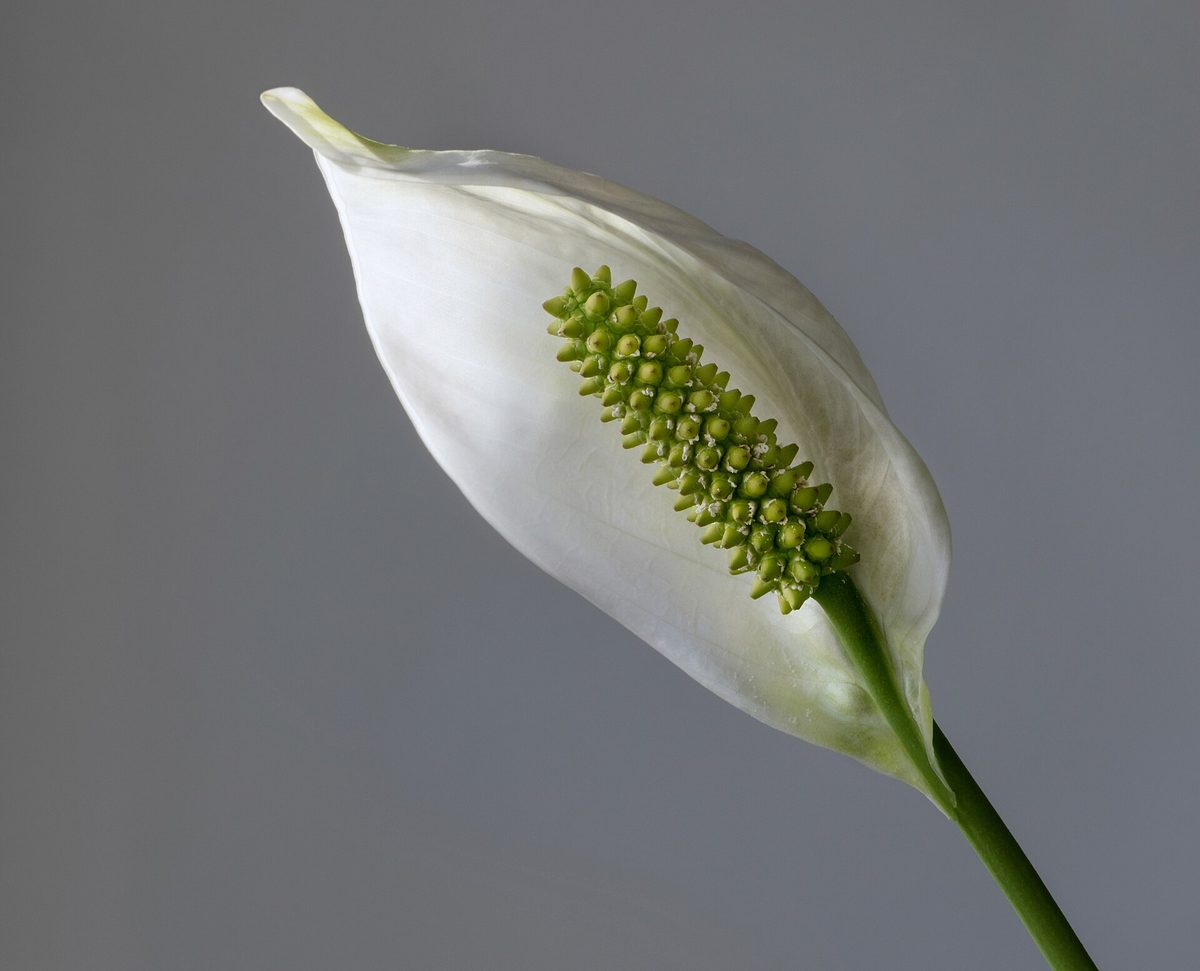
Photo: W.carter, CC BY-SA 4.0 via Wikimedia Commons

Quick facts
| Light: | Bright, indirect light; tolerates low light123 |
|---|---|
| Water: | Medium1425 |
| Soil: | Well drained and moist513 |
| Minimum temperature: | 60.8 °F (16 °C)11 source |
| Size: | 1–3.9 ft (0.3–1.2 m) × 1–3.9 ft (0.3–1.2 m)11 source |
| Bloom: | , White and green451 source |
| Cats: | Toxic to cats (1 source) 9 |
| Dogs: | Toxic to dogs (1 source) 9 |
| Family: | Araceae |
How much light does a Peace Lily need?
Peace lilies tolerate low light, but they grow best in bright indirect light. The plant also flowers best in indirect sunlight. Outdoors, it prefers full shade and also accepts part shade. Full shade means less than two hours of direct sunlight, and part shade means two to six hours. Keep it out of direct sun.
How often to water a Peace Lily
Water needs fall in the medium range, and the soil should stay moist but not soggy. Let the soil dry out slightly between waterings. Medium is both the lowest and the highest water level listed. Soil drainage is listed as well drained and moist. No watering schedule in days is documented for this plant.
Best soil for a Peace Lily
The soil drainage listed for this species is well drained and moist. Peace lilies will flourish in almost any well-drained potting mix. Good drainage is listed as a need for this species. A mix that stays moist but not soggy, then dries slightly between waterings, fits both the water and drainage facts. Water needs are medium, and the soil should be kept moist but not soggy. Let the mix dry slightly between waterings. No cited source records a soil pH range, so that value is not documented.
Temperature and humidity
Try to keep the plant above 60 °F (16 °C), because cold damage may occur below that point. Common indoor plants such as peace lilies enjoy high humidity. The species also thrives in humid, tropical rainforest understories. The humidity level is listed simply as high. For outdoor growing, the documented hardiness zones run from 11a to 12b. No cited source gives a maximum temperature. No cited source gives a humidity percentage either.
Fertilizing a Peace Lily
Fertilize your peace lily once a month during the growing season, March through August. A 20-20-20 water soluble fertilizer solution with a nitrogen level of 50 ppm is the mix documented. That works out to one feeding a month across six months. Fertilizer amounts beyond that nitrogen level are not documented.
- Fertilizer: Monthly in the growing season (Mar–Aug)7
How to propagate a Peace Lily
Peace lilies are easily propagated by division. Division is the only propagation method on record for this plant. It has an erect, mounding habit. Mature height and spread are each 1 to 3.9 ft (0.3 to 1.2 m). Most peace lilies grow between 1 and 4 feet tall and wide, and a few cultivars reach 6 feet (1.8 m).
Common problems
Mealybugs, purple mite, fungus gnats, spider mites and scales are the pests recorded for peace lilies. Mealybugs are probably the most common insect indoors. Fungus gnats and spider mites are two of the five groups on that list. Scales and purple mite complete the list.
| Problem | Kind |
|---|---|
| Mealybugs | Pest |
| Purple mite | Pest |
| Fungus gnats | Pest |
| Spider mites | Pest |
| Scales | Pest |
| Root rot | Disease |
Is Peace Lily toxic to cats and dogs?
For cats, the ASPCA lists the peace lily as toxic. For dogs, the ASPCA also lists it as toxic. The listing reads Toxic to Dogs, Toxic to Cats. Keep this plant away from both cats and dogs. Cats and dogs are the two animals this site covers, and both are listed as affected. The ASPCA Animal Poison Control Center is the source of both the cat and the dog entries. No severity level is recorded for either animal.
Pet-safe alternatives
Recommended supplies
- Light: bright, indirect light, such as near an east window; a full-spectrum grow light substitutes where no window does.
- Soil: a free-draining mix, and a pot with a drainage hole.
- Humidity: it wants humid air; a pebble tray or a humidifier is the usual fix.
Questions and answers
- Is a peace lily toxic to cats and dogs?
- The ASPCA lists the peace lily as toxic to both cats and dogs. The listing reads Toxic to Dogs, Toxic to Cats. Keep the plant away from both animals.
- How much light does a peace lily need?
- Peace lilies tolerate low light, but they grow best in bright indirect light. They also flower best in indirect sunlight. Outdoors, full shade is preferred, and part shade is also accepted.
- How should I water a peace lily?
- Keep the soil moist but not soggy, and let it dry slightly between waterings. Water needs are medium. Soil drainage is listed as well drained and moist.
Sources
- Clemson Cooperative Extension HGIC. https://hgic.clemson.edu/factsheet/peace-lily/. Accessed 25 October 2026.
- Iowa State University Extension and Outreach. https://yardandgarden.extension.iastate.edu/how-to/easy-low-maintenance-houseplants. Accessed 25 October 2026.
- University of Florida IFAS Extension (EDIS). https://ask.ifas.ufl.edu/publication/EP477. Accessed 25 October 2026.
- NC State Extension. https://plants.ces.ncsu.edu/plants/spathiphyllum. Accessed 25 October 2026.
- NC State Extension Gardener Plant Toolbox. https://plants.ces.ncsu.edu/plants/spathiphyllum/. Accessed 25 October 2026.
- Clemson Cooperative Extension HGIC. https://hgic.clemson.edu/indoor-plants-for-the-classroom/. Accessed 25 October 2026.
- University of Florida IFAS Extension (EDIS). https://ask.ifas.ufl.edu/publication/EP161. Accessed 25 October 2026.
- UF/IFAS Extension (EDIS). https://ask.ifas.ufl.edu/ep161. Accessed 25 October 2026.
- ASPCA Animal Poison Control Center. https://www.aspca.org/pet-care/aspca-poison-control/toxic-and-non-toxic-plants/peace-lily. Accessed 25 October 2026.
How this page was made
- Written with AI assistance from the sources listed on this page. AI is never the source of a fact.