Aji (Capsicum chinense)
Formerly Capsicum cerasiforme, Capsicum luteum, Capsicum sinense
Give your aji pepper full sun outdoors and keep its soil consistently moist rather than letting it dry out between waterings. It is rated for USDA zones 10a to 11b, and temperatures under 50 °F (10 °C) can reduce fruit set. Pet toxicity for cats and dogs is not documented in the facts for this page.
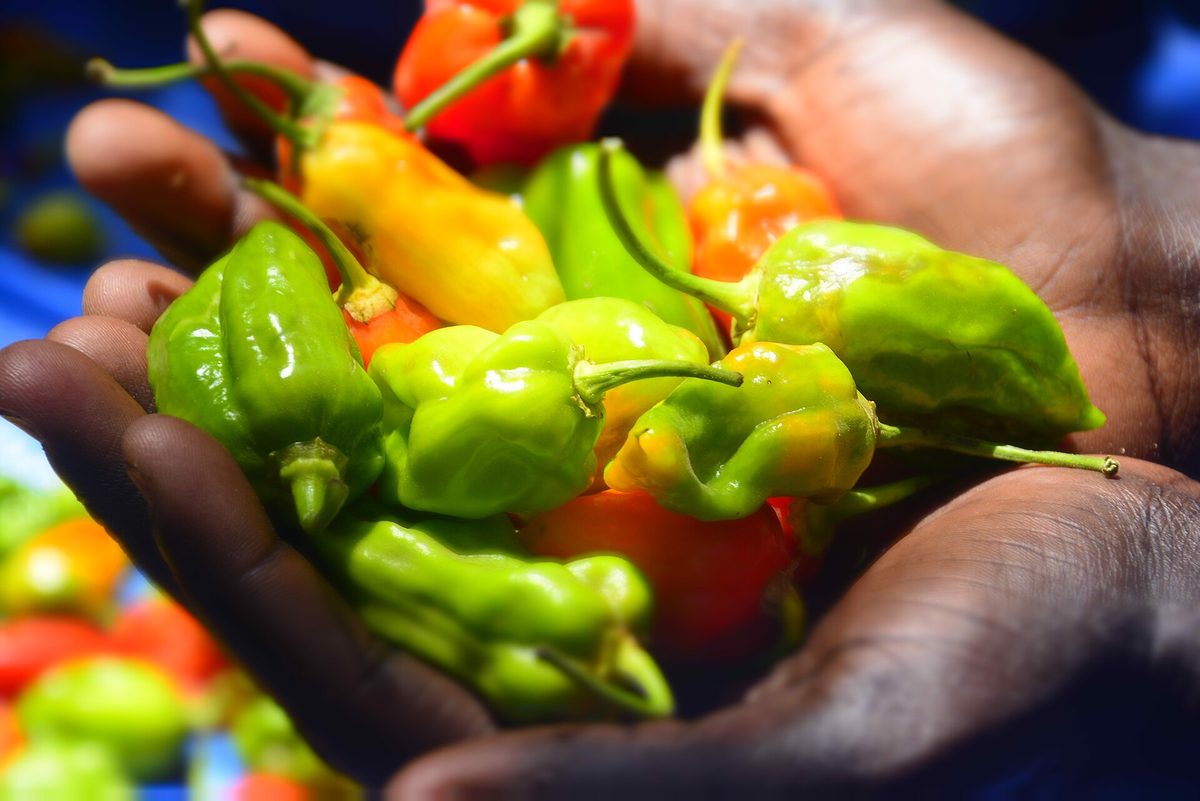
Photo: Kalamuh 045, CC BY-SA 4.0 via Wikimedia Commons

Quick facts
| Water: | Dry to wet11 source |
|---|---|
| Soil: | Well drained; pH 6–6.52134 |
| Minimum temperature: | 50 °F (10 °C)551 source |
| Size: | 1–2.5 ft (0.3–0.76 m) × 1–2 ft (0.3–0.61 m)27 |
| Growth rate: | Moderate27 |
| Bloom: | White21 source |
| Cats: | Not documented by major sources |
| Dogs: | Not documented by major sources |
| Native range: | BZN, GUY, SUR9 |
| Family: | Solanaceae |
How often to water an Aji
Aim for soil that stays consistently moist instead of drying out between waterings. The recorded water range for this species runs from dry to wet. Pair that moisture with soil that drains well. A rich, moist, well-drained soil is the description given for growing this pepper in full sun.
- Water: Dry to wet1
Best soil for an Aji
Soil for this pepper should be well drained. The description is rich, moist, well-drained soil in full sun. Follow the results of a soil test to maintain a soil pH between 6.0 and 6.5. The soil should also stay consistently moist rather than drying out between waterings. Soil that drains well and sits at pH 6 to 6.5 matches both recorded needs.
Temperature and humidity
Temperatures lower than 50 °F (10 °C) can reduce fruit set in peppers. Air temperatures higher than 94 °F (34 °C) or lower than 50 °F (10 °C) are described as excessive. This pepper is rated for USDA zones 10a to 11b. No cited source records a humidity preference for this plant.
Fertilizing an Aji
Fertilizer can go on up to once a month during the growing season. The recorded frequency is monthly in the growing season. This pepper has a moderate growth rate and medium maintenance needs. Mature plants spread 1 to 2 ft (0.3–0.61 m) wide.
- Fertilizer: Monthly in the growing season6
Pruning an Aji
Light shaping is the recorded pruning type for this pepper. Leggy stems can be cut back by 4 to 6 in (10 to 15 cm), using hand shears or scissors, or simply pinched off. Maintenance is rated medium. The plant is erect in habit and reaches 1 to 2.5 ft (0.3–0.76 m) tall.
- Pruning: Light shaping6
How to propagate an Aji
Seed is the only propagation method recorded for this plant. Established plants are described as not widely available in the US, so starting from seed is the advice given. Starting seeds indoors is recommended, about 8 to 10 weeks before you transplant them. Its growth rate is recorded as moderate.
- Propagation: Seed7
Common problems
Recorded pests include aphids, armyworms, buffalo treehopper, tomato fruitworm, cucumber beetles, cutworms, earwigs, flea beetles, hornworms and lygus bugs. The list continues with nematodes, omnivorous leafroller, pepper weevil, snails and slugs, spider mites, thrips, vegetable leafminers and whiteflies. Recorded diseases are curly top, mosaic viruses, phytophthora root and crown rot, powdery mildew, spotted wilt virus and verticillium wilt.
- Common pests: aphids, armyworms, buffalo treehopper, tomato fruitworm, cucumber beetles, cutworms, earwigs, flea beetles, hornworms, lygus bugs, nematodes, omnivorous leafroller, pepper weevil, snails and slugs, spider mites, thrips, vegetable leafminers and whiteflies8
- Common diseases: curly top, mosaic viruses, phytophthora root and crown rot, powdery mildew, spotted wilt virus and verticillium wilt8
| Problem | Kind |
|---|---|
| Aphids | Pest |
| Armyworms | Pest |
| Buffalo treehopper | Pest |
| Tomato fruitworm | Pest |
| Cucumber beetles | Pest |
| Cutworms | Pest |
| Earwigs | Pest |
| Flea beetles | Pest |
| Hornworms | Pest |
| Lygus bugs | Pest |
| Nematodes | Pest |
| Omnivorous leafroller | Pest |
| Pepper weevil | Pest |
| Snails and slugs | Pest |
| Spider mites | Pest |
| Thrips | Pest |
| Vegetable leafminers | Pest |
| Whiteflies | Pest |
| Curly top | Disease |
| Mosaic viruses | Disease |
| Phytophthora root and crown rot | Disease |
| Powdery mildew | Disease |
| Spotted wilt virus | Disease |
| Verticillium wilt | Disease |
Is Aji toxic to cats and dogs?
Recommended supplies
- Soil: a free-draining mix, and a pot with a drainage hole.
Questions and answers
- How much sun does an aji pepper need?
- Outdoors it needs full sun, described as six or more hours of direct sunlight a day. A site with full sun for at least six to eight hours is advised as well.
- How big does an aji pepper get?
- It reaches 1 to 2.5 ft (0.3–0.76 m) tall and 1 to 2 ft (0.3–0.61 m) wide. Its habit is erect and its growth rate is moderate. Its flowers are white.
- Which temperatures should I avoid for an aji pepper?
- Air temperatures below 50 °F (10 °C) can reduce fruit set in peppers. This plant is rated for USDA zones 10a to 11b. It is also reported as resistant to deer browsing.
Sources
- Oregon State University Extension Service. https://extension.oregonstate.edu/catalog/ec-1227-grow-your-own-peppers. Accessed 12 October 2026.
- NC State Extension Gardener Plant Toolbox. https://plants.ces.ncsu.edu/plants/capsicum-chinense/. Accessed 12 October 2026.
- Penn State Extension. https://extension.psu.edu/pepper-production. Accessed 12 October 2026.
- Clemson Cooperative Extension HGIC. https://hgic.clemson.edu/factsheet/pepper/. Accessed 12 October 2026.
- University of Missouri Extension. https://extension.missouri.edu/publications/g6372. Accessed 27 October 2026.
- Brooklyn Botanic Garden. https://www.bbg.org/article/growing_chile_peppers. Accessed 12 October 2026.
- Clemson Cooperative Extension Home & Garden Information Center. https://hgic.clemson.edu/how-to-grow-biquinho-peppers-in-south-carolina/. Accessed 12 October 2026.
- UC Statewide Integrated Pest Management Program. https://ipm.ucanr.edu/home-and-landscape/peppers/. Accessed 12 October 2026.
- Royal Botanic Gardens, Kew (World Checklist of Vascular Plants). https://sftp.kew.org/pub/data-repositories/WCVP/wcvp.zip. Accessed 4 June 2026.
How this page was made
- Written with AI assistance from the sources listed on this page. AI is never the source of a fact.