Flamingo-lily (Anthurium andraeanum)
Formerly Anthurium venustum, Anthurium andraeanum album, Anthurium andraeanum var. album
Anthurium andraeanum does best in bright, indirect light, though it tolerates low light too. Water it when the top inch of soil feels dry, and let it dry out slightly between waterings. This plant is toxic to both cats and dogs.
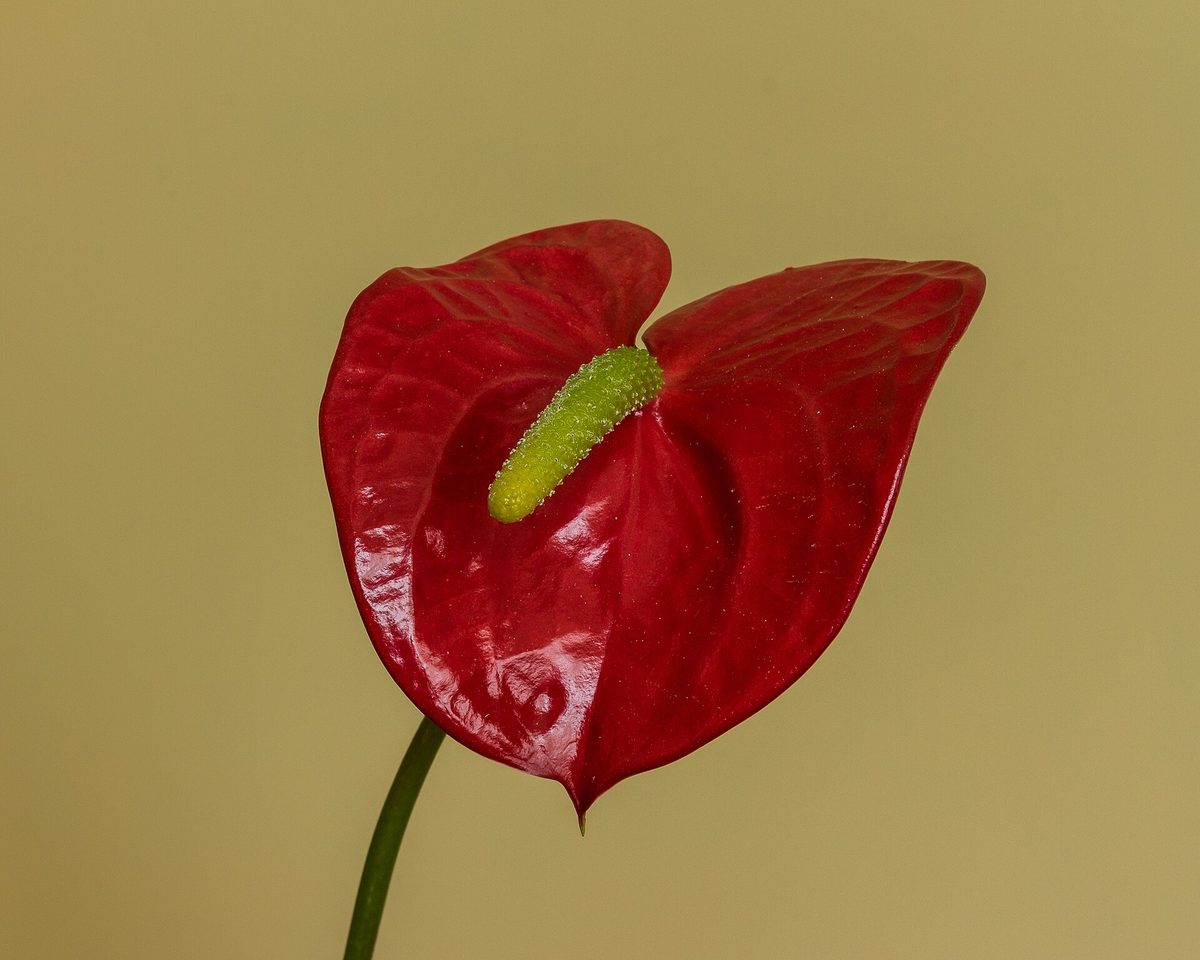
Photo: Agnes Monkelbaan, CC BY-SA 4.0 via Wikimedia Commons

Quick facts
| Light: | Bright, indirect light; tolerates low light11 source |
|---|---|
| Water: | Medium123 |
| Soil: | Well drained and moist; pH 6–6.54532 |
| Minimum temperature: | 55.4 °F (13 °C)51 source |
| Size: | 1–1.5 ft (0.3–0.46 m) × 0.8–1 ft (0.23–0.3 m)364 |
| Growth rate: | Slow364 |
| Bloom: | White, pink, red, orange, green and multicoloured364 |
| Cats: | Toxic to cats 104 |
| Dogs: | Toxic to dogs 104 |
| Native range: | CLM, ECU11 |
| Family: | Araceae |
How much light does a Flamingo-lily need?
Indoors, this plant does best with bright, indirect light. It can also tolerate low light conditions. Outdoors, it needs some shade rather than full sun exposure. Part shade suits it better than full shade. Both part shade and full shade are places it can grow.
- Light: Bright, indirect light; tolerates low light1
How often to water a Flamingo-lily
Water this plant when the top inch of soil feels dry. Water thoroughly, then let the soil dry out slightly before you water again. Overall, this plant needs a medium amount of water. It also grows best in soil that drains well but still stays moist.
Best soil for a Flamingo-lily
Soil for this plant needs to drain well. At the same time, the soil should stay moist rather than dry out completely. A potting mix built for good drainage suits it well indoors. Avoid soil that stays soggy or fully waterlogged. Aim for a substrate pH between 6.0 and 6.5. Keep your growing mix within that pH band for this plant.
Temperature and humidity
Keep air temperatures above 55 °F (13 °C) for this plant. It also needs high humidity to grow well indoors. Relative humidity should be high for the best growth. Outdoors, this plant is only winter hardy in USDA zones 11 to 12. More precisely, that range runs from zone 11a to zone 12b. Indoors, keep the room above that same temperature too.
Fertilizing a Flamingo-lily
Feed this plant monthly during the growing season. A 20-20-20 water-soluble fertilizer works well, mixed to a nitrogen level of about 50 ppm. Applied once a month, that amount should be adequate. Outside the growing season, it does not need regular feeding.
- Fertilizer: Monthly in the growing season5
How to propagate a Flamingo-lily
Dividing an existing plant is one way to propagate it. Stem cuttings are another option named for it. Growing it from seed is also a third method. All three — division, stem cuttings, and seed — are methods documented for propagating this plant. Division is named alongside both of the other methods. These three methods are the only propagation methods documented for this plant.
Common problems
Watch for aphids, spider mites, mealybugs, and scale insects on this plant. Burrowing nematodes are also recorded as a pest of it. Bacterial blight and bacterial wilt are both listed as diseases that affect it. Root rot, black nose disease, and leaf spot are the other diseases named for this plant. Those five pests and five diseases are the ones documented for this plant.
| Problem | Kind |
|---|---|
| Aphids | Pest |
| Spider mites | Pest |
| Mealybugs | Pest |
| Scale insects | Pest |
| Burrowing nematode | Pest |
| Bacterial blight | Disease |
| Bacterial wilt | Disease |
| Root rot | Disease |
| Black nose disease | Disease |
| Leaf spot | Disease |
Is Flamingo-lily toxic to cats and dogs?
This plant is toxic to cats. It is also toxic to dogs. Cats are listed as being at risk from this plant. Dogs carry that same risk listing. It is named as a problem plant for cats. The same problem listing covers dogs. Both animals are classed as toxic cases for this plant. Both of these classifications come from listings that cover this plant specifically.
Pet-safe alternatives
Recommended supplies
- Light: bright, indirect light, such as near an east window; a full-spectrum grow light substitutes where no window does.
- Soil: a free-draining mix, and a pot with a drainage hole.
- Humidity: it wants humid air; a pebble tray or a humidifier is the usual fix.
Questions and answers
- Is Anthurium andraeanum toxic to cats and dogs?
- Yes, this plant is toxic to both cats and dogs. It is listed as a problem plant for each of them. Cats and dogs are each named individually in toxicity listings for it.
- How much light does this plant need indoors?
- This plant prefers bright, indirect light indoors, and it tolerates low light too. Outdoors, it grows best in part shade or full shade. Full sun outdoors is not the right fit for it.
- How often should this plant be fertilized?
- Feed this plant monthly during the growing season. A 20-20-20 water-soluble fertilizer mixed to a nitrogen level of about 50 ppm works well, applied about once a month.
Sources
- NC State Extension. https://plants.ces.ncsu.edu/plants/anthurium-andraeanum. Accessed 14 October 2026.
- Clemson Cooperative Extension Home & Garden Information Center. https://hgic.clemson.edu/anthurium-easy-houseplants-that-offer-long-lasting-color/. Accessed 14 October 2026.
- NC State Extension Gardener Plant Toolbox. https://plants.ces.ncsu.edu/plants/anthurium-andraeanum/common-name/flamingo-lily/. Accessed 14 October 2026.
- NC State Extension. https://plants.ces.ncsu.edu/plants/anthurium-andraeanum/. Accessed 14 October 2026.
- University of Florida IFAS Extension (EDIS). https://ask.ifas.ufl.edu/publication/EP159. Accessed 14 October 2026.
- University of Florida IFAS Extension (EDIS). https://ask.ifas.ufl.edu/publication/FP042. Accessed 14 October 2026.
- EPPO Global Database. https://gd.eppo.int/taxon/AURAN/pathwayspests. Accessed 14 October 2026.
- University of Florida IFAS Extension (EDIS). https://ask.ifas.ufl.edu/publication/PP292. Accessed 14 October 2026.
- University of Florida IFAS Extension (EDIS). https://edis.ifas.ufl.edu/pp292. Accessed 14 October 2026.
- ASPCA Animal Poison Control Center. https://www.aspca.org/pet-care/aspca-poison-control/toxic-and-non-toxic-plants/flamingo-flower. Accessed 14 October 2026.
- Royal Botanic Gardens, Kew (World Checklist of Vascular Plants). https://sftp.kew.org/pub/data-repositories/WCVP/wcvp.zip. Accessed 4 June 2026.
How this page was made
- Written with AI assistance from the sources listed on this page. AI is never the source of a fact.