Baby Rubberplant (Peperomia obtusifolia)
Formerly Piper humile, Peperomia earlei, Peperomia lunana
Peperomia obtusifolia grows best in bright, indirect light, and it tolerates low light for several months without stress. Let the soil dry out between waterings, since this plant prefers conditions from dry to medium moisture. It is non-toxic to cats and dogs, according to NC State Extension and Pet Poison Helpline.
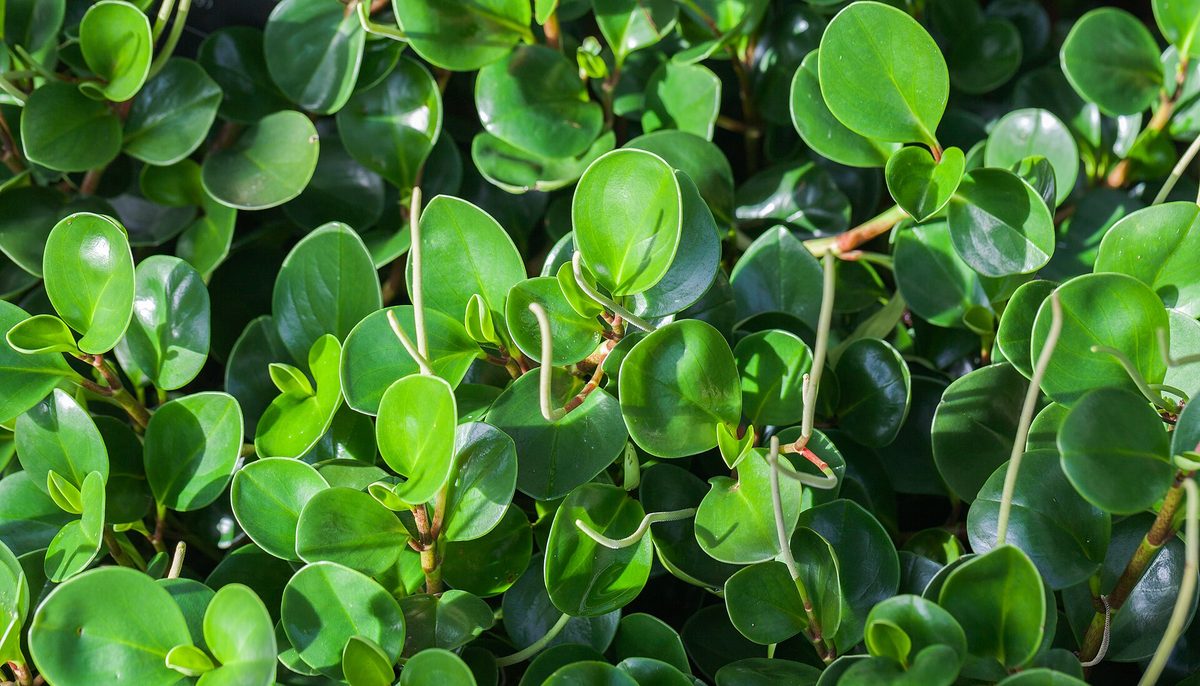
Photo: Wikimedia Commons contributor, CC BY-SA 3.0 via Wikimedia Commons

Quick facts
| Light: | Bright, indirect light; tolerates low light112 |
|---|---|
| Water: | Dry to medium11 source |
| Soil: | Well drained and moist; pH 6–813 |
| Size: | 0.5–1.2 ft (0.15–0.38 m) × 0.7–2 ft (0.2–0.61 m)23 |
| Growth rate: | Moderate231 |
| Bloom: | White13 |
| Cats: | Non-toxic to cats 156 |
| Dogs: | Non-toxic to dogs 156 |
| Native range: | BAH, BLZ, BOL, BZC, BZE, BZL, BZN, BZS, CAY, CLM, COS, CUB, DOM, ECU, ELS, FLA, FRG, GUA, GUY, HAI, HON, JAM, LEE, MXC, MXE, MXG, MXN, MXS, MXT, NIC, PAN, PER, PUE, SUR, TRT, VEN, VNA, WIN7 |
| Family: | Piperaceae |
How much light does a Baby Rubberplant need?
Give this plant bright, indirect light indoors for the best growth. It also tolerates low light for several months without showing stress. Non-variegated varieties tolerate low light better than variegated ones. Outdoors, give it part shade for best results, though it also tolerates full shade. Part shade outdoors means about 2 to 6 hours of direct sun a day.
How often to water a Baby Rubberplant
Water this plant on the dry side, since it prefers moisture levels from dry to medium overall. Choose a pot that drains well, matching this plant's need for well-drained, moist soil. Soil that does not drain well can lead to stem and root rot in this plant.
- Water: Dry to medium1
Best soil for a Baby Rubberplant
Plant this peperomia in soil that drains well but still holds some moisture. Soil that stays wet and does not drain can lead to stem and root rot. A soil pH between 6 and 8 suits this plant; that range is considered neutral. This plant also tolerates clay soil, in addition to a well-drained mix. In short, well-drained soil, a neutral pH, and tolerance for clay all describe what this plant needs. Heavy, waterlogged soil is the main thing to avoid with this plant.
Temperature and humidity
Outdoors, this plant can grow in USDA hardiness zones 10a through 11b. It also grows well in warm rooms with average or even below-average humidity, such as near a radiator. It does not need an especially humid room, since average humidity works well for it.
- Humidity: Average4
How to propagate a Baby Rubberplant
You can propagate this plant in several ways: from stem cuttings, from leaf cuttings, or by dividing an existing plant. Both stem and leaf cuttings of this plant root easily. Division is the third method listed for propagating it. Any of these three methods, cuttings or division, will produce a new plant. Leaf cuttings and stem cuttings are both named as easy ways to start new plants.
- Propagation: Stem cuttings, leaf cuttings and division3
Common problems
Watch this plant for mealybugs, spider mites, and whiteflies. Mites are the main pest problem for this plant. It can also develop stem rot, root rot, and leaf spot diseases. Good drainage helps prevent stem and root rot, since wet soil that cannot drain is a cause of both. Mealybugs, spider mites, and whiteflies are the pests to check for on this plant.
| Problem | Kind |
|---|---|
| Mealybugs | Pest |
| Spider mites | Pest |
| Whiteflies | Pest |
| Root rot | Disease |
| Stem rot | Disease |
| Leaf spot | Disease |
Is Baby Rubberplant toxic to cats and dogs?
This plant appears on NC State Extension's plant toolbox with a non-toxic rating for cats. The same toolbox entry also gives it a non-toxic rating for dogs. Pet Poison Helpline also names peperomia among the plant varieties that are non-toxic to pets. Pet Poison Helpline's non-toxic listing applies to both cats and dogs. No cited source here lists this plant as toxic to either animal.
Recommended supplies
- Light: bright, indirect light, such as near an east window; a full-spectrum grow light substitutes where no window does.
- Soil: a free-draining mix, and a pot with a drainage hole.
Questions and answers
- Is peperomia obtusifolia toxic to cats or dogs?
- This plant is non-toxic to both cats and dogs, based on listings from NC State Extension and Pet Poison Helpline. No toxic reaction is listed for either animal.
- How big does peperomia obtusifolia get, and how fast does it grow?
- This plant typically reaches 0.5 to 1.2 ft (0.15 to 0.38 m) tall and 0.7 to 2 ft (0.2 to 0.61 m) wide. It grows in an erect, spreading habit at a moderate rate. It is a succulent, herbaceous perennial that needs low maintenance overall.
- What pests and diseases affect peperomia obtusifolia?
- Watch for mealybugs, spider mites, and whiteflies, which are its most common pests. It can also develop root rot, stem rot, and leaf spot. Good drainage helps lower the risk of the rot problems.
Sources
- NC State Extension Plant Toolbox. https://plants.ces.ncsu.edu/plants/peperomia-obtusifolia/. Accessed 14 October 2026.
- Clemson Cooperative Extension Home & Garden Information Center. https://hgic.clemson.edu/factsheet/peperomia-peperomia-spp-indoor-plant-care-and-growing-guide/. Accessed 14 October 2026.
- University of Florida IFAS Extension (EDIS). https://ask.ifas.ufl.edu/publication/FP466. Accessed 14 October 2026.
- Iowa State University Extension and Outreach (Yard and Garden). https://yardandgarden.extension.iastate.edu/how-to/easy-low-maintenance-houseplants. Accessed 14 October 2026.
- Pet Poison Helpline. https://www.petpoisonhelpline.com/uncategorized/pet-safe-plants-flora-and-fauna-can-coexist/. Accessed 14 October 2026.
- ASPCA Animal Poison Control Center. https://www.aspca.org/pet-care/aspca-poison-control/toxic-and-non-toxic-plants/blunt-leaf-peperomia. Accessed 14 October 2026.
- Royal Botanic Gardens, Kew (World Checklist of Vascular Plants). https://sftp.kew.org/pub/data-repositories/WCVP/wcvp.zip. Accessed 4 June 2026.
How this page was made
- Written with AI assistance from the sources listed on this page. AI is never the source of a fact.