Zamioculcas zamiifolia
Formerly Caladium zamiifolium, Zamioculcas lanceolata
Keep a ZZ plant in bright, indirect light and water it only after the potting medium has completely dried. It also tolerates low light. Its water rating is dry. The ASPCA lists this plant as toxic to cats and also toxic to dogs.
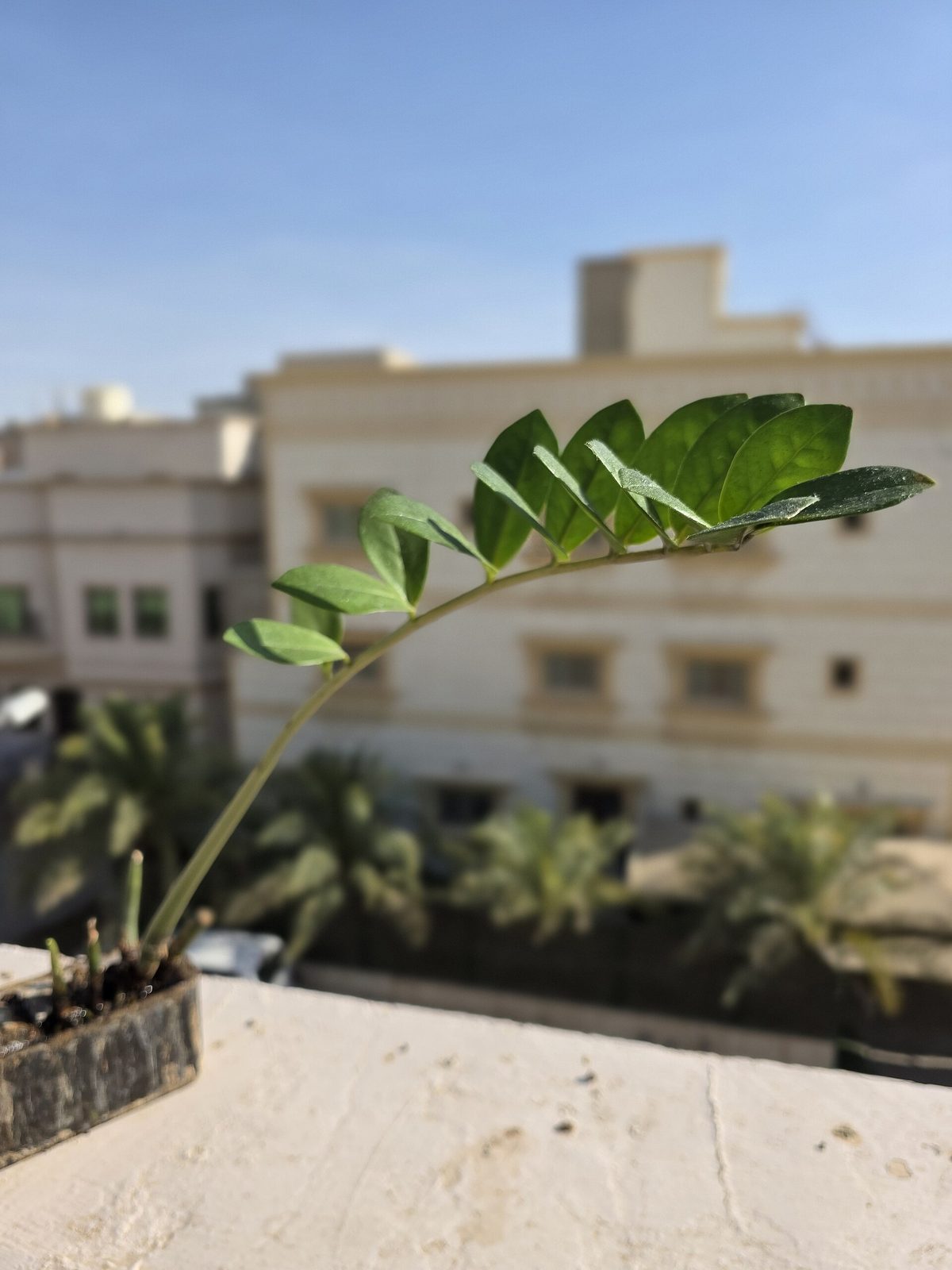
Photo: Mishary94, CC BY-SA 4.0 via Wikimedia Commons

Quick facts
| Light: | Bright, indirect light; tolerates low light12234 |
|---|---|
| Water: | Dry2144 |
| Soil: | Well drained; pH 6–712546 |
| Minimum temperature: | 60.8 °F (16 °C)122 |
| Size: | 2–4 ft (0.61–1.22 m) × 2–4 ft (0.61–1.22 m)11 source |
| Growth rate: | Slow14 |
| Bloom: | Green and white11 source |
| Cats: | Toxic to cats (1 source) 9 |
| Dogs: | Toxic to dogs (1 source) 9 |
| Family: | Araceae |
How much light does a Zamioculcas zamiifolia need?
Indoors, bright indirect light suits this plant best. It also tolerates low light, and bright, indirect to low light is the indoor range listed. Outdoors, plant it in partial to deep shade, with part shade preferred. Give it strong, filtered light with no direct sun. The listed hardiness range for growing it outdoors is USDA zones 9a to 10b.
How often to water a Zamioculcas zamiifolia
The water need of this plant is rated dry. Water it once or twice a month, only after the potting medium has completely dried. In summer the listed rate is twice a month, and only if the soil has dried out completely. The plant is highly drought tolerant. Overwatering can lead to root rot.
Best soil for a Zamioculcas zamiifolia
This plant needs well-drained soil. Soil drainage is rated good, and a coarse, well-draining mix suits it. Drainage matters because root rot may occur if ZZ plants are grown in poorly drained soil. A pH of 6.0 to 7.0 is given for this plant. The same range comes with an electrical conductivity of 1.0 to 2.0 dS/m.
Temperature and humidity
Temperatures should stay above 60 °F (16 °C). A plant kept outdoors is brought in once the temperature falls below 60 °F (16 °C). The stored minimum is 60.8 °F (16 °C). Regular indoor humidity levels are enough for it to thrive. Its humidity need is listed as average. In the ground outdoors, the listed USDA zones are 9a through 10b.
Fertilizing a Zamioculcas zamiifolia
A balanced fertilizer, applied only once or twice during the growing season, is the feeding this plant gets. The feeding level is classed as light. ZZ is a slow-growing plant, even under favorable conditions. Its growth rate is listed as slow.
- Fertilizer: Light, once a year5
How to propagate a Zamioculcas zamiifolia
Division and leaf cuttings are the two ways to propagate a ZZ plant. Propagation is vegetative, using leaf cuttings. Division is the other listed method. The erect, pinnate leaves emerge from a thick, underground rhizome. A mature plant stands 2–4 ft (0.61–1.22 m) tall and spreads 2–4 ft (0.61–1.22 m) wide. The growth rate of the species is slow.
Common problems
Scale insects are the pest to watch for, and no significant problems are recorded. Opogona sacchari and scale insects are both on the list of common pests. Root rot is the disease listed for this plant. Root rot may occur in poorly drained soil, and overwatering can lead to it.
| Problem | Kind |
|---|---|
| Opogona sacchari | Pest |
| Scale insects | Pest |
| Root rot | Disease |
Is Zamioculcas zamiifolia toxic to cats and dogs?
For cats, the ASPCA entry classes this plant as toxic. For dogs, the entry also classes it as toxic. The ASPCA says plants of this type are toxic and can cause a number of symptoms when pets ingest them. The position is the same for cats and for dogs. This site covers cats and dogs for pet toxicity. No severity is recorded for either animal in the facts on this page.
Pet-safe alternatives
Recommended supplies
- Light: bright, indirect light, such as near an east window; a full-spectrum grow light substitutes where no window does.
- Soil: a free-draining mix, and a pot with a drainage hole.
Questions and answers
- Is a ZZ plant toxic to cats and dogs?
- The ASPCA classes this plant as toxic to both cats and dogs. Toxicity is recorded separately for each animal, and both entries read toxic. The ASPCA says ingestion by pets can cause a number of symptoms.
- How often should I water a ZZ plant?
- Water it once or twice a month, and only after the potting medium has completely dried. The plant is highly drought tolerant. Overwatering can lead to root rot.
- How big does a ZZ plant get?
- A mature plant stands 2–4 ft (0.61–1.22 m) tall. It spreads 2–4 ft (0.61–1.22 m) wide. The leaves stand erect and rise from a thick, underground rhizome. The growth rate is slow.
Sources
- NC State Extension Gardener Plant Toolbox. https://plants.ces.ncsu.edu/plants/zamioculcas-zamiifolia/. Accessed 25 October 2026.
- Clemson Cooperative Extension HGIC. https://hgic.clemson.edu/factsheet/zz-plant-zamioculcas-zamiifolia-indoor-care-growing-tips-plant-guide/. Accessed 25 October 2026.
- Brooklyn Botanic Garden. https://www.bbg.org/article/zz_plant_a_narrative_guide. Accessed 25 October 2026.
- University of Florida IFAS Extension (EDIS). https://ask.ifas.ufl.edu/publication/EP480. Accessed 25 October 2026.
- Clemson Cooperative Extension HGIC. https://hgic.clemson.edu/factsheet/zz-plant/. Accessed 25 October 2026.
- University of Florida IFAS Extension (EDIS, ENH997/EP252). https://ask.ifas.ufl.edu/publication/EP252. Accessed 25 October 2026.
- Iowa State University Extension and Outreach (Yard and Garden). https://yardandgarden.extension.iastate.edu/article/2009/2-4/Zamioculcas.html. Accessed 25 October 2026.
- Iowa State University Extension and Outreach (Yard and Garden). https://yardandgarden.extension.iastate.edu/faq/i-recently-purchased-zz-plant-how-do-i-care-it. Accessed 25 October 2026.
- ASPCA Animal Poison Control Center. https://www.aspca.org/news/these-houseplants-can-cause-trouble-your-pets. Accessed 25 October 2026.
How this page was made
- Written with AI assistance from the sources listed on this page. AI is never the source of a fact.