Dracaena masoniana
Formerly Sansevieria masoniana
Dracaena masoniana does well in bright, indirect light, and it tolerates low light. Let the growing medium dry out between waterings, since the plant is very drought tolerant. It is toxic to cats and dogs if ingested. The poison severity for cats is listed as low.
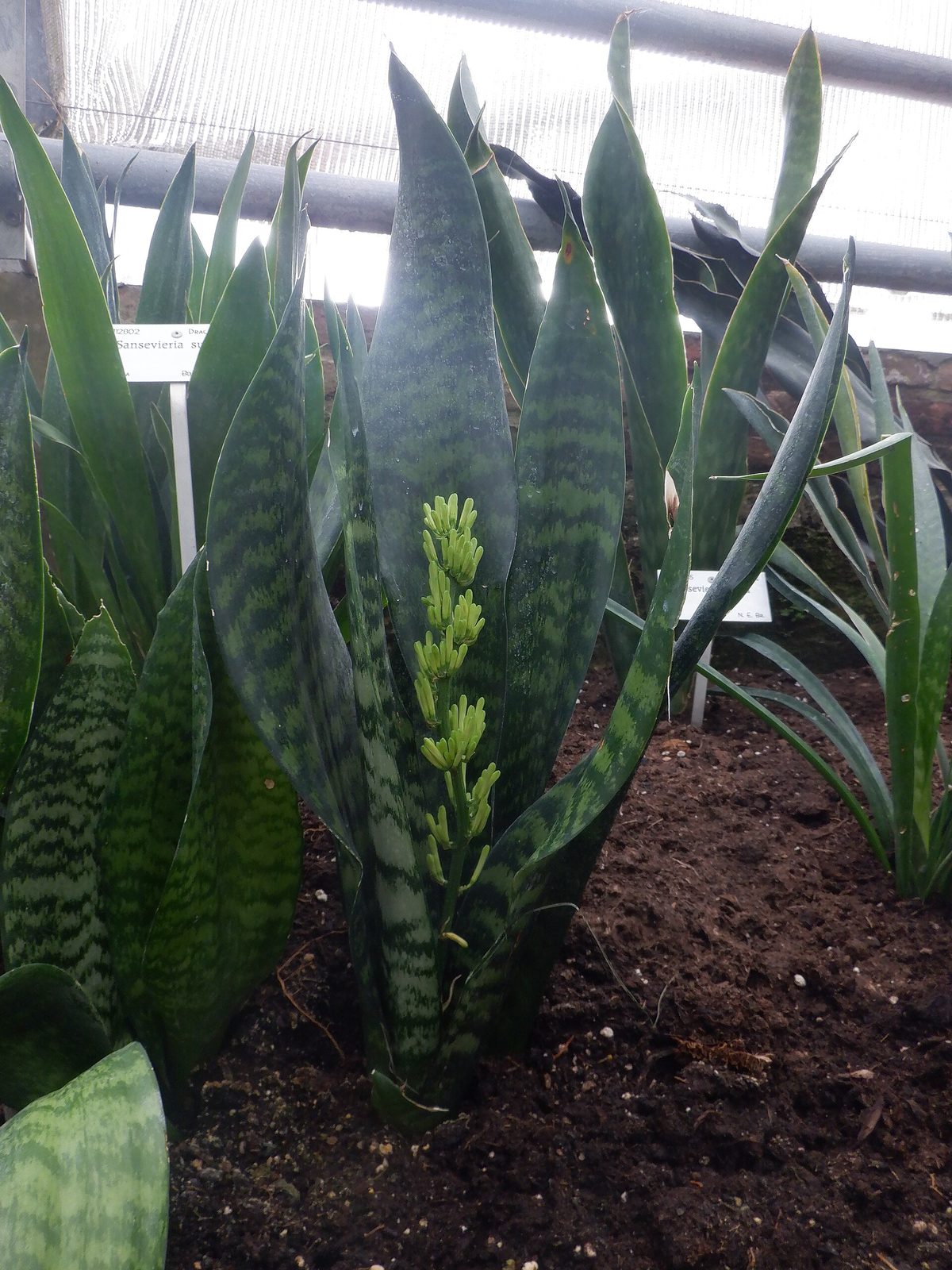
Photo: Hannes wilms, CC BY-SA 4.0 via Wikimedia Commons

Quick facts
| Light: | Bright, indirect light; tolerates low light11 source |
|---|---|
| Water: | Dry to medium11 source |
| Soil: | Well drained, moist and occasionally dry12 |
| Minimum temperature: | 55.4 °F (13 °C)11 source |
| Size: | 3–5 ft (0.91–1.52 m) × 1–2 ft (0.3–0.61 m)11 source |
| Growth rate: | Slow11 source |
| Bloom: | Jun–Aug, White11 source |
| Cats: | Toxic to cats (1 source) Severity reported: Mild 1 |
| Dogs: | Toxic to dogs (1 source) 1 |
| Family: | Asparagaceae |
How much light does a Dracaena masoniana need?
Bright, indirect light suits Dracaena masoniana best when you grow it indoors. It is also tolerant of low light conditions. Low light is described as a tolerance, while bright, indirect light is the preference.
Outdoors, it prefers part shade, meaning direct sunlight for only part of the day, roughly 2 to 6 hours.
- Light: Bright, indirect light; tolerates low light1
How often to water a Dracaena masoniana
Very drought tolerant, this plant does best when you let the growing medium dry out between waterings. The listed water need runs from dry to medium. Its soil drainage listing includes well drained, moist and occasionally dry conditions.
Black spot and root rot can occur from overwatering.
- Water: Dry to medium1
Best soil for a Dracaena masoniana
Good drainage is listed for Dracaena masoniana. The full listing reads well drained, moist and occasionally dry. In other words, the soil can be moist at times and occasionally dry at others.
Occasionally dry is part of the listing, alongside moist. Its water range runs from dry to medium. Black spot and root rot are the diseases listed, and the source ties both to overwatering.
Temperature and humidity
Temperatures below 55 °F (13 °C) are the ones to avoid. Cold drafts should be avoided as well.
The listed hardiness range is USDA zones 9a to 11b. Zone 9a is the coldest zone in that range, and 11b is the warmest.
- Minimum temperature: 55.4 °F (13 °C)1
Fertilizing a Dracaena masoniana
Feed this plant monthly during the growing season. Use an all-purpose fertilizer at half strength. Fertilizing this way is described as the route to a more robust plant.
Growth is slow, and the maintenance level is listed as low. Monthly in the growing season is the frequency recorded for this plant.
- Fertilizer: Monthly in the growing season2
Pruning a Dracaena masoniana
Pruning here means removing dead growth only. If a leaf is damaged, cut it off at the soil level.
The habit is erect, with a mature height of 3–5 ft (0.91–1.52 m) and a spread of 1–2 ft (0.3–0.61 m). Maintenance is listed as low, and growth is slow.
- Pruning: Remove dead growth only2
How to propagate a Dracaena masoniana
Dracaena masoniana can be propagated by division or by leaf cuttings. Those are the two propagation methods listed for it.
The species grows slowly. It matures at 3–5 ft (0.91–1.52 m) tall. The mature spread is 1–2 ft (0.3–0.61 m). Its habit is erect. No cited source describes steps or timing for either method.
- Propagation: Division and leaf cuttings1
Common problems
Spider mites, scale, mealybugs, thrips and aphids are the pests to monitor. Monitoring for all five is the advice given.
Black spot and root rot are the two diseases listed. Both can occur from overwatering. The plant's water range runs from dry to medium.
| Problem | Kind |
|---|---|
| Spider mites | Pest |
| Scale insects | Pest |
| Mealybugs | Pest |
| Thrips | Pest |
| Aphids | Pest |
| Black spot | Disease |
| Root rot | Disease |
Is Dracaena masoniana toxic to cats and dogs?
Dracaena masoniana is listed as toxic to cats if ingested. It is listed as toxic to dogs if ingested as well.
The poison severity for cats is listed as low. No cited source gives a severity rating for dogs.
The listing concerns ingestion, meaning a pet eating part of the plant. Cats and dogs are both recorded as toxic, so the position is the same for each animal. Both toxicity entries apply if the plant is ingested.
Pet-safe alternatives
Recommended supplies
- Light: bright, indirect light, such as near an east window; a full-spectrum grow light substitutes where no window does.
- Soil: a free-draining mix, and a pot with a drainage hole.
Questions and answers
- Is Dracaena masoniana toxic to cats and dogs?
- It is listed as toxic to both cats and dogs if ingested. The poison severity for cats is listed as low. Toxicity is recorded for ingestion in both animals.
- How much light does Dracaena masoniana need indoors?
- It prefers bright, indirect light. It is also tolerant of low light conditions. Outdoors, it prefers part shade, which means about 2 to 6 hours of direct sun.
- How should I water Dracaena masoniana?
- It is very drought tolerant, and it is best to let the growing medium dry out between waterings. The listed water range runs from dry to medium. Overwatering can bring on black spot and root rot.
Sources
- NC State Extension Gardener Plant Toolbox. https://plants.ces.ncsu.edu/plants/dracaena-masoniana/. Accessed 25 October 2026.
- Penn State Extension. https://extension.psu.edu/snake-plant-a-forgiving-low-maintenance-houseplant. Accessed 25 October 2026.
How this page was made
- Written with AI assistance from the sources listed on this page. AI is never the source of a fact.