Tuberose (Polianthes tuberosa)
Formerly Agave amica, Tuberosa amica, Polianthes gracilis
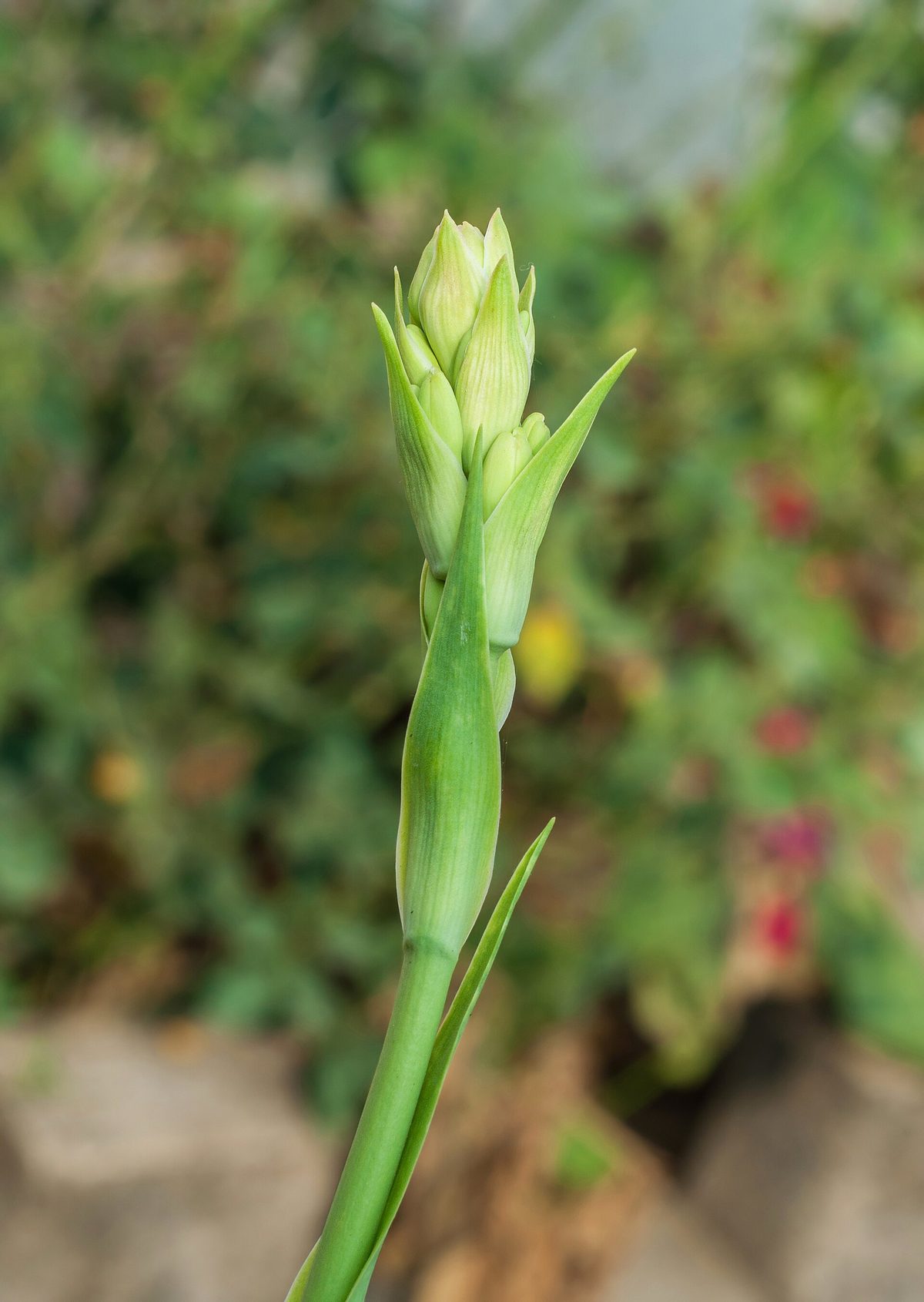
Photo: Joydeep, CC BY-SA 3.0 via Wikimedia Commons

Quick facts
| Soil: | Well drained and occasionally dry; pH 6–811 source |
|---|---|
| Size: | 2–3 ft (0.61–0.91 m) × 1–3.5 ft (0.3–1.07 m)11 source |
| Growth rate: | Moderate111 source |
| Bloom: | White11 source |
| Cats: | Not documented by major sources |
| Dogs: | Not documented by major sources |
| Native range: | MXE, MXS3 |
| Family: | Asparagaceae |
Best soil for a Tuberose
Tuberose is listed for soil with good drainage, and the conditions named are well drained and occasionally dry. Soil that is too wet can cause root rot, which is one of the two diseases listed for this plant. The soil pH range for tuberose runs from 6 to 8, which the source calls neutral. Both ends of that range, pH 6.0 and pH 8.0, fall within the neutral band.
How to propagate a Tuberose
Tuberose can be propagated by division and by stem cuttings. Division and stem cuttings are the two propagation methods on record for this plant. The plant type is listed as a bulb.
Mature plants reach 2 to 3 ft (0.61 to 0.91 m) in height and 1 to 3.5 ft (0.3 to 1.07 m) in width. The growth habit is erect and the growth rate is moderate.
- Propagation: Division and stem cuttings1
Common problems
Spider mites, aphids, scale insects, thrips, foliar nematode, stem nematode and agave weevil are the pests recorded for tuberose. Anthracnose and root rot are the diseases listed. Too wet soils can cause root rot. You should watch for spider mites, aphids, scale insects, thrips and anthracnose.
| Problem | Kind |
|---|---|
| Spider mites | Pest |
| Aphids | Pest |
| Scale insects | Pest |
| Thrips | Pest |
| Foliar nematode | Pest |
| Stem nematode | Pest |
| Agave weevil | Pest |
| Anthracnose | Disease |
| Root rot | Disease |
Is Tuberose toxic to cats and dogs?
Recommended supplies
- Soil: a free-draining mix, and a pot with a drainage hole.
Questions and answers
- Which USDA hardiness zones is tuberose listed for?
- Tuberose is listed for zones 8a through 10b. That covers 8a, 8b, 9a, 9b, 10a and 10b. Zones colder than 8a are outside the listed range.
- How much sun does tuberose like?
- Full sun is preferred, which means 6 or more hours of direct sunlight a day. Part shade is also listed, which means direct sunlight for only part of the day, about 2 to 6 hours.
- How big does tuberose get, and what color are the flowers?
- A mature plant is 2 to 3 ft (0.61 to 0.91 m) tall and 1 to 3.5 ft (0.3 to 1.07 m) wide. The flowers are white. The growth rate is listed as moderate.
Sources
- NC State Extension Gardener Plant Toolbox. https://plants.ces.ncsu.edu/plants/agave-amica/. Accessed 14 October 2026.
- EPPO Global Database. https://gd.eppo.int/taxon/POCTU/pests. Accessed 14 October 2026.
- Royal Botanic Gardens, Kew (World Checklist of Vascular Plants). https://sftp.kew.org/pub/data-repositories/WCVP/wcvp.zip. Accessed 4 June 2026.
How this page was made
- Written with AI assistance from the sources listed on this page. AI is never the source of a fact.