Porcelainflower (Hoya carnosa)
Formerly Asclepias carnosa, Hoya picta, Hoya compacta
Hoya carnosa does best outdoors in partial shade. Let the soil dry out between waterings, since this plant tolerates dry to medium moisture. It also needs soil with good drainage. The ASPCA lists it as non-toxic to both cats and dogs.
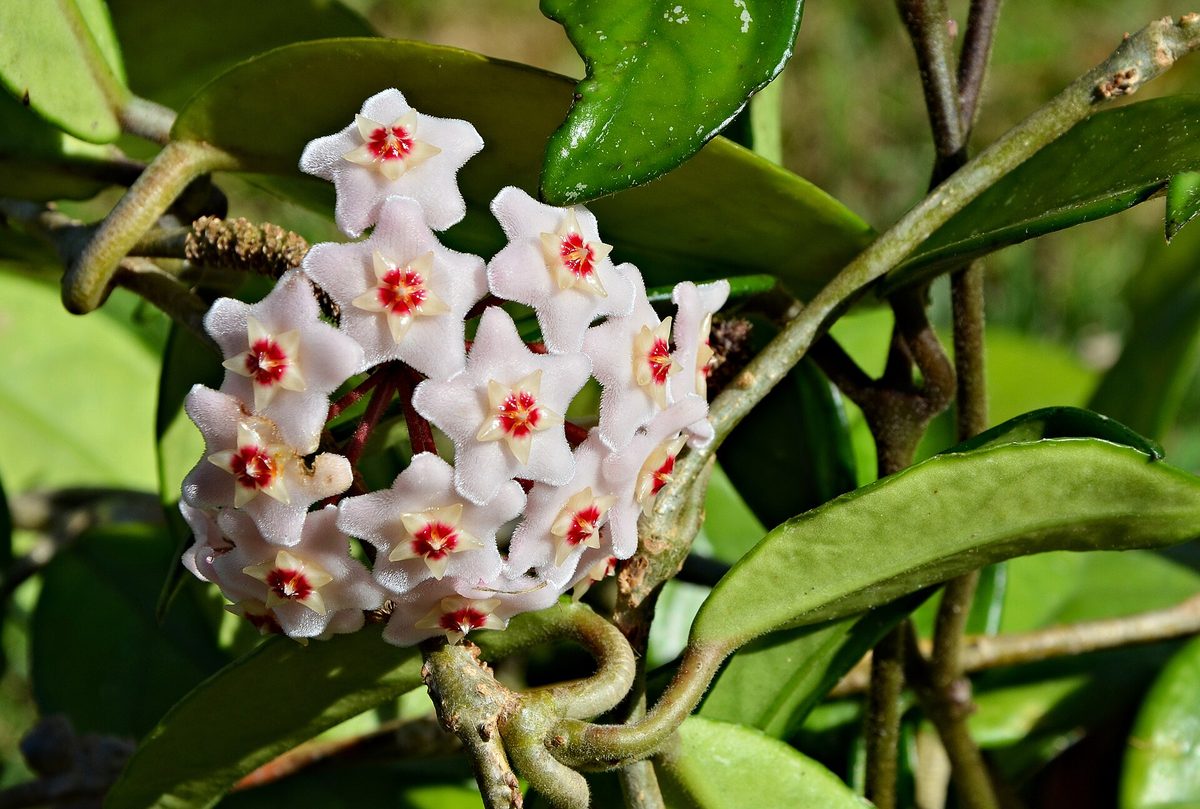
Photo: JLPC, CC BY-SA 3.0 via Wikimedia Commons

Quick facts
| Light: | Part shade11 source |
|---|---|
| Water: | Dry to medium21 source |
| Soil: | Well drained; pH 6–811 source |
| Growth rate: | Rapid11 source |
| Bloom: | Mar–Apr and May–Jun, White and pink611 source |
| Cats: | Non-toxic to cats 45 |
| Dogs: | Non-toxic to dogs 45 |
| Native range: | CHC, CHH, CHS, JAP, LAO, MYA, NNS, TAI7 |
| Family: | Apocynaceae |
How much light does a Porcelainflower need?
Outdoors, Hoya carnosa prefers partial shade. It can spend summer outdoors on a patio, as long as the spot stays in partial shade. If you grow it indoors instead, bright indirect light works best year-round. This plant also tolerates lower light, from low to medium levels, when bright light isn't available. Its flowers range from white to pink. It blooms between March and April, and again between May and June.
- Light: Part shade1
How often to water a Porcelainflower
Let the soil dry out completely before you water Hoya carnosa again. You can use the weight test to judge when it's time. Overall, this plant's water needs range from dry to medium. This plant also needs soil that drains well. It also likes high humidity in the air around it.
- Water: Dry to medium2
Best soil for a Porcelainflower
Hoya carnosa needs soil with good drainage. It also prefers to dry out between waterings. Aim for a near-neutral pH, somewhere between 6.0 and 8.0. A simple soil test can tell you where your potting mix falls in that range. This plant grows as a vine and an epiphyte. It also has a rapid growth rate. This plant is also evergreen.
Hardiness and temperature
Hoya carnosa does not tolerate nighttime temperatures below 50°F (10°C). This plant also likes high humidity. A humidifier, or a tray of wet pebbles under the pot, can help raise the moisture in the air around it. Ideal humidity for this plant falls between 40% and 60%.
- Minimum temperature: 50 °F (10 °C)1
Winter care
Bring Hoya carnosa indoors before nighttime temperatures drop below 50°F (10°C). Indoors, place it where it gets bright, indirect light. It also tolerates low or medium light if a bright spot isn't available. This plant prefers high humidity, which you can raise with a humidifier or a tray of wet pebbles under the pot.
- Minimum temperature: 50 °F (10 °C)1
How to propagate a Porcelainflower
You can propagate Hoya carnosa by stem cuttings. Leaf cuttings and layering are other ways to start new plants from it. This plant also grows as a vine and an epiphyte. It has a rapid growth rate. It is also evergreen. This plant likes high humidity. It also needs soil that drains well.
- Propagation: Stem cuttings, leaf cuttings and layering1
Common problems
Mealybugs and fungus gnats are common pests on Hoya carnosa. Fungus gnats are drawn to potting mix that stays too wet. Spider mites, scale, flat mites, and root-knot nematodes can also affect this plant. Diseases to watch for include root rot, fungal leaf spot, and powdery mildew. Two viruses, impatiens necrotic spot virus and tomato spotted wilt virus, have also been recorded on it.
| Problem | Kind |
|---|---|
| Mealybugs | Pest |
| Fungus gnats | Pest |
| Spider mites | Pest |
| Scale insects | Pest |
| Flat mites | Pest |
| Root knot nematode | Pest |
| Root rot | Disease |
| Fungal leaf spot | Disease |
| Powdery mildew | Disease |
| Fungal wilt | Disease |
| Impatiens necrotic spot virus | Disease |
| Tomato spotted wilt virus | Disease |
Is Porcelainflower toxic to cats and dogs?
The ASPCA lists Hoya carnosa as non-toxic to cats. The ASPCA also lists it as non-toxic to dogs. NC State Extension's plant database agrees, marking the species as non-toxic for both cats and dogs. Hoya carnosa grows as a vine and an epiphyte. This plant also has a rapid growth rate. It prefers high humidity. Even so, if your cat or dog chews on this plant and seems unwell afterward, contact your vet or a pet poison line.
Recommended supplies
- Soil: a free-draining mix, and a pot with a drainage hole.
- Humidity: it wants humid air; a pebble tray or a humidifier is the usual fix.
Questions and answers
- Is Hoya carnosa toxic to cats or dogs?
- The ASPCA lists Hoya carnosa as non-toxic to both cats and dogs. NC State Extension's plant database also lists it as non-toxic for cats and dogs.
- How much light does Hoya carnosa need outdoors?
- Hoya carnosa does best outdoors in partial shade, such as on a shaded patio in summer. Indoors, it prefers bright, indirect light but also tolerates low or medium light.
- How often should you water Hoya carnosa?
- Let the soil dry out completely before you water again, and use the weight test to judge when it's time. Water needs for this plant range from dry to medium.
Sources
- NC State Extension Gardener Plant Toolbox. https://plants.ces.ncsu.edu/plants/hoya-carnosa/. Accessed 14 October 2026.
- Clemson Cooperative Extension HGIC. https://hgic.clemson.edu/factsheet/indoor-plants-waxflowers-hoya/. Accessed 21 October 2026.
- EPPO Global Database. https://gd.eppo.int/taxon/HOYCA/pests. Accessed 14 October 2026.
- ASPCA Animal Poison Control Center. https://www.aspca.org/pet-care/aspca-poison-control/toxic-and-non-toxic-plants/wax-plant. Accessed 21 October 2026.
- NC State Extension Gardener Plant Toolbox. https://plants.ces.ncsu.edu/plants/hoya-carnosa/common-name/porcelainflower/. Accessed 21 October 2026.
- Chicago Botanic Garden. https://www.chicagobotanic.org/plant-information/plant-finder/hoya-carnosa-wax-plant. Accessed 21 October 2026.
- Royal Botanic Gardens, Kew (World Checklist of Vascular Plants). https://sftp.kew.org/pub/data-repositories/WCVP/wcvp.zip. Accessed 4 June 2026.
How this page was made
- Written with AI assistance from the sources listed on this page. AI is never the source of a fact.