Adam's Needle (Yucca filamentosa)
Formerly Yucca filamentosa f. bicolor, Yucca filamentosa var. media, Yucca filamentosa var. maxima
To keep Adam's needle (Yucca filamentosa) healthy, give it full sun and a dry soil moisture level. It also tolerates part shade and full shade. The plant is toxic to cats and toxic to dogs. It is hardy in USDA zones 4a to 10b.
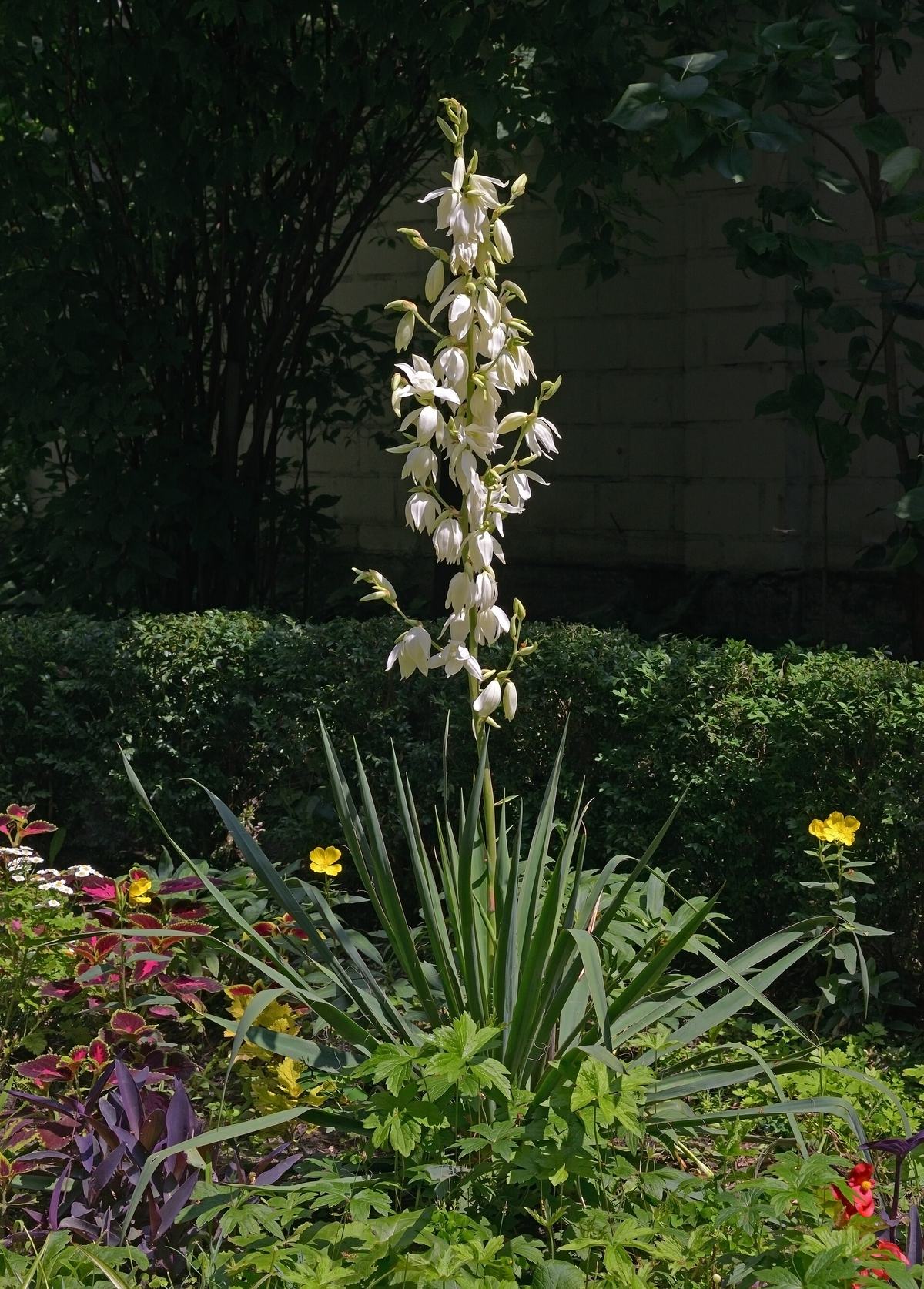
Photo: Ввласенко, CC BY-SA 4.0 via Wikimedia Commons

Quick facts
| Light: | Full sun, part shade and full shade (full sun preferred)12 |
|---|---|
| Water: | Dry31 source |
| Soil: | Well drained, moist and occasionally dry; pH 6–811 source |
| Hardiness: | Zones 4a–10b11 source |
| Size: | 3–15 ft (0.91–4.57 m) × 3–5 ft (0.91–1.52 m)211 source |
| Growth rate: | Moderate12 |
| Bloom: | Apr–Jun, White1671 source |
| Cats: | Toxic to cats 45 |
| Dogs: | Toxic to dogs 45 |
| Native range: | ALA, FLA, GEO, LOU, MRY, MSI, NCA, SCA, TEN, VRG, WVA8 |
| Family: | Asparagaceae |
How much light does an Adam's Needle need?
Adam's needle prefers full sun, which means 6 or more hours of direct sunlight a day. It also tolerates part shade and full shade. One extension source says it tolerates partial shade well, provided enough air circulates to keep the plant on the dry side. The minimum listed for direct sun is 6 hours a day.
How often to water an Adam's Needle
The recorded water need for Adam's needle is dry. Dry is both the lowest and the highest moisture level listed. The plant tolerates drought and heat. Its soil drainage is listed as well drained, moist and occasionally dry. Salt, erosion, urban conditions and clay soil also appear among its tolerances.
- Water: Dry3
Best soil for an Adam's Needle
The drainage classes listed for this plant are well drained, moist and occasionally dry. Its soil pH is recorded as 6 to 8, described as neutral. It is said to require a neutral pH and good drainage. Clay soil is among the conditions it tolerates, along with drought, heat and salt. Erosion and urban conditions are on the same list. A soil pH anywhere from 6.0 to 8.0 falls inside the recorded band.
Hardiness and temperature
Adam's needle is listed for USDA hardiness zones 4a to 10b. The zones recorded run through 4a, 4b, 5a, 5b, 6a, 6b, 7a, 7b, 8a, 8b, 9a, 9b, 10a and 10b. Heat is one of the conditions the plant tolerates. Drought and salt spray are on that list too.
- Hardiness: Zones 4a–10b1
How to plant an Adam's Needle
Adam's needle suits gardens in USDA zones 4a to 10b. Allow a spread of 3 to 5 ft (0.91 to 1.52 m) for each plant. Its mature height runs from 3 to 15 ft (0.91 to 4.57 m). The preferred position is full sun, with 6 or more hours of direct sunlight a day. Its soil should have a neutral pH and good drainage. Its growth rate is listed as moderate.
- Hardiness: Zones 4a–10b1
Winter care
Adam's needle is listed for USDA zones 4a through 10b. Zone 4a is the coldest zone in that listing, and zone 10b is the warmest. Drought, heat and salt are all conditions the plant tolerates. Its soil should have a neutral pH and good drainage.
- Hardiness: Zones 4a–10b1
How to propagate an Adam's Needle
You can propagate Adam's needle by division, root cutting or seed. Yuccas germinate promptly from fresh seed that has been held over winter. Stem cuttings and offsets are also recorded as methods for this plant. In total, five methods are listed: seed, division, root cuttings, stem cuttings and offsets.
Common problems
Leaf spot and blight are the diseases recorded for Adam's needle. In areas of poor drainage, the leaves may be sensitive to them. The plant is reported resistant to deer. Rabbits and squirrels also appear in its list of challenges it resists.
- Common diseases: leaf spot and blight1
| Problem | Kind |
|---|---|
| Leaf spot | Disease |
| Blight | Disease |
Is Adam's Needle toxic to cats and dogs?
Adam's needle is toxic to cats, according to the ASPCA listing for this plant. The same listing records it as toxic to dogs. Pet Poison Helpline says that in dogs and cats the plant typically causes only mild vomiting and diarrhea and possibly pupil dilation. Those signs are described as typical in both animals, and as only mild. The toxicity position is the same for cats and for dogs.
Pet-safe alternatives
Recommended supplies
- Soil: a free-draining mix, and a pot with a drainage hole.
Questions and answers
- Is Adam's needle toxic to cats and dogs?
- Adam's needle is listed as toxic to cats and toxic to dogs. Pet Poison Helpline says it typically causes only mild vomiting, diarrhea and possibly dilated pupils in both animals.
- How much sun does Adam's needle need?
- It prefers full sun, meaning 6 or more hours of direct sunlight a day. Part shade and full shade are also listed as conditions it tolerates.
- Which hardiness zones suit Adam's needle?
- It is listed for USDA zones 4a to 10b. It also tolerates heat, drought and salt, so it is not limited to one kind of site.
Sources
- NC State Extension Gardener Plant Toolbox. https://plants.ces.ncsu.edu/plants/yucca-filamentosa/. Accessed 14 October 2026.
- University of Florida IFAS Extension (EDIS). https://ask.ifas.ufl.edu/publication/FP615. Accessed 14 October 2026.
- Lady Bird Johnson Wildflower Center (Native Plant Database). https://www.wildflower.org/plants/result.php?id_plant=YUFI. Accessed 1 November 2026.
- ASPCA Animal Poison Control Center. https://www.aspca.org/pet-care/aspca-poison-control/toxic-and-non-toxic-plants/yucca. Accessed 14 October 2026.
- Pet Poison Helpline. https://www.petpoisonhelpline.com/poison/yucca/. Accessed 14 October 2026.
- Clemson Cooperative Extension Home & Garden Information Center. https://hgic.clemson.edu/factsheet/yucca/. Accessed 21 October 2026.
- Chicago Botanic Garden (Plant Finder). https://www.chicagobotanic.org/plant-information/plant-finder/yucca-filamentosa-adams-needle. Accessed 21 October 2026.
- Royal Botanic Gardens, Kew (World Checklist of Vascular Plants). https://sftp.kew.org/pub/data-repositories/WCVP/wcvp.zip. Accessed 4 June 2026.
How this page was made
- Written with AI assistance from the sources listed on this page. AI is never the source of a fact.