Uruguayan Pampas Grass (Cortaderia selloana)
Formerly Gynerium argenteum, Arundo selloana, Moorea argentea
Full sun, meaning six or more hours of direct sunlight a day, suits Uruguayan pampas grass best outdoors, though it also tolerates part shade with two to six hours of direct sun. Cats and dogs are both listed as non-toxic to this ornamental grass by the ASPCA.
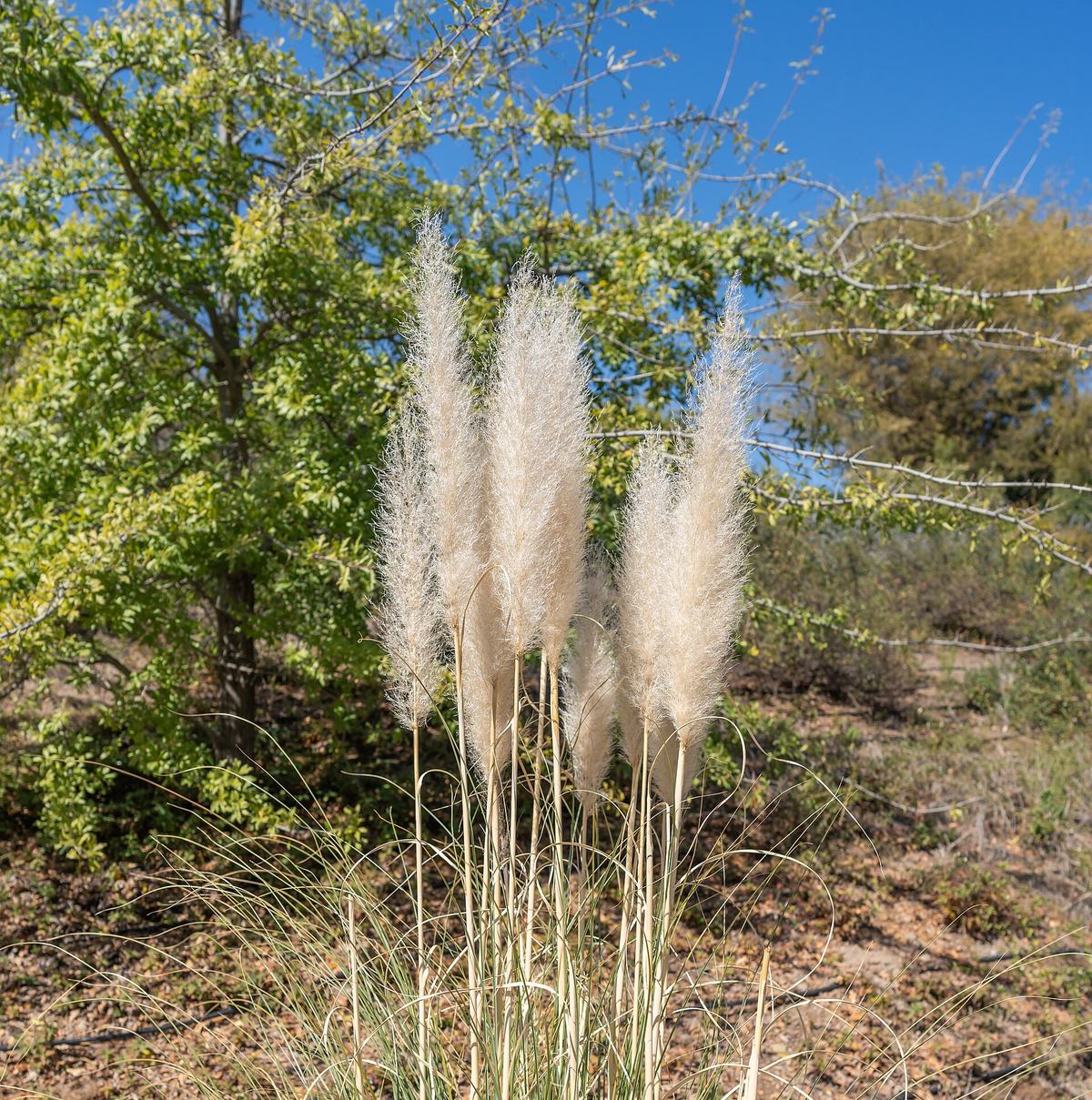
Photo: Rjcastillo, CC BY 4.0 via Wikimedia Commons

Quick facts
| Light: | Full sun and part shade (full sun preferred)111 source |
|---|---|
| Soil: | Well drained11 source |
| Hardiness: | Zones 6a–10b11 source |
| Size: | 6–12 ft (1.83–3.66 m) × 6–10 ft (1.83–3.05 m)15 |
| Growth rate: | Rapid11 source |
| Bloom: | Jul–Aug and Sep–Oct, White and pink611 source |
| Cats: | Non-toxic to cats 41 |
| Dogs: | Non-toxic to dogs 41 |
| Native range: | AGE, AGS, AGW, BOL, BZS, CLC, CLN, CLS, PAR, URU7 |
| Family: | Poaceae |
How much light does a Uruguayan Pampas Grass need?
Outdoors, Uruguayan pampas grass performs best with direct sunlight for six or more hours a day, the threshold that counts as full sun. It also grows in part shade, defined as two to six hours of direct sun a day, when a fully sunny spot is not available. Full sun is still the better-suited condition between the two for this grass, with part shade serving as a tolerated second choice.
Best soil for a Uruguayan Pampas Grass
Soil that drains well is essential for Uruguayan pampas grass growing outdoors, rather than ground that stays wet. Choose a planting site where water does not pool or linger after rain, matching this grass's preference for soil that drains well. Heavy, poorly drained soil that holds water for long periods works against the drainage this grass needs outdoors.
- Soil drainage: Well drained1
Hardiness and temperature
Uruguayan pampas grass is documented as hardy outdoors from USDA zone 6a up to USDA zone 10b. The lower end of that documented range is zone 6a, and the higher end is zone 10b. This hardiness range spans five numbered USDA zones in total, from zone six through zone ten.
- Hardiness: Zones 6a–10b1
Pruning a Uruguayan Pampas Grass
Give Uruguayan pampas grass a hard renewal prune in February, before new growth starts for the season. This timing follows general guidance for ornamental grasses, which recommends cutting old growth back before the next flush of new growth appears. Cutting back this grass in February, rather than later in spring, lines up with that same before-new-growth guidance.
- Pruning: Hard renewal pruning (Feb)2
How to plant a Uruguayan Pampas Grass
Give Uruguayan pampas grass plenty of room when you plant it, since mature clumps spread 6-10 ft (1.83-3.05 m) wide and grow 6-12 ft (1.83-3.66 m) tall. Pick a site in full sun with soil that drains well, the combination this grass is documented to prefer outdoors. This grass is documented as hardy for planting outdoors in USDA zones 6a through 10b.
- Hardiness: Zones 6a–10b1
Winter care
Zone 6a is the coldest zone where this grass is documented as hardy through winter, and zone 10b is the warmest. Outside that range, no winter hardiness is documented for this grass. That span covers zones 6a through 10b in full, the complete hardy range documented for this grass outdoors in winter.
- Hardiness: Zones 6a–10b1
Care calendar
| Task | Jan | Feb | Mar | Apr | May | Jun | Jul | Aug | Sep | Oct | Nov | Dec |
|---|---|---|---|---|---|---|---|---|---|---|---|---|
| Prune | Prune in Feb | |||||||||||
| Bloom | Bloom in Jul | Bloom in Aug | Bloom in Sep | Bloom in Oct |
Common problems
Fall armyworm, known scientifically as Spodoptera frugiperda, is the pest documented for Uruguayan pampas grass. Xylella fastidiosa is the disease documented for this grass. Both the fall armyworm and Xylella fastidiosa are tracked for this species in pest and disease reference records.
| Problem | Kind |
|---|---|
| Fall armyworm | Pest |
| Xylella fastidiosa | Disease |
Is Uruguayan Pampas Grass toxic to cats and dogs?
Uruguayan pampas grass carries a non-toxic listing for cats from the ASPCA Animal Poison Control Center. That same organization records this grass as non-toxic for dogs as well. NC State Extension's Plant Toolbox also lists this grass as non-toxic for cats. The same NC State listing marks this grass as non-toxic for dogs. For pet owners with cats or dogs at home, this grass is one of the species recorded as non-toxic by both the ASPCA and NC State Extension listings.
Recommended supplies
- Soil: a free-draining mix, and a pot with a drainage hole.
Questions and answers
- Is Uruguayan pampas grass toxic to cats or dogs?
- Uruguayan pampas grass is listed as non-toxic to cats and non-toxic to dogs by the ASPCA. NC State Extension's Plant Toolbox lists the same non-toxic status for both cats and dogs.
- What USDA hardiness zones does Uruguayan pampas grass grow in?
- Uruguayan pampas grass is documented as hardy outdoors from USDA zone 6a through zone 10b. That range covers five numbered USDA zones in total.
- When should you prune Uruguayan pampas grass?
- Prune Uruguayan pampas grass hard in February, before new growth starts for the season. That timing follows general guidance for ornamental grasses to cut old growth back before new growth appears.
Sources
- NC State Extension Gardener Plant Toolbox. https://plants.ces.ncsu.edu/plants/cortaderia-selloana/. Accessed 14 October 2026.
- Clemson Cooperative Extension Home & Garden Information Center. https://hgic.clemson.edu/this-month-in-your-garden-february-2024/. Accessed 14 October 2026.
- EPPO Global Database. https://gd.eppo.int/taxon/CDTSE/pests. Accessed 14 October 2026.
- ASPCA Animal Poison Control Center. https://www.aspca.org/pet-care/aspca-poison-control/toxic-and-non-toxic-plants/pampas-grass. Accessed 14 October 2026.
- Utah State University Extension. https://extension.usu.edu/washington/gardening/trees-shrubs/grasses. Accessed 30 October 2026.
- Chicago Botanic Garden. https://www.chicagobotanic.org/plant-information/plant-finder/cortaderia-selloana-pumila-dwarf-pampas-grass. Accessed 30 October 2026.
- Royal Botanic Gardens, Kew (World Checklist of Vascular Plants). https://sftp.kew.org/pub/data-repositories/WCVP/wcvp.zip. Accessed 4 June 2026.
How this page was made
- Written with AI assistance from the sources listed on this page. AI is never the source of a fact.