Rose of Sharon (Hibiscus syriacus)
Formerly Althaea frutex, Ketmia syriaca, Hibiscus floridus
Give rose of Sharon full sun to part shade and water that keeps soil evenly moist to just slightly dry between waterings. It grows into a vigorous, fast shrub with little fuss once established. The ASPCA lists this plant as non-toxic to both cats and dogs.
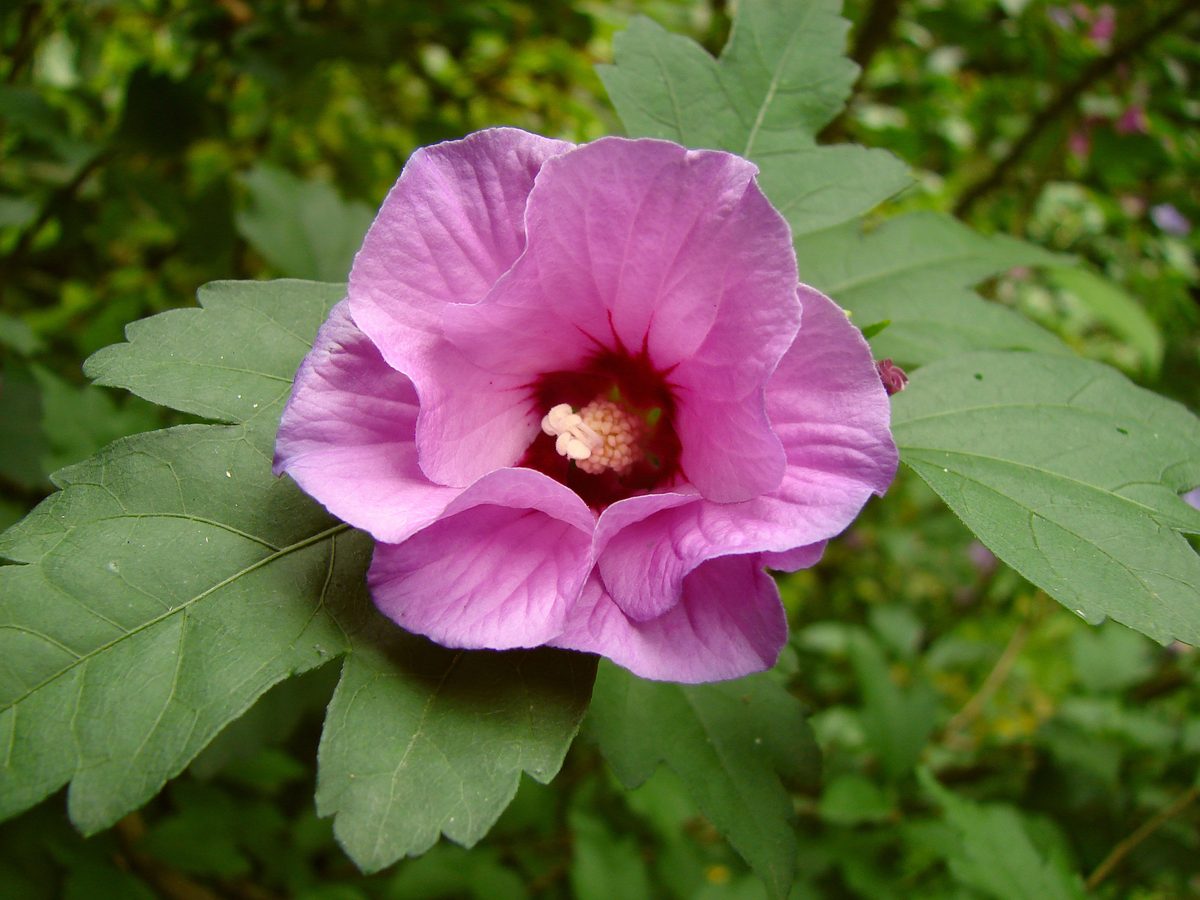
Photo: Chrumps, CC BY-SA 2.5 via Wikimedia Commons

Quick facts
| Light: | Full sun and part shade (full sun preferred)11 source |
|---|---|
| Water: | Dry to wet11 source |
| Soil: | Well drained, moist, occasionally dry and occasionally wet; pH 5–8121 source |
| Hardiness: | Zones 5a–9b11 source |
| Size: | 8–12 ft (2.44–3.66 m) × 6–10 ft (1.83–3.05 m)124 |
| Growth rate: | Rapid11 source |
| Bloom: | Red, white, purple, multicoloured, yellow, pink and blue17 |
| Cats: | Non-toxic to cats 61 |
| Dogs: | Non-toxic to dogs 61 |
| Native range: | CHC, CHS, TAI8 |
| Family: | Malvaceae |
How much light does a Rose of Sharon need?
Rose of Sharon does best in full sun. That means at least six hours of direct light hitting the leaves each day. The shrub also tolerates part shade, so a spot that gets sun for part of the day still works. Full sun is the preferred exposure for this shrub. If your yard only offers part shade, you can still grow this shrub there. Choose the sunniest spot you have for the best results, whether that is an open bed or a spot near a south-facing wall. Avoid deep, all-day shade, since that falls outside the range this shrub tolerates.
- Light: Full sun and part shade (full sun preferred)1
How often to water a Rose of Sharon
This shrub tolerates a wide range of soil moisture, from fairly dry to medium wet. That range runs from dry-to-medium conditions up to medium-wet soil, so it does not need constant watering. Check the top few inches of soil, and water once that layer moves from moist toward dry. Once roots are established, the plant handles short dry spells within that range without much trouble. It also tolerates soil on the wetter side, up to medium-wet conditions, better than many flowering shrubs. Avoid soil that stays soaked beyond medium wet, since that falls outside the documented range. In containers, check the soil more often, since pots dry faster than garden beds.
- Water: Dry to wet1
Best soil for a Rose of Sharon
Good garden soil for rose of Sharon ranges from well-drained to moist, and it tolerates soil that turns occasionally dry or occasionally wet. Soil pH between 5 and 8 suits this shrub, a wide band that covers most acidic to mildly alkaline garden soils. You rarely need to adjust pH before planting unless your soil sits far outside that band. The main thing to avoid is soil that stays waterlogged for long stretches, since that falls outside the tolerated drainage range.
Hardiness and temperature
This shrub is winter-hardy across USDA zones 5a through 9b. Zone 5a marks the cold edge of that range, where winters are the harshest this shrub is documented to tolerate outdoors. Zone 9b marks the warm edge, where winters stay mild. Across that whole span, the shrub is reported to survive outdoors without extra winter protection. No cited source gives an exact minimum temperature in degrees for this species. Instead, rely on the zone range to judge whether your site is cold enough to cause trouble. Gardeners outside zones 5a-9b should treat it as a container plant that overwinters indoors or in a sheltered spot.
How to plant a Rose of Sharon
Choose a planting site within USDA zones 5a through 9b, the range where this shrub survives winter outdoors. Pick a spot with full sun to part shade, since that is the exposure this shrub tolerates. Space new plants to allow for a mature spread of roughly 6-10 ft (1.8-3 m), so they are not crowded once full-grown. The shrub reaches a mature height of about 8-12 ft (2.4-3.7 m), so plan for its full-grown size. Work the soil before planting so it drains well but still holds some moisture, matching the range this shrub tolerates. Set the plant at its growing depth, water it in, and keep soil moist while roots establish. Gardeners outside zones 5a-9b should plan on growing it in a container instead of in the ground.
- Hardiness: Zones 5a–9b1
Winter care
Winter care depends on your USDA zone, since this shrub is hardy from 5a through 9b. Inside that range, it survives outdoors all winter without extra protection. Zone 5a marks the coldest winters this shrub is documented to handle in the ground. No source cited here gives an exact minimum temperature for this species. If you garden colder than zone 5a, grow it in a pot and move it somewhere sheltered for winter. Zone 9b marks the mild end, where little winter protection is needed. Check your local zone against that 5a-9b range when you plan for winter.
How to propagate a Rose of Sharon
The documented way to propagate rose of Sharon is from seed. Collect seed from the dried pods once flowering finishes, then sow it in prepared soil. Give seedlings time, since they need a few growing seasons before they reach flowering size and their first flowers. The facts checked for this page list only seed propagation for this species, with no documented note on cuttings or division.
- Propagation: Seed4
Common problems
Two pests are documented for rose of Sharon. They are Japanese beetles and brown marmorated stink bugs. Japanese beetles chew ragged holes in leaves and flowers. Stink bugs feed on leaves, buds, and seed pods. Check the plant often during summer for either pest. No disease is documented for this species here. Treat for pests only after you spot real damage or insects.
- Common pests: japanese beetle and brown marmorated stink bug5
| Problem | Kind |
|---|---|
| Japanese beetle | Pest |
| Brown marmorated stink bug | Pest |
Is Rose of Sharon toxic to cats and dogs?
Cats get a non-toxic listing for rose of Sharon from the ASPCA. Dogs get that same non-toxic listing from the ASPCA. The listing covers the whole plant, not one part such as the flowers or leaves. A non-toxic listing is not the same as a guarantee against any reaction at all. Large amounts of almost any plant material can cause vomiting or loose stool in a cat or dog. That holds true even with a non-toxic listing like this one. Contact your vet or a pet poison line if your pet shows ongoing symptoms after chewing on this plant.
Recommended supplies
- Soil: a free-draining mix, and a pot with a drainage hole.
Questions and answers
- Is rose of Sharon toxic to cats or dogs?
- Rose of Sharon has a non-toxic listing from the ASPCA for both cats and dogs. That listing covers the whole plant, not one single part. Even so, a non-toxic listing does not promise zero reaction if a pet eats a large amount.
- How much sun does rose of Sharon need?
- Rose of Sharon grows best in full sun, with at least six hours of direct light a day. It also tolerates part shade, so it still grows in a yard with some shade. Full sun remains the preferred exposure for the fullest growth.
- How do you propagate rose of Sharon?
- The documented method for propagating rose of Sharon is from seed. Collect seed from dried pods after flowering and sow it in prepared soil. No other propagation method is documented for this species in the facts checked here.
Sources
- North Carolina Extension Gardener Plant Toolbox. https://plants.ces.ncsu.edu/plants/hibiscus-syriacus/. Accessed 24 September 2026.
- Cornell University CALS Woody Plants Database. https://woodyplants.cals.cornell.edu/plant/110. Accessed 24 September 2026.
- Iowa State University Extension and Outreach (Yard and Garden). https://yardandgarden.extension.iastate.edu/article/2001/5-18-2001/winter.html. Accessed 28 October 2026.
- Clemson Cooperative Extension Home & Garden Information Center. https://hgic.clemson.edu/factsheet/hibiscus/. Accessed 24 September 2026.
- EPPO Global Database. https://gd.eppo.int/taxon/HIBSY/pests. Accessed 24 September 2026.
- ASPCA Animal Poison Control Center. https://www.aspca.org/pet-care/aspca-poison-control/toxic-and-non-toxic-plants/rose-sharon. Accessed 24 September 2026.
- Clemson Cooperative Extension Home & Garden Information Center. https://hgic.clemson.edu/bring-on-the-heat-bring-on-the-blooms-with-rose-of-sharon/. Accessed 24 September 2026.
- Royal Botanic Gardens, Kew (World Checklist of Vascular Plants). https://sftp.kew.org/pub/data-repositories/WCVP/wcvp.zip. Accessed 4 June 2026.
How this page was made
- Written with AI assistance from the sources listed on this page. AI is never the source of a fact.