Autumn Olive (Elaeagnus umbellata)
Formerly Elaeagnus crispa, Elaeagnus parvifolia, Elaeagnus crocea
Keep autumn olive alive with full sun to part shade, moist well-drained soil, and water needs that run from dry to medium. It is a deciduous shrub that the NC State Extension calls invasive. The ASPCA lists it as non-toxic to cats and non-toxic to dogs.
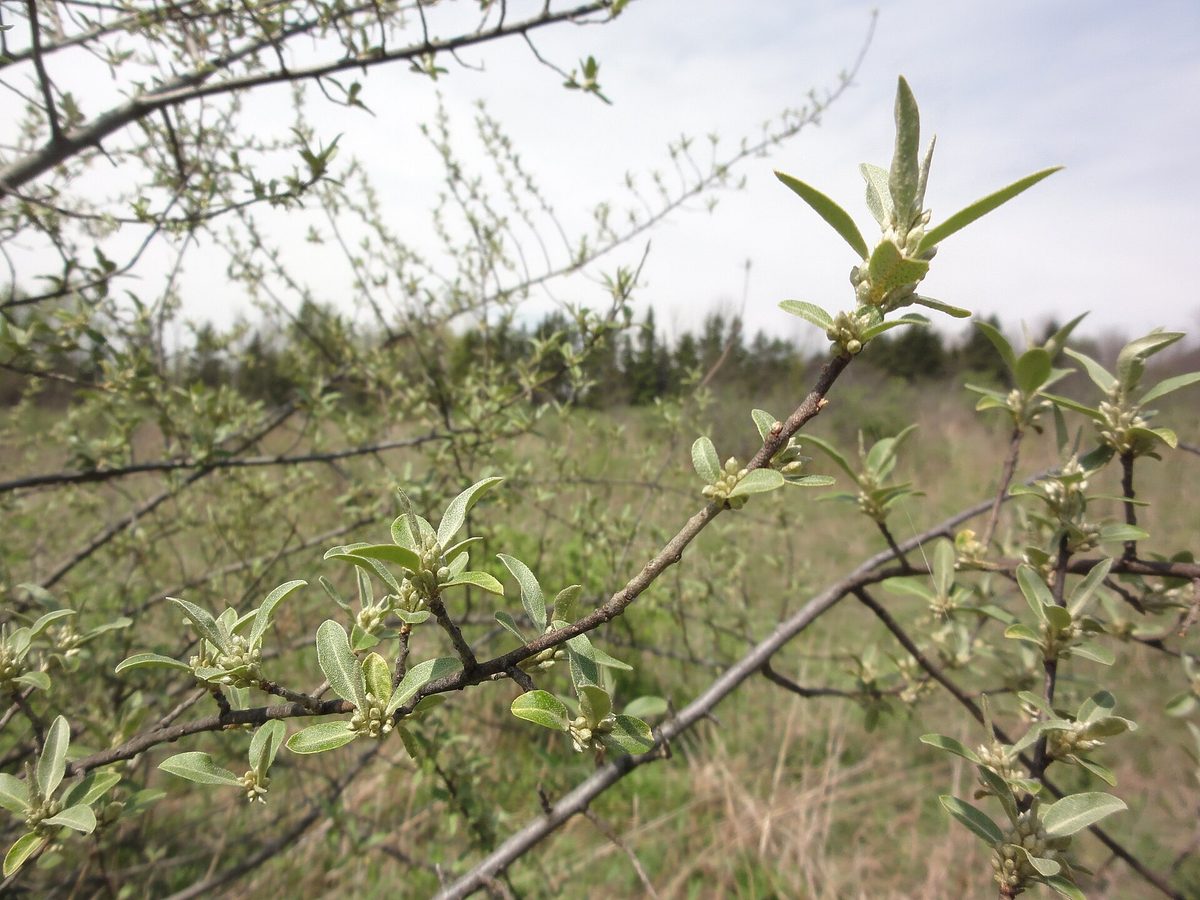
Photo: R. A. Nonenmacher, CC BY-SA 4.0 via Wikimedia Commons

Quick facts
| Light: | Full sun and part shade (full sun preferred)112 |
|---|---|
| Water: | Dry to medium11 source |
| Soil: | Well drained and moist12 |
| Hardiness: | Zones 4a–9b11 source |
| Size: | 10–18 ft (3.05–5.49 m) × 12–18 ft (3.66–5.49 m)125 |
| Growth rate: | Rapid111 source |
| Bloom: | May–Jun, May–Jun (Northeastern U.S.), Apr–May (New England, Illinois, Blue Ridge Mountains, West Virginia, North and South Carolina) and Feb–Apr (Florida), White and yellow11 source |
| Cats: | Non-toxic to cats 41 |
| Dogs: | Non-toxic to dogs 41 |
| Native range: | AFG, CHC, CHM, CHN, CHS, CHT, JAP, KOR, NEP, PAK, WHM6 |
| Family: | Elaeagnaceae |
How much light does an Autumn Olive need?
Autumn olive grows in full sun to partial shade, and full sun is the preferred condition. Full sun here means six or more hours of direct sunlight a day. Part shade is also a listed light condition, so a spot with somewhat less direct sun stays within the range given for this shrub.
How often to water an Autumn Olive
Drought is something autumn olive tolerates well, since the source calls it highly tolerant of drought and erosion. It does not tolerate wet sites. The recorded water range runs from dry to medium. It also prefers moist, well-drained soil. Do not plan on a wet site for this shrub.
- Water: Dry to medium1
Best soil for an Autumn Olive
Moist, well-drained soil is what autumn olive prefers. The listed drainage conditions for this shrub are well drained and moist. The source also says it does not tolerate wet sites. Its water range runs from dry to medium. It is highly tolerant of drought and erosion. No cited source records a soil pH range for this plant, so that detail is not documented on this page.
Hardiness and temperature
USDA hardiness zones 4a to 9b are listed for autumn olive. Zones 4a, 4b, 5a, 5b, 6a, 6b, 7a, 7b, 8a, 8b, 9a and 9b are all named in that listing. No cited source records a minimum temperature for this plant, so a lowest tolerated temperature is not documented. Humidity needs are not documented either. The plant is a deciduous shrub.
- Hardiness: Zones 4a–9b1
How to plant an Autumn Olive
Plant autumn olive in USDA zones 4a to 9b, the range listed for it. Its mature height is 10–18 ft (3.05–5.49 m). Its mature spread is 12–18 ft (3.66–5.49 m), so leave that much room across. The growth rate is recorded as rapid. It prefers full sun and moist, well-drained soil. The native-status register lists it as introduced in the lower 48 states and in Hawaii. The NC State Extension Gardener Plant Toolbox calls it invasive.
- Hardiness: Zones 4a–9b1
Winter care
This shrub is deciduous. Its listed hardiness range runs from zone 4a to zone 9b. Zone 4a is the coldest zone in that listed range. No cited source records a minimum temperature for this plant, so a specific cold limit is not documented. Winter protection, mulching and frost-timing advice are not documented either.
- Hardiness: Zones 4a–9b1
How to propagate an Autumn Olive
The recommended propagation strategy for autumn olive is seed. Seed is the only method recorded in the facts for this page. Cuttings, division and layering are not documented here. Details such as seed treatment, timing and germination are not documented either. The NC State Extension Gardener Plant Toolbox calls the plant invasive.
- Propagation: Seed1
Common problems
Pests recorded for autumn olive include Japanese beetle, spotted lanternfly, brown marmorated stink bug, spotted wing drosophila, citrus longhorn beetle, Japanese maple scale and white peach scale. The EPPO Global Database code for citrus longhorn beetle is Anoplophora chinensis. No cited source records common diseases for this plant, so diseases are not documented here.
- Common pests: japanese beetle, spotted lanternfly, brown marmorated stink bug, spotted wing drosophila, citrus longhorn beetle, japanese maple scale and white peach scale3
| Problem | Kind |
|---|---|
| Japanese beetle | Pest |
| Spotted lanternfly | Pest |
| Brown marmorated stink bug | Pest |
| Spotted wing drosophila | Pest |
| Citrus longhorn beetle | Pest |
| Japanese maple scale | Pest |
| White peach scale | Pest |
Is Autumn Olive toxic to cats and dogs?
The ASPCA lists autumn olive as non-toxic to cats. The ASPCA also lists it as non-toxic to dogs. The NC State Extension Gardener Plant Toolbox likewise marks it non-toxic for cats and for dogs. The cat position and the dog position are the same: non-toxic in both listings. The page records no toxic parts and no clinical signs for either animal. Cats and dogs are the only two animals this site covers for toxicity.
Recommended supplies
- Soil: a free-draining mix, and a pot with a drainage hole.
Questions and answers
- Is autumn olive toxic to cats and dogs?
- The ASPCA lists autumn olive as non-toxic to cats and non-toxic to dogs. The NC State Extension Gardener Plant Toolbox also marks it non-toxic for both. This site covers cats and dogs only for toxicity.
- How much sun does autumn olive need?
- It grows in full sun to partial shade, and full sun is preferred. Full sun means six or more hours of direct sunlight a day. Part shade is also listed.
- Which hardiness zones is autumn olive listed for?
- It is listed for USDA hardiness zones 4a to 9b. The listing includes every half-zone step from 4a through 9b. No minimum temperature is recorded in the cited sources, so a specific cold limit is not documented.
Sources
- NC State Extension. https://plants.ces.ncsu.edu/plants/elaeagnus-umbellata/. Accessed 14 October 2026.
- Cornell University CALS Woody Plants Database. https://woodyplants.cals.cornell.edu/plant/87. Accessed 14 October 2026.
- EPPO Global Database. https://gd.eppo.int/taxon/ELGUM/pests. Accessed 14 October 2026.
- ASPCA Animal Poison Control Center. https://www.aspca.org/pet-care/aspca-poison-control/toxic-and-non-toxic-plants/autumn-olive. Accessed 14 October 2026.
- Cornell University CALS Woody Plants Database. https://woodyplants.cals.cornell.edu/plant/view?id=87. Accessed 1 November 2026.
- Royal Botanic Gardens, Kew (World Checklist of Vascular Plants). https://sftp.kew.org/pub/data-repositories/WCVP/wcvp.zip. Accessed 4 June 2026.
How this page was made
- Written with AI assistance from the sources listed on this page. AI is never the source of a fact.