American Pokeweed (Phytolacca americana)
Formerly Phytolacca rigida, Phytolacca decandra, Phytolacca vulgaris
Grow American pokeweed in full sun or part shade, and give it medium water. It is toxic to both cats and dogs. This herbaceous perennial reaches 4–10 ft (1.22–3.05 m) tall and is listed for USDA zones 4a to 8b. It is native to the lower 48 US states.
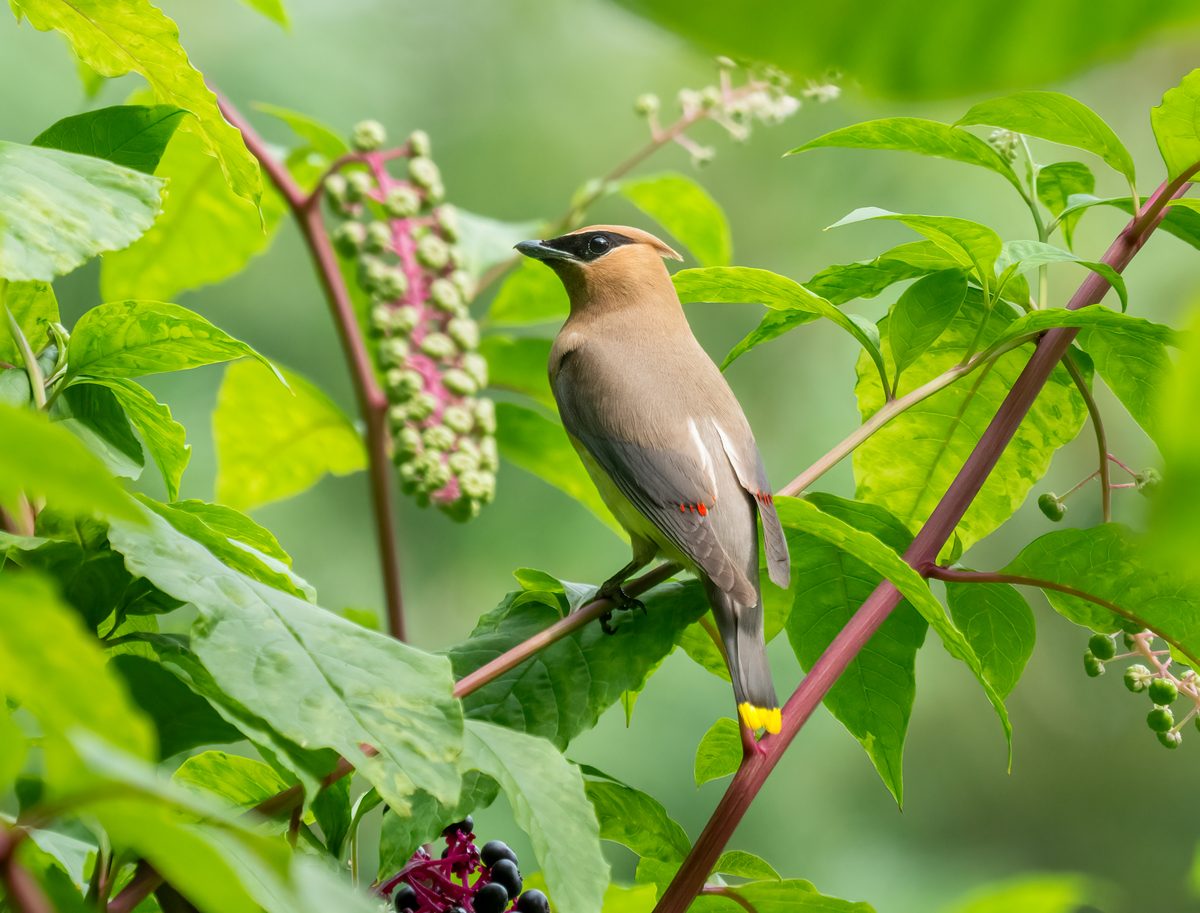
Photo: Rhododendrites, CC BY-SA 4.0 via Wikimedia Commons

Quick facts
| Light: | Full sun and part shade (full sun preferred)11 source |
|---|---|
| Water: | Medium21 source |
| Soil: | Well drained, moist and occasionally dry11 source |
| Hardiness: | Zones 4a–8b11 source |
| Size: | 4–10 ft (1.22–3.05 m) × 3–5 ft (0.91–1.52 m)711 source |
| Growth rate: | Rapid11 source |
| Bloom: | Jul–Sep, White, pink, purple and green1281 source |
| Cats: | Toxic to cats (1 source) 1 |
| Dogs: | Toxic to dogs 16 |
| Native range: | ALA, ARI, ARK, CAL, CNT, DEL, FLA, GEO, ILL, INI, IOW, KAN, KTY, LOU, MAI, MAS, MIC, MIN, MRY, MSI, MSO, MXC, MXE, MXG, MXN, MXS, NBR, NCA, NEB, NWH, NWJ, NWM, NWY, OHI, OKL, ONT, ORE, PEN, QUE, RHO, SCA, TEN, TEX, VER, VRG, WDC, WIS, WVA9 |
| Family: | Phytolaccaceae |
How much light does an American Pokeweed need?
American pokeweed grows in full sun or part shade, and full sun is preferred. Full sun means 6 or more hours of direct sunlight a day. Part shade means direct sunlight for only part of the day, about 2 to 6 hours. The minimum recorded is 2 hours a day.
How often to water an American Pokeweed
Medium is the water level recorded for American pokeweed. The record gives medium for both the low end and the high end of its water need. The soil it grows in can be well drained, moist or occasionally dry. No watering schedule in days is documented for this plant.
- Water: Medium2
Best soil for an American Pokeweed
American pokeweed grows in soil that is well drained, moist or occasionally dry. Good drainage is the condition named for it. Its water need is medium across those soil conditions. No soil pH range is documented for this plant, and no soil texture is listed either. It is a herbaceous perennial that grows rapidly. It reaches 4–10 ft (1.22–3.05 m) tall and 3–5 ft (0.91–1.52 m) wide. It is native to the lower 48 US states.
- Soil drainage: Well drained, moist and occasionally dry1
Hardiness and temperature
American pokeweed is listed for USDA hardiness zones 4a to 8b. That range covers zones 4a, 4b, 5a, 5b, 6a, 6b, 7a, 7b, 8a and 8b. It is a herbaceous perennial plant. It is native to the lower 48 US states. No minimum temperature or humidity preference is documented for this plant. Its growth rate is rapid. It reaches 4–10 ft (1.22–3.05 m) in height.
- Hardiness: Zones 4a–8b1
Pruning an American Pokeweed
Pruning for American pokeweed means removing dead growth only. Dead stems can be cut back to 12 to 24 inches (30–61 cm) and left standing until they disintegrate on their own. Native bees nest in the dead, hollow stems, so gardeners are encouraged to leave them in place.
How to plant an American Pokeweed
Plant American pokeweed where winters match USDA zones 4a to 8b. Allow room for a plant that grows 3–5 ft (0.91–1.52 m) wide. It also reaches 4–10 ft (1.22–3.05 m) in height. Choose a site with full sun or part shade. Growth is rapid. It is native to the lower 48 US states. No planting time relative to frost is documented.
- Hardiness: Zones 4a–8b1
Winter care
Winter hardiness for American pokeweed is listed as USDA zones 4a to 8b. It is a herbaceous perennial. Dead stems can be cut back to 12 to 24 inches (30–61 cm) and left standing until they disintegrate on their own. Native bees nest in those dead, hollow stems. No minimum temperature or winter protection is documented for this plant. It is native to the lower 48 US states. It reaches 4–10 ft (1.22–3.05 m) in height.
- Hardiness: Zones 4a–8b1
How to propagate an American Pokeweed
American pokeweed can be propagated by seed, division or stem cuttings. One described step is to gather about a pint of the purple berries, crush them, cover them with water and let them ferment for a few days. Division and stem cuttings are listed alongside seed without further detail. A rapid growth rate is recorded for the plant. It is a herbaceous perennial.
- Propagation: Seed, division and stem cuttings4
Common problems
The pests recorded for American pokeweed are drosophila suzukii, halyomorpha halys, spodoptera eridania, spodoptera ornithogalli, homalodisca vitripennis and heterodera glycines. The diseases recorded are mosaic virus, tomato spotted wilt virus, tomato chlorosis virus and cotton root rot. The plant is described as susceptible to mosaic virus. Deer resistance is reported for this plant.
| Problem | Kind |
|---|---|
| Drosophila suzukii | Pest |
| Halyomorpha halys | Pest |
| Spodoptera eridania | Pest |
| Spodoptera ornithogalli | Pest |
| Homalodisca vitripennis | Pest |
| Heterodera glycines | Pest |
| Mosaic virus | Disease |
| Tomato spotted wilt virus | Disease |
| Tomato chlorosis virus | Disease |
| Cotton root rot | Disease |
Is American Pokeweed toxic to cats and dogs?
American pokeweed is listed as toxic to cats. It is also listed as toxic to dogs. All parts of this plant are described as poisonous to pets, which includes the cats and dogs covered here. Pet Poison Helpline says that pokeberry causes mild to severe oral irritation and gastrointestinal upset when it is ingested. The record for each animal reads toxic, with no separate severity grade stated.
Pet-safe alternatives
Recommended supplies
- Soil: a free-draining mix, and a pot with a drainage hole.
Questions and answers
- Is American pokeweed toxic to cats and dogs?
- American pokeweed is listed as toxic to both cats and dogs. All parts of the plant are described as poisonous to pets.
- How much sun does American pokeweed need?
- It grows in full sun or part shade, and full sun is preferred. Full sun means 6 or more hours of direct sunlight a day, and part shade means about 2 to 6 hours.
- Which hardiness zones suit American pokeweed?
- It is listed for USDA zones 4a to 8b. It reaches 4–10 ft (1.22–3.05 m) tall and 3–5 ft (0.91–1.52 m) wide.
Sources
- NC State Extension Gardener Plant Toolbox. https://plants.ces.ncsu.edu/plants/phytolacca-americana/. Accessed 23 September 2026.
- Lady Bird Johnson Wildflower Center (Native Plant Database). https://www.wildflower.org/plants/result.php?id_plant=PHAM4. Accessed 23 September 2026.
- NC State Extension Gardener Plant Toolbox. https://plants.ces.ncsu.edu/plants/phytolacca-americana/common-name/scoke/. Accessed 30 October 2026.
- University of Florida IFAS Extension (EDIS/Ask IFAS). https://ask.ifas.ufl.edu/ag254. Accessed 6 October 2026.
- EPPO Global Database. https://gd.eppo.int/taxon/PHTAM/pests. Accessed 23 September 2026.
- Pet Poison Helpline. https://www.petpoisonhelpline.com/poison/pokeweed/. Accessed 24 September 2026.
- University of Florida IFAS Extension (EDIS). https://ask.ifas.ufl.edu/publication/ep631. Accessed 27 October 2026.
- Lady Bird Johnson Wildflower Center (Native Plant Database). https://www.wildflower.org/plants/result.php?id_plant=pham4. Accessed 23 September 2026.
- Royal Botanic Gardens, Kew (World Checklist of Vascular Plants). https://sftp.kew.org/pub/data-repositories/WCVP/wcvp.zip. Accessed 4 June 2026.
How this page was made
- Written with AI assistance from the sources listed on this page. AI is never the source of a fact.