Coriander (Coriandrum sativum)
Formerly Sium coriandrum, Bifora loureiroi, Coriandrum majus
To keep coriander growing, give it full sun or part shade and keep the plants evenly moist. It prefers medium moisture and well-drained soil, and it is an annual that you start from seed. The ASPCA lists it as non-toxic to both cats and dogs.
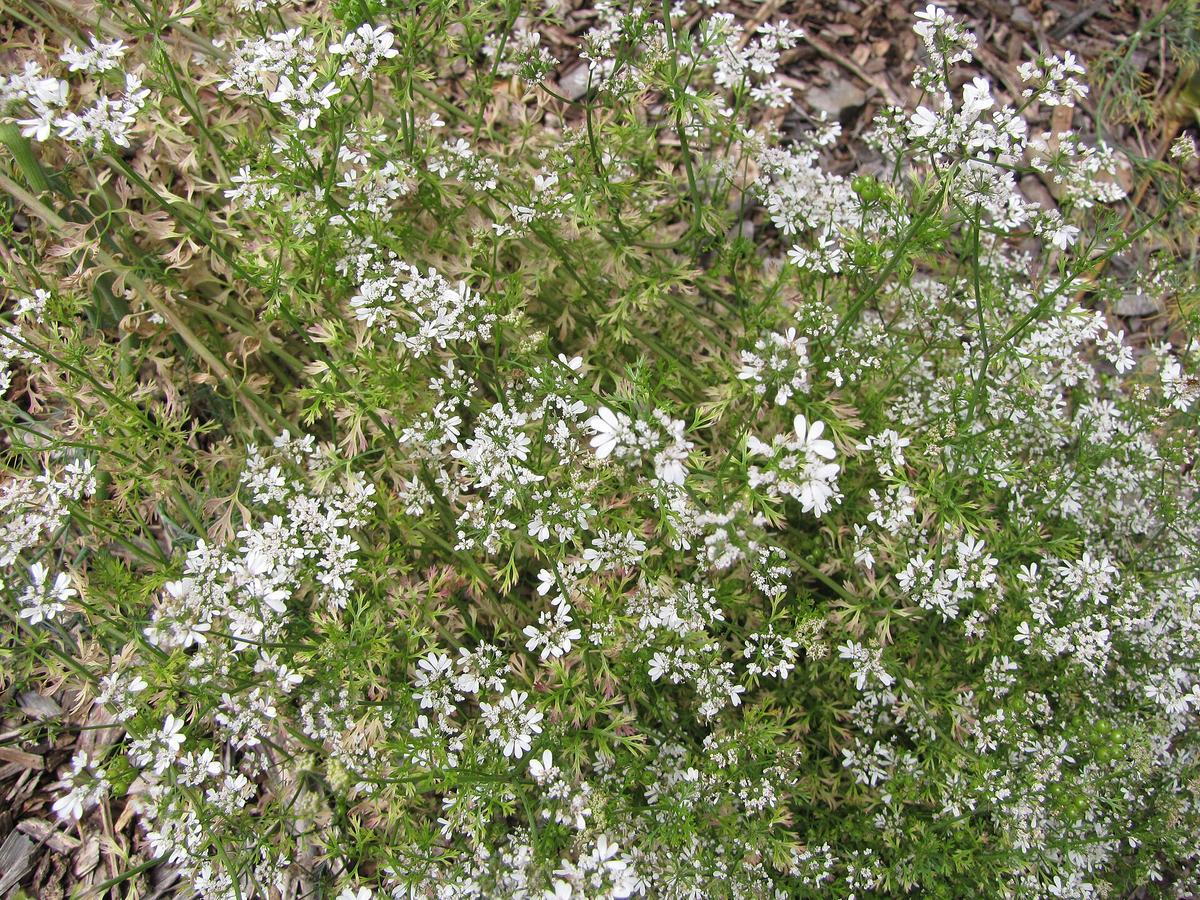
Photo: Forest and Kim Starr, CC BY 3.0 via Wikimedia Commons

Quick facts
| Light: | Full sun and part shade (full sun preferred)123 |
|---|---|
| Water: | Medium13 |
| Soil: | Well drained and moist; pH 6.5–6.5141 source |
| Size: | 1–3 ft (0.3–0.91 m) × 1–2 ft (0.3–0.61 m)1111 source |
| Growth rate: | Rapid111 source |
| Bloom: | Pink, purple and white13 |
| Cats: | Non-toxic to cats 101 |
| Dogs: | Non-toxic to dogs 101 |
| Native range: | AFG, IRN, LBS, NCS, PAK, PAL, SAU, SIN, TCS, TUR12 |
| Family: | Apiaceae |
How much light does a Coriander need?
Coriander does best in full sun, which means six or more hours of direct sunlight a day. It also accepts part shade, although full sun is the preferred exposure. In spring or fall, plant coriander in full sun. In summer, plant it in partial sun instead. Both full sun and part shade are listed outdoor conditions for this plant.
How often to water a Coriander
Coriander needs medium water. Keep the plants evenly moist throughout the growing season. It prefers soil that is medium moist and well drained. The drainage entry for this plant is recorded as well drained and moist. Medium is both the lowest and the highest water level recorded, with no range above or below it.
Best soil for a Coriander
Coriander grows in soil that is well drained and moist. The drainage entry lists two conditions, well drained and moist. Good drainage is the condition named for it. The recorded pH is around 6.5. That is one value, not a range. Penn State describes well-drained soil with a pH around 6.5. The water record agrees, naming medium moist, well-drained soil as the preference.
Pruning a Coriander
Pruning for coriander means deadheading. Pinching off the flower stems will extend the harvest of leaves. Pinching is a way to keep picking leaves for longer. Deadheading is the only pruning type recorded for this plant. Flower stems are the part you pinch off. Coriander is an annual plant.
- Pruning: Deadheading5
When and how to harvest Coriander
You can begin picking as soon as the plants are 4 to 6 inches (10–15 cm) tall. Harvest plants once they reach about 6 inches (15 cm) tall, or pick leaves sparingly from plants that are 4–6 inches tall. Coriander matures in 60–70 days from seed. Pinching off flower stems extends the harvest of leaves. The plant is an annual with rapid growth.
How to propagate a Coriander
Coriander is propagated by seed. Seed is the recommended propagation strategy. It is easily grown from seed that is sown directly in the garden after the danger of frost is past. Seeds germinate in about 21 days. The plants grow 1–3 ft (0.3–0.91 m) tall. They reach 1–2 ft (0.3–0.61 m) wide. Its growth rate is rapid.
Common problems
The pests recorded for coriander are beet armyworm, cabbage looper, green peach aphid, willow carrot aphid and leafhoppers. The diseases recorded include alternaria leaf spot, bacterial leaf spot, cilantro yellow blotch, fusarium wilt, powdery mildew and damping off. The full disease list also names apium virus y disease, carrot motley dwarf, rhizoctonia root and crown rot, septoria leaf spot, stemphylium leaf spot and aster yellows.
- Common pests: beet armyworm, cabbage looper, green peach aphid, willow carrot aphid and leafhoppers9
- Common diseases: alternaria leaf spot, apium virus y disease, bacterial leaf spot, carrot motley dwarf, cilantro yellow blotch, fusarium wilt, powdery mildew, rhizoctonia root and crown rot, septoria leaf spot, stemphylium leaf spot, aster yellows and damping off9
| Problem | Kind |
|---|---|
| Beet armyworm | Pest |
| Cabbage looper | Pest |
| Green peach aphid | Pest |
| Willow carrot aphid | Pest |
| Leafhoppers | Pest |
| Alternaria leaf spot | Disease |
| Apium virus y disease | Disease |
| Bacterial leaf spot | Disease |
| Carrot motley dwarf | Disease |
| Cilantro yellow blotch | Disease |
| Fusarium wilt | Disease |
| Powdery mildew | Disease |
| Rhizoctonia root and crown rot | Disease |
| Septoria leaf spot | Disease |
| Stemphylium leaf spot | Disease |
| Aster yellows | Disease |
| Damping off | Disease |
Is Coriander toxic to cats and dogs?
Cats: the ASPCA lists coriander as non-toxic. Dogs: the ASPCA lists coriander as non-toxic. NC State Extension describes it as non-toxic for cats. NC State Extension describes it as non-toxic for dogs. The position is recorded separately for each animal, and both entries read non-toxic. Cats and dogs share the same recorded position. Neither entry names a toxic plant part or a severity.
Recommended supplies
- Soil: a free-draining mix, and a pot with a drainage hole.
Questions and answers
- Does coriander need full sun?
- Full sun is the preferred exposure, meaning six or more hours of direct sunlight a day. Part shade is also listed, and in summer the advice is to plant in partial sun.
- Is coriander toxic to cats and dogs?
- Coriander is listed as non-toxic to cats and non-toxic to dogs. Those are separate entries, one for each animal. Neither entry names a severity.
- How long does coriander take to harvest?
- Coriander takes 60–70 days from seed to mature. Leaf picking can begin as soon as the plants are 4 to 6 inches (10–15 cm) tall. Pinching off flower stems extends the harvest of leaves.
Sources
- NC State Extension Gardener Plant Toolbox. https://plants.ces.ncsu.edu/plants/coriandrum-sativum/. Accessed 14 October 2026.
- Oregon State University Extension Service. https://extension.oregonstate.edu/imported-publication/cilantro. Accessed 14 October 2026.
- University of Wisconsin-Madison Division of Extension. https://hort.extension.wisc.edu/articles/cilantro-coriander-coriandrum-sativum/. Accessed 14 October 2026.
- Penn State Extension. https://extension.psu.edu/cilantro-a-unique-culinary-herb. Accessed 14 October 2026.
- University of Maryland Extension. https://extension.umd.edu/resource/cilantrocoriander. Accessed 30 October 2026.
- Iowa State University Extension and Outreach (Yard and Garden). https://yardandgarden.extension.iastate.edu/how-to/growing-harvesting-and-drying-herbs. Accessed 14 October 2026.
- University of Minnesota Extension. https://extension.umn.edu/garden-and-home/yard-and-garden/gardening-in-minnesota/planting-vegetables-in-midsummer-for-fall-harvest. Accessed 27 October 2026.
- University of Illinois Extension. https://extension.illinois.edu/herbs/cilantro. Accessed 1 November 2026.
- UC Statewide Integrated Pest Management Program. https://ipm.ucanr.edu/agriculture/cilantro-and-parsley/. Accessed 14 October 2026.
- ASPCA Animal Poison Control Center. https://www.aspca.org/pet-care/aspca-poison-control/toxic-and-non-toxic-plants/cilantro. Accessed 14 October 2026.
- Utah State University Extension. https://extension.usu.edu/yardandgarden/research/cilantro-coriander-in-the-garden. Accessed 1 November 2026.
- Royal Botanic Gardens, Kew (World Checklist of Vascular Plants). https://sftp.kew.org/pub/data-repositories/WCVP/wcvp.zip. Accessed 4 June 2026.
How this page was made
- Written with AI assistance from the sources listed on this page. AI is never the source of a fact.