American Black Nightshade (Solanum americanum)
Formerly Solanum nodiflorum, Solanum pterocaulum, Solanum minutibaccatum
Give American black nightshade (Solanum americanum) full sun and soil that is moist and well drained, and expect it to reach about 5 ft (1.52 m) tall. Its water need runs from medium to wet. All parts of the plant are potentially toxic to cats and dogs if ingested. It is native to the lower 48 states and Puerto Rico, and it is propagated from seed.
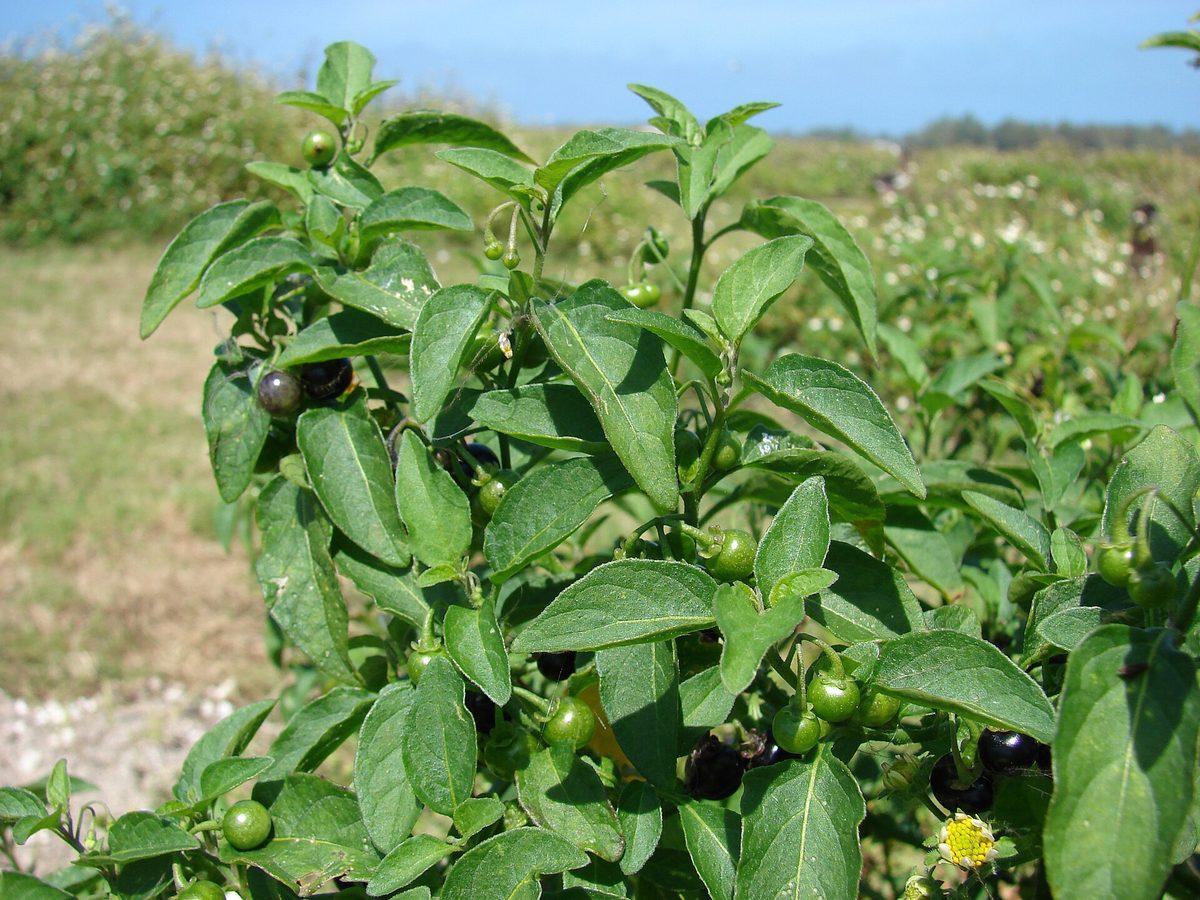
Photo: Forest and Kim Starr, CC BY 3.0 via Wikimedia Commons

Quick facts
| Light: | Full sun11 source |
|---|---|
| Water: | Medium to wet11 source |
| Soil: | Well drained and moist11 source |
| Size: | 5 ft (1.52 m) × 1.5–3 ft (0.46–0.91 m)311 source |
| Bloom: | Jun–Nov, White, yellow and green131 source |
| Cats: | Toxic to cats (1 source) 1 |
| Dogs: | Toxic to dogs (1 source) 1 |
| Native range: | AGE, AGW, ALA, ARI, ARU, BAH, BLZ, BOL, BRC, BZC, BZE, BZL, BZN, BZS, CAL, CAY, CLC, CLM, CLN, COS, CUB, DOM, ECU, ELS, FLA, FRG, GAL, GEO, GUA, GUY, HAI, HON, JAM, LEE, LOU, MSI, MXC, MXE, MXG, MXN, MXS, MXT, NIC, NLA, ORE, PAN, PAR, PER, PUE, SCA, SUR, TCI, TEX, TRT, URU, UTA, VEN, VNA, WAS, WIN4 |
| Family: | Solanaceae |
How much light does an American Black Nightshade need?
Full sun is the light level recorded for this plant outdoors. That means six or more hours of direct sunlight a day. Full sun is the only light value on file, and no part shade range is documented. Choose a spot that gets at least six hours of direct sun a day.
- Light: Full sun1
How often to water an American Black Nightshade
Medium to wet is the water range recorded for this plant. The source says it will thrive in moist soils. Moist and well drained are the soil drainage values on file, and they sit alongside that range. Check that the soil feels moist, which is the condition the source describes.
- Water: Medium to wet1
Best soil for an American Black Nightshade
Moist, well drained soil is what this plant is recorded with. The source lists good drainage and moist conditions as separate entries. It adds that the plant will thrive in moist soils. Medium to wet is the water range that goes with those soil values. A bed that is both well drained and moist matches those entries. Both entries describe the soil itself, and the water range is recorded separately. No soil pH range is documented for this plant.
How to propagate an American Black Nightshade
Seed is the only propagation method recorded for this plant. The source says it is easily propagated by the dispersal of seeds. New plants of American black nightshade come from seed, according to the record. Seed dispersal is the process the source names. Easy propagation by seed is the only claim made about starting new plants.
- Propagation: Seed1
Common problems
Colorado potato beetle, whitefly and spider mites are the pests recorded for this plant. One source describes American nightshade as the host of many plant pests. It names the Colorado potato beetle as one example. Whitefly is listed as well, along with spider mites. The pest list has three entries in all.
| Problem | Kind |
|---|---|
| Colorado potato beetle | Pest |
| Whitefly | Pest |
| Spider mites | Pest |
Is American Black Nightshade toxic to cats and dogs?
Cats and dogs are both recorded as affected, with the same toxic label for each. For cats, the recorded position is toxic. For dogs, the recorded position is also toxic. The source says all parts of the plant are potentially toxic to pets if ingested. That covers the whole plant, not one part of it. The page covers cats and dogs only, and the record here does not name a severity. Ingestion is the route the source names.
Pet-safe alternatives
Recommended supplies
- Soil: a free-draining mix, and a pot with a drainage hole.
Questions and answers
- Is American black nightshade toxic to cats and dogs?
- The record lists it as toxic for both cats and dogs. The source says all parts of the plant are potentially toxic to pets if ingested. Cats and dogs share the same recorded toxic label. Ingestion is the route the source names.
- How much sun does American black nightshade need?
- Full sun is the light level recorded for it outdoors. That means six or more hours of direct sunlight a day. The water range recorded is medium to wet, and it will thrive in moist soils. Well drained and moist soil goes with that, according to the drainage values on file.
- How tall does it grow, and when does it bloom?
- It reaches about 5 ft (1.52 m) tall, with a spread of 1.5–3 ft (0.46–0.91 m). The flowers are white, yellow and green. Flowers are present in summer and fall. It is native to the lower 48 states and Puerto Rico.
Sources
- NC State Extension Gardener Plant Toolbox. https://plants.ces.ncsu.edu/plants/solanum-americanum/. Accessed 14 October 2026.
- EPPO Global Database. https://gd.eppo.int/taxon/SOLAM/pests. Accessed 14 October 2026.
- Lady Bird Johnson Wildflower Center (Native Plant Database). https://www.wildflower.org/plants/result.php?id_plant=soam. Accessed 15 October 2026.
- Royal Botanic Gardens, Kew (World Checklist of Vascular Plants). https://sftp.kew.org/pub/data-repositories/WCVP/wcvp.zip. Accessed 4 June 2026.
How this page was made
- Written with AI assistance from the sources listed on this page. AI is never the source of a fact.