Edible Banana (Musa acuminata)
Formerly Musa zebrina, Musa cavendishii, Musa errans
Keep this banana plant in direct sun indoors, with bright, indirect light as a tolerated alternative, and do not let the soil dry out. Water needs run from medium to wet. The ASPCA lists it as non-toxic to both cats and dogs.
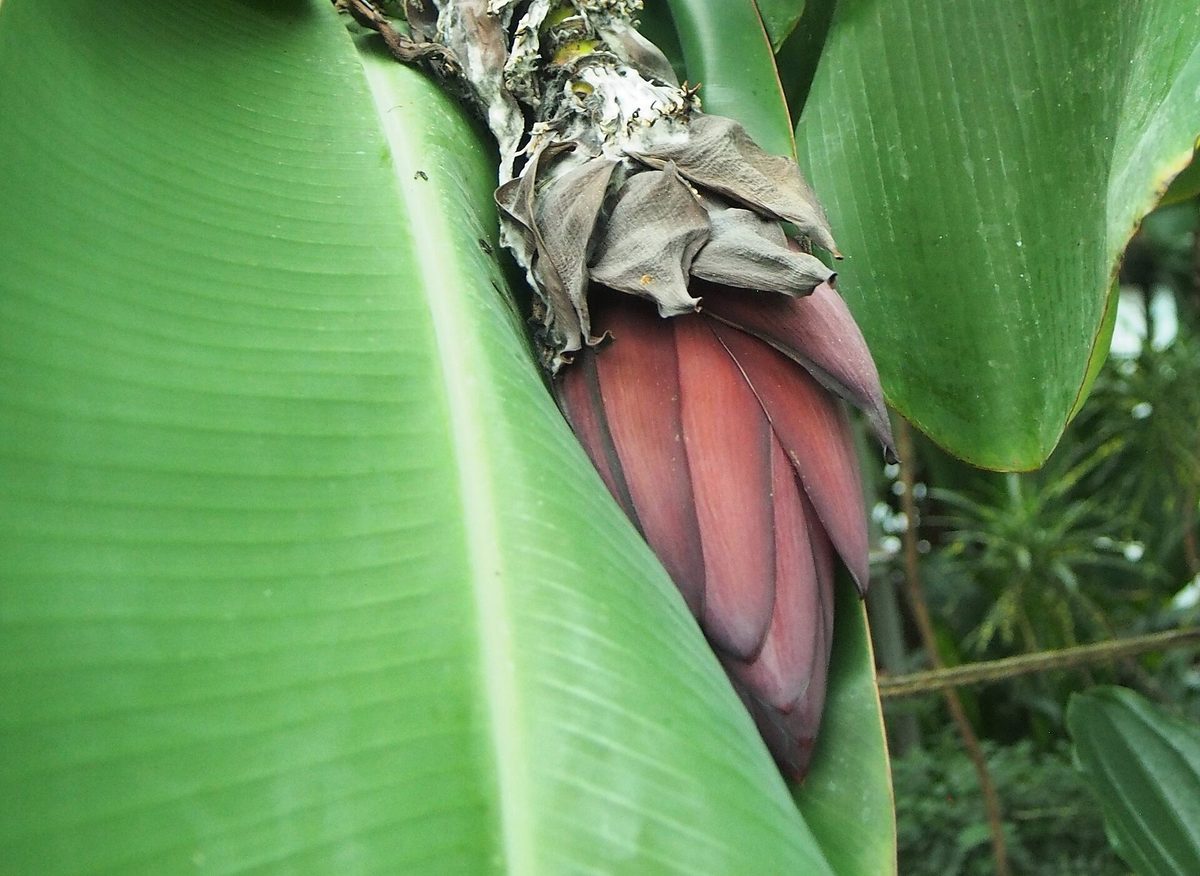
Photo: Agnieszka Kwiecień, Nova, CC BY-SA 4.0 via Wikimedia Commons

Quick facts
| Light: | Direct sun; tolerates bright, indirect light11 source |
|---|---|
| Water: | Medium to wet21 source |
| Soil: | Well drained and moist; pH 6–73451 source |
| Minimum temperature: | 28.4 °F (-2 °C)61 source |
| Size: | 8 ft (2.44 m) × 6–10 ft (1.83–3.05 m)11431 source |
| Growth rate: | Rapid431 source |
| Bloom: | Yellow, brown and white431 source |
| Cats: | Non-toxic to cats 104 |
| Dogs: | Non-toxic to dogs 104 |
| Native range: | BAN, BOR, CHC, CHS, IND, JAW, LAO, LSI, MLY, MYA, PHI, SRL, SUL, SUM, THA, VIE12 |
| Family: | Musaceae |
How much light does an Edible Banana need?
Outdoors, full sun is preferred, and the plant also accepts part shade. Full sun means six or more hours of direct sunlight a day. Indoors, the stored preference is direct sun. Bright, indirect light is tolerated, and warm temperatures are listed alongside it. Planting in full sun is advised for the best growth and fruit production.
- Light: Direct sun; tolerates bright, indirect light1
How often to water an Edible Banana
Water needs fall between medium and wet. The recorded range runs from medium at the dry end to wet at the other. The soil should not be allowed to dry out, and the same source tells you to fertilize regularly. Outdoors, banana plants do best in organically rich, moist, well-drained soil in full sun.
- Water: Medium to wet2
Best soil for an Edible Banana
Choose a soil that is both well drained and moist. Outdoors, banana plants do best in organically rich, moist, well-drained soil in full sun. The recommended soil pH is in the range of 6 to 7. A pH of 6 is the low end of that range, and 7 is the high end. Water needs run from medium to wet, and the soil should not dry out.
Temperature and humidity
Temperatures below 28 °F (-2 °C) may kill the plant to the ground. It is rated for USDA zones 10a to 11b. Humidity should be high. If good light is available, place the plant in a high humidity area. You can also group plants together. Warm temperatures are listed alongside bright, indirect light for indoor growing. No cited source records a maximum temperature.
Fertilizing an Edible Banana
Frequent feeding is the pattern here, with fertilizer applied 4 to 6 times for maximum production. Iowa State University Extension advises feeding plants every week with a water-soluble fertilizer. The record classes the plant as a heavy feeder. Fertilize regularly, and do not let the soil dry out.
How to propagate an Edible Banana
New banana plants come from seed, offsets or division. The University of Florida IFAS Extension says the most common propagation material is suckers, or pieces of the rhizome. Seed is also listed by the NC State Extension Gardener Plant Toolbox. That gives you three methods to choose from: seed, offsets and division.
Common problems
Aphids, spider mites, mealybugs and scale are the ones to watch for on houseplants. Sugarcane weevil, burrowing nematode, banana stem weevil and banana moth are also recorded. Recorded diseases are anthracnose, mosaic virus, panama disease, black sigatoka, bunchy top virus and xanthomonas wilt. Black sigatoka is described as an important leaf disease in Florida.
| Problem | Kind |
|---|---|
| Aphids | Pest |
| Spider mites | Pest |
| Mealybugs | Pest |
| Scale insects | Pest |
| Sugarcane weevil | Pest |
| Burrowing nematode | Pest |
| Banana stem weevil | Pest |
| Banana moth | Pest |
| Anthracnose | Disease |
| Mosaic virus | Disease |
| Panama disease | Disease |
| Black sigatoka | Disease |
| Bunchy top virus | Disease |
| Xanthomonas wilt | Disease |
Is Edible Banana toxic to cats and dogs?
For cats, the ASPCA Animal Poison Control Center lists this edible banana as non-toxic. For dogs, the ASPCA listing for this plant is also non-toxic. NC State Extension Gardener Plant Toolbox tags the plant as non-toxic for cats. It tags the plant as non-toxic for dogs in the same way. Cats and dogs get the same listing from the ASPCA and from NC State.
Recommended supplies
- Light: direct sun for several hours; indoors that means an unobstructed south window or a grow light.
- Soil: a free-draining mix, and a pot with a drainage hole.
- Humidity: it wants humid air; a pebble tray or a humidifier is the usual fix.
Questions and answers
- Is the edible banana toxic to cats and dogs?
- The ASPCA lists it as non-toxic to both cats and dogs. NC State Extension Gardener Plant Toolbox tags it as non-toxic for cats and as non-toxic for dogs as well.
- How much light does a banana plant need?
- Outdoors it prefers full sun, meaning six or more hours of direct sunlight a day, and it accepts part shade. Indoors the stored preference is direct sun, with bright, indirect light tolerated. Full sun is advised for the best growth and fruit production.
- What temperature and humidity does an edible banana want?
- Temperatures below 28 °F (-2 °C) may kill the plant to the ground. It is rated for USDA zones 10a to 11b. Humidity should be high, and grouping plants together is one way to raise it.
Sources
- Iowa State University Extension and Outreach (Yard and Garden). https://yardandgarden.extension.iastate.edu/how-to/planting-and-caring-tender-perennials. Accessed 14 October 2026.
- NC State Extension Gardener Plant Toolbox. https://plants.ces.ncsu.edu/plants/musa-acuminata. Accessed 14 October 2026.
- NC State Extension Gardener Plant Toolbox. https://plants.ces.ncsu.edu/plants/musa-acuminata/common-name/edible-banana/. Accessed 14 October 2026.
- NC State Extension Gardener Plant Toolbox. https://plants.ces.ncsu.edu/plants/musa-acuminata/. Accessed 14 October 2026.
- Penn State Extension. https://extension.psu.edu/programs/master-gardener/counties/adams/news/banana-plant-a-bold-and-beautiful-tropical-addition-to-the-garden. Accessed 14 October 2026.
- University of Florida IFAS Extension (EDIS/Ask IFAS). https://ask.ifas.ufl.edu/publication/MG040. Accessed 14 October 2026.
- University of Illinois Extension. https://extension.illinois.edu/blogs/ilriverhort/2018-09-04-go-tropical-ornamental-bananas. Accessed 28 October 2026.
- University of Florida IFAS Extension (EDIS/Ask IFAS). https://ask.ifas.ufl.edu/mg040. Accessed 14 October 2026.
- EPPO Global Database. https://gd.eppo.int/taxon/MUBAC/pests. Accessed 14 October 2026.
- ASPCA Animal Poison Control Center. https://www.aspca.org/pet-care/aspca-poison-control/toxic-and-non-toxic-plants/edible-banana. Accessed 14 October 2026.
- Chicago Botanic Garden. https://www.chicagobotanic.org/plant-information/plant-finder/musa-acuminata-dwarf-cavendish-blood-banana. Accessed 15 October 2026.
- Royal Botanic Gardens, Kew (World Checklist of Vascular Plants). https://sftp.kew.org/pub/data-repositories/WCVP/wcvp.zip. Accessed 4 June 2026.
How this page was made
- Written with AI assistance from the sources listed on this page. AI is never the source of a fact.