White Mulberry (Morus alba)
Formerly Morus multicaulis, Morus kaki, Morus lhou
Give white mulberry a spot with full sun to part shade, and water it when the soil dries partway between waterings. The ASPCA lists this plant as non-toxic to cats and dogs. It tolerates some drought and some wet soil once established, so a missed watering rarely causes harm.
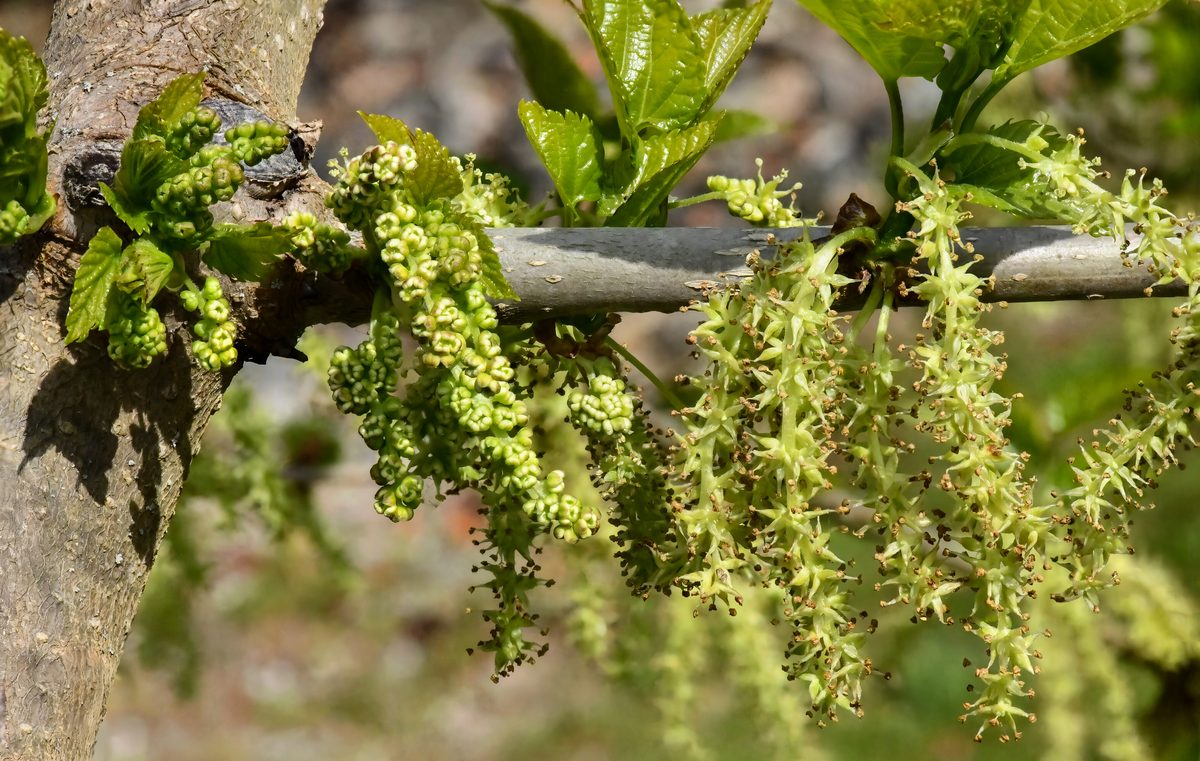
Photo: Didier Descouens, CC BY-SA 4.0 via Wikimedia Commons

Quick facts
| Light: | Full sun and part shade (full sun preferred)12 |
|---|---|
| Water: | Dry to wet11 source |
| Soil: | Well drained, occasionally dry and occasionally wet; pH 5–821 |
| Hardiness: | Zones 4a–8b11 source |
| Size: | 30–50 ft (9.14–15.24 m) × 30–50 ft (9.14–15.24 m)241 |
| Growth rate: | Rapid1515 |
| Bloom: | Yellow and green11 source |
| Cats: | Non-toxic to cats 31 |
| Dogs: | Non-toxic to dogs 31 |
| Native range: | CHC, CHN6 |
| Family: | Moraceae |
How much light does a White Mulberry need?
White mulberry does best with full sun for most of the day. Aim for a spot that gets direct light for several hours, since that is the preferred condition for this tree. It also tolerates part shade, so a site with some shade during the day still supports healthy growth. Full sun remains the better choice when you have one, because it is the condition the tree is listed as preferring over part shade. If your yard only offers partial shade, the tree can still grow there, just know that full sun is the stronger option.
How often to water a White Mulberry
This tree's water needs sit between dry-to-medium and medium-wet, so it tolerates a fairly wide range of soil moisture. Check the soil near the root zone before you water again, and let the top few inches dry out some between waterings. Established trees handle short dry spells without much trouble, since their tolerance runs from dry to medium moisture. They also handle soil on the wetter side, up to medium-wet, without extra care. Avoid soil that stays soaked for long stretches, since that sits outside the tolerance range this tree is documented to handle.
- Water: Dry to wet1
Best soil for a White Mulberry
Good drainage matters most for this tree, but it also tolerates soil that runs occasionally dry or occasionally wet. That range covers most garden soil, as long as water does not sit on the surface for long periods. Soil pH can run from 5 to 8, which spans strongly acidic to fairly alkaline ground. That wide range means most native soils will suit this tree without added amendments.
Hardiness and temperature
White mulberry is documented as hardy in USDA zones 4a through 8b. That range spans cold winters near zone 4a to mild winters near zone 8b. Gardeners at the cold end of that range should expect hard freezes most winters. Near the warm end, in zone 8b, winters stay mild and bring little cold stress. No cited source lists an exact minimum winter temperature for this species. Use the zone range as your guide, and check your local zone before you plant. If your site sits colder than zone 4a, a sheltered spot can help the tree survive winter.
- Hardiness: Zones 4a–8b1
How to plant a White Mulberry
Choose a planting site that falls within this tree's hardy range of USDA zones 4a through 8b. If you garden in zone 4a, pick a sheltered spot that stays out of harsh winter wind. If you garden in zone 8b, the tree should handle the milder local winters without extra protection. Gardeners in zones between those two, such as zone 6, sit comfortably within the tree's documented range. Check your zone before you plant, since a site colder than zone 4a falls outside the range this tree is documented to tolerate.
- Hardiness: Zones 4a–8b1
Winter care
This tree's hardiness rating covers USDA zones 4a through 8b. In that range, it should handle typical local winter lows without extra help. No cited source gives an exact minimum temperature this tree can survive. Use your USDA zone instead to judge whether winter here suits this tree. Near zone 4a, the cold edge of that range, mulch the base of the trunk. Avoid a spot fully exposed to winter wind at that cold edge. Near zone 8b, the warm edge, winters stay mild enough that little extra care is needed.
- Hardiness: Zones 4a–8b1
How to propagate a White Mulberry
You can start new white mulberry trees from seed or by layering an existing branch. Seed-grown trees take longer to reach a usable size, but they work well if you want several trees at once. Layering means bending a low branch to the ground and letting it root while still attached to the parent tree. Once that layered section has rooted on its own, you can cut it free and move it to its new spot.
- Propagation: Seed and layering1
Common problems
Watch for borers, whiteflies, scales, mealybugs, and foliage-feeding caterpillars on this tree. Nematodes in the soil can also affect its roots. On the disease side, bacterial blight, coral spot canker, armillaria root rot, wetwood, and wood decay are all documented problems for white mulberry.
| Problem | Kind |
|---|---|
| Borers | Pest |
| Whiteflies | Pest |
| Scales | Pest |
| Mealybugs | Pest |
| Foliage feeding caterpillars | Pest |
| Nematodes | Pest |
| Bacterial blight | Disease |
| Coral spot canker | Disease |
| Armillaria root rot | Disease |
| Wetwood | Disease |
| Wood decay | Disease |
Is White Mulberry toxic to cats and dogs?
The ASPCA lists white mulberry as non-toxic to cats. The same ASPCA listing marks it as non-toxic to dogs. Both ratings come from the ASPCA Animal Poison Control Center's records for this plant. That means the ASPCA does not classify any part of this tree, including its fruit and leaves, as poisonous to cats. The same holds for dogs, whether they chew on the leaves, bark, or fallen fruit.
Recommended supplies
- Soil: a free-draining mix, and a pot with a drainage hole.
Questions and answers
- Is white mulberry toxic to cats or dogs?
- The ASPCA lists white mulberry as non-toxic to both cats and dogs. That rating comes from the ASPCA Animal Poison Control Center's own records for this plant.
- What USDA zones can white mulberry survive in?
- White mulberry is documented as hardy in USDA zones 4a through 8b. That range spans cold-winter areas near zone 4a to much milder areas near zone 8b.
- How should I propagate white mulberry?
- You can grow new white mulberry trees from seed or by layering a low branch. Layering involves rooting a branch while it is still attached to the parent tree, then cutting it free once roots form.
Sources
- NC State Extension Gardener Plant Toolbox. https://plants.ces.ncsu.edu/plants/morus-alba/. Accessed 24 September 2026.
- Cornell University CALS Woody Plants Database. https://woodyplants.cals.cornell.edu/plant/156. Accessed 24 September 2026.
- ASPCA Animal Poison Control Center. https://www.aspca.org/pet-care/aspca-poison-control/toxic-and-non-toxic-plants/mulberry-tree. Accessed 24 September 2026.
- Utah State University Extension. https://extension.usu.edu/treebrowser/catalog/mulberry-white. Accessed 21 October 2026.
- USDA Forest Service Fire Effects Information System. https://www.fs.usda.gov/database/feis/plants/tree/moralb/all.html. Accessed 24 September 2026.
- Royal Botanic Gardens, Kew (World Checklist of Vascular Plants). https://sftp.kew.org/pub/data-repositories/WCVP/wcvp.zip. Accessed 4 June 2026.
How this page was made
- Written with AI assistance from the sources listed on this page. AI is never the source of a fact.