Bear's Breech (Acanthus mollis)
Formerly Acanthus niger, Acanthus hispanicus, Acanthus latifolius
Plant bear's breech where it gets full sun or part shade, and keep the soil well drained. Its water needs run from dry to medium. No cited source records whether this plant is toxic to cats or to dogs, so its pet toxicity is not documented on this page.
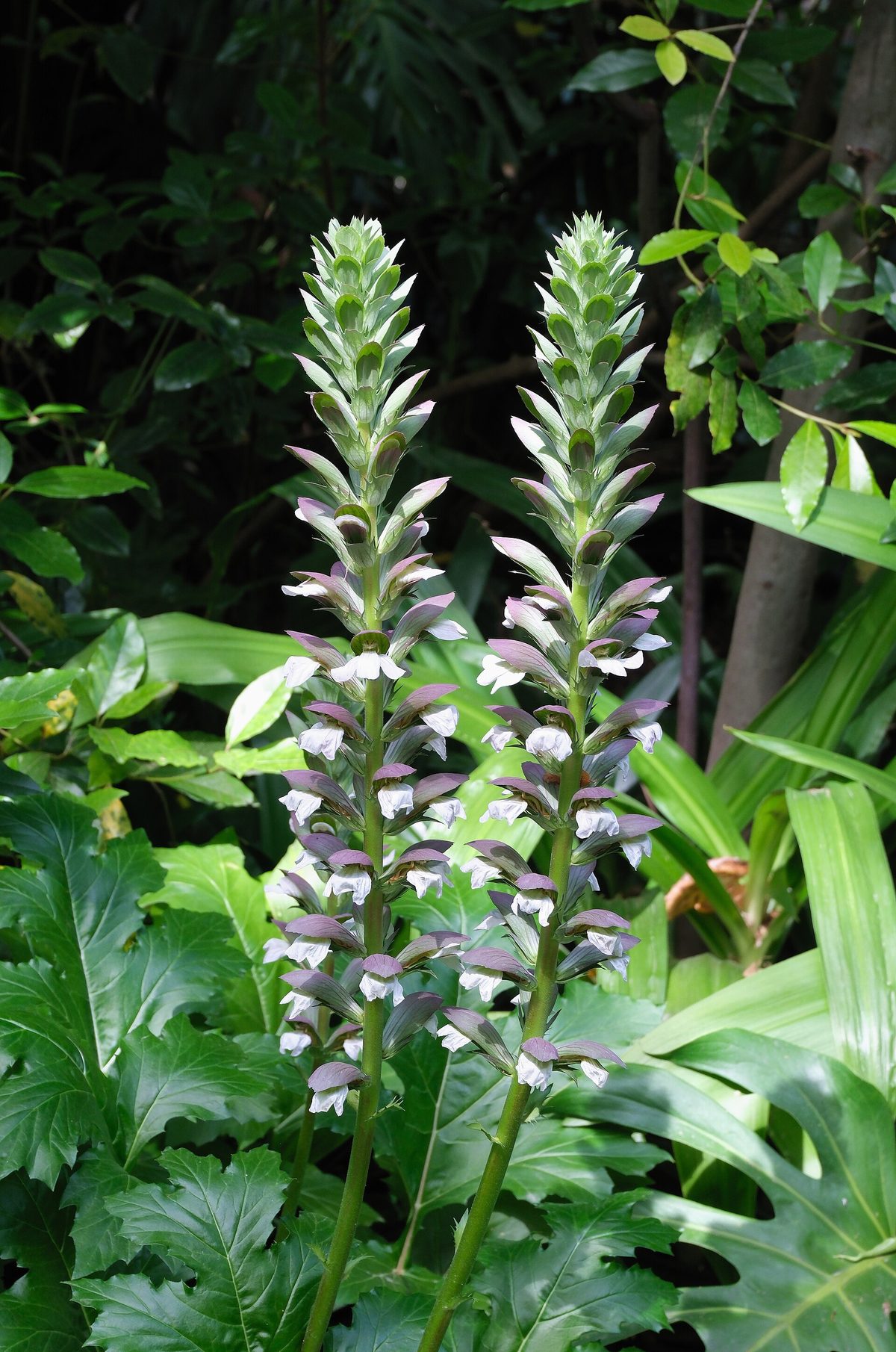
Photo: Alvesgaspar, CC BY-SA 4.0 via Wikimedia Commons

Quick facts
| Light: | Full sun and part shade (full sun preferred)12 |
|---|---|
| Water: | Dry to medium11 source |
| Soil: | Well drained11 source |
| Hardiness: | Zones 7a–10b11 source |
| Size: | 4–6 ft (1.22–1.83 m) × 2–3 ft (0.61–0.91 m)11 source |
| Growth rate: | Rapid111 source |
| Bloom: | White and purple11 source |
| Cats: | Not documented by major sources |
| Dogs: | Not documented by major sources |
| Native range: | ALG, EAI, GRC, ITA, LBS, MOR, SAR, SIC, TUE, TUN, TUR, YUG3 |
| Family: | Acanthaceae |
How much light does a Bear's Breech need?
Sunlight for this plant ranges from full sun to partial shade, and full sun is the preferred setting. In hot climates it does better with some shade, which prevents leaf scorch. Partial shade here means direct sunlight for only part of the day, between 2 and 6 hours. The minimum recorded is 2 hours of direct sun each day.
How often to water a Bear's Breech
Moisture needs for this plant run from dry to medium. If it is not irrigated, the plant may go dormant in summer. It is also listed as drought tolerant. Wet soil does not suit it, because the plant tolerates most soil types except wet ones. Well-drained soil is the preferred setting, and it is the drainage class on record.
- Water: Dry to medium1
Best soil for a Bear's Breech
Fertile, well-drained soil is what this plant prefers. It tolerates most soil types, with wet soils as the exception. Clay soil is among its listed tolerances, as is drought. Fertile ground with good drainage gives it the setting that the source describes. No cited source gives a preferred soil pH, so that value is not documented.
- Soil drainage: Well drained1
Hardiness and temperature
Hardiness zones 7a to 10b are listed for this plant. The zones 7a, 7b, 8a, 8b, 9a, 9b, 10a and 10b are all named in the record. In hot climates, some shade prevents leaf scorch. No cited source records a minimum temperature, so that value is not documented. No humidity preference is recorded either.
- Hardiness: Zones 7a–10b1
How to plant a Bear's Breech
Planting suits USDA zones 7a to 10b. Choose a spot with full sun or part shade. Pick well-drained soil, since the plant tolerates most soil types except wet ones. Allow 2 to 3 ft (0.61–0.91 m) of width for each plant. Plan for a height of 4 to 6 ft (1.22–1.83 m), which includes the plant in bloom. Its growth rate is listed as rapid. In the contiguous United States it is recorded as introduced rather than native.
- Hardiness: Zones 7a–10b1
Winter care
Hardiness extends down to zone 7a on the cold side. The warm end of the range is zone 10b. The plant is recorded as a herbaceous perennial. No cited source records a minimum temperature, so a specific cold limit is not documented. No winter protection method is documented for it either.
- Hardiness: Zones 7a–10b1
How to propagate a Bear's Breech
Propagate bear's breech by seed, division or root cuttings. Division and root cuttings are done in early spring. Growing from seeds also works. The species has a rapid growth rate. A mature plant is 2 to 3 ft (0.61–0.91 m) wide and stands 4 to 6 ft (1.22–1.83 m) tall.
- Propagation: Seed, division and root cuttings1
Common problems
Two kinds of pest are recorded for this plant, snails and slugs, and both are described as occasional problems. Powdery mildew is the disease listed, and it is described as an occasional one. No other pest or disease is documented on this page for the species.
| Problem | Kind |
|---|---|
| Snails | Pest |
| Slugs and snails | Pest |
| Powdery mildew | Disease |
Is Bear's Breech toxic to cats and dogs?
Recommended supplies
- Soil: a free-draining mix, and a pot with a drainage hole.
Questions and answers
- Does bear's breech need full sun?
- It grows in full sun to partial shade, and full sun is the preferred setting. Some shade in hot climates prevents leaf scorch. Partial shade means direct sunlight for only part of the day, between 2 and 6 hours.
- Is bear's breech native to the United States?
- In the contiguous United States it is recorded as introduced. Its native range is recorded under the region codes ALG, EAI, GRC, ITA, LBS, MOR, SAR, SIC, TUE, TUN, TUR and YUG.
- What problems affect bear's breech?
- Snails and slugs are occasional problems for this plant. Powdery mildew is an occasional disease. Wet soil does not suit it, since it tolerates most soil types except wet ones.
Sources
- NC State Extension Gardener Plant Toolbox. https://plants.ces.ncsu.edu/plants/acanthus-mollis/. Accessed 13 October 2026.
- Clemson Cooperative Extension Home & Garden Information Center. https://hgic.clemson.edu/factsheet/plants-that-tolerate-drought/. Accessed 13 October 2026.
- Royal Botanic Gardens, Kew (World Checklist of Vascular Plants). https://sftp.kew.org/pub/data-repositories/WCVP/wcvp.zip. Accessed 4 June 2026.
How this page was made
- Written with AI assistance from the sources listed on this page. AI is never the source of a fact.