Greater Burdock (Arctium lappa)
Formerly Lappa vulgaris, Bardana lappa, Arcion majus
Give greater burdock full sun and a medium amount of water. Part shade is also accepted. Choose well drained soil for it. The listed hardiness range is USDA zones 3a to 10b. It is a herbaceous perennial with a rapid growth rate. Its flowers are purple. Toxicity to cats and dogs is not documented on this page.
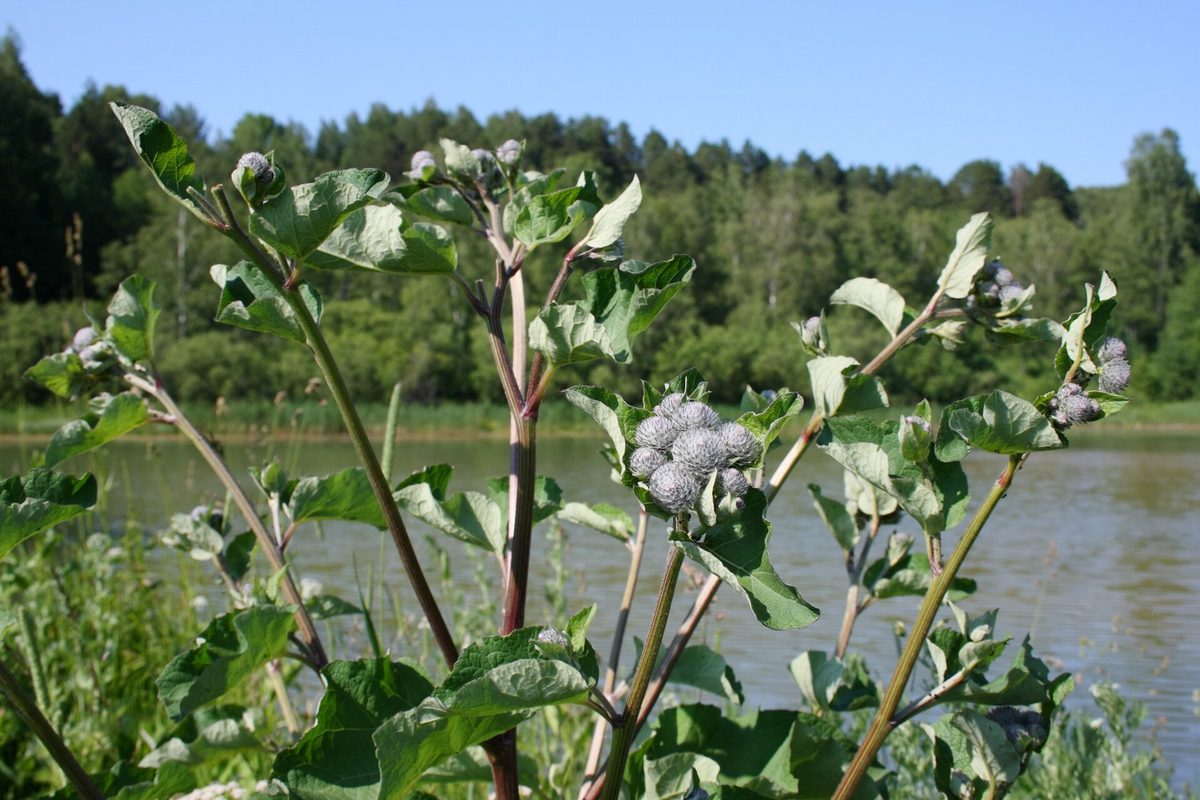
Photo: Ilya Plekhanov, CC BY-SA 3.0 via Wikimedia Commons

Quick facts
| Light: | Full sun and part shade (full sun preferred)11 source |
|---|---|
| Water: | Medium11 source |
| Soil: | Well drained11 source |
| Hardiness: | Zones 3a–10b11 source |
| Size: | 2–10 ft (0.61–3.05 m) × 2–4 ft (0.61–1.22 m)11 source |
| Growth rate: | Rapid11 source |
| Bloom: | Purple11 source |
| Cats: | Not documented by major sources |
| Dogs: | Not documented by major sources |
| Native range: | AFG, ALB, ALT, AUT, BAL, BGM, BLR, BLT, BUL, CBD, CHC, CHH, CHI, CHM, CHN, CHQ, CHS, CHT, CHX, COR, CYP, CZE, DEN, EAI, EHM, FIN, FOR, FRA, GER, GNL, GRC, HUN, ICE, IRN, IRQ, ITA, JAP, KAZ, KGZ, KOR, KRA, KRI, KRY, LAO, LBS, MLY, MYA, NCS, NEP, NET, NOR, PAK, PAL, POL, POR, ROM, RUC, RUE, RUN, RUS, RUW, SAR, SIC, SIN, SPA, SVA, SWE, SWI, TAI, TCS, TKM, TUE, TUR, TZK, UKR, UZB, VIE, WHM, WSB, YUG3 |
| Family: | Asteraceae |
How much light does a Greater Burdock need?
Greater burdock accepts full sun or part shade, and full sun is the preferred choice. Full sun means 6 or more hours of direct sunlight a day. Part shade means direct sun for only part of the day, between 2 and 6 hours. The lowest amount recorded for this plant is 2 hours a day.
How often to water a Greater Burdock
Medium is the recorded water need for greater burdock. The source describes it as preferring moist, well drained soil in a full sun location. Both the minimum and the maximum water level are recorded as medium, so the facts give no separate range for dry or wet conditions. No watering schedule in days is documented for this plant.
- Water: Medium1
Best soil for a Greater Burdock
Choose well drained soil for this plant. The source adds that it prefers moist soil rich in organic matter and nitrogen. A good drainage rating is listed for it. Well drained is the only drainage class recorded. Root rot is among the diseases the source lists for this plant.
- Soil drainage: Well drained1
Hardiness and temperature
The recorded hardiness range runs from USDA zone 3a to zone 10b. That covers every half-zone step between them, from 3a and 3b up through 10a and 10b. Zone 3a is the coldest end of the range and zone 10b is the warmest. Both ends, 3a and 10b, count as inside the listed range.
- Hardiness: Zones 3a–10b1
How to plant a Greater Burdock
Leave room for a spread of 2 to 4 ft (0.61 to 1.22 m). Mature height runs from 2 to 10 ft (0.61 to 3.05 m), and the habit is erect. Pick a spot in USDA zones 3a to 10b. Full sun is preferred, and the soil should be well drained. The growth rate is rapid. The flowers are purple. Greater burdock is listed as introduced in the lower 48 states and in Hawaii.
- Hardiness: Zones 3a–10b1
Winter care
Zone 3a is the coldest end of the recorded hardiness range for greater burdock. Zone 10b is the warmest end of that same range. Anyone growing in zones 3a through 10b falls inside the range the source lists. The species is listed as a herbaceous perennial, and its habit is erect.
- Hardiness: Zones 3a–10b1
How to propagate a Greater Burdock
Seed is the recorded propagation method for greater burdock. Cultivated plants are sown from seed, and the first-year roots are harvested before they become too fibrous. The source places that root harvest by late autumn. The plant is a herbaceous perennial, and seed is the only method listed. Rapid growth is recorded for the species.
- Propagation: Seed1
Common problems
Five pests are recorded for greater burdock: Liriomyza huidobrensis, Lycorma delicatula, Meloidogyne mali, Nemorimyza maculosa and Spodoptera praefica. The source says the plant is susceptible to powdery mildew and root rot. That susceptibility carries potential to impact agricultural plants. Other recorded diseases are Phymatotrichopsis omnivora, Xanthomonas hortorum pv. gardneri, tobacco ringspot virus, tomato spotted wilt virus and tobacco rattle virus.
- Common pests: liriomyza huidobrensis, lycorma delicatula, meloidogyne mali, nemorimyza maculosa and spodoptera praefica2
- Common diseases: powdery mildew, root rot, phymatotrichopsis omnivora, xanthomonas hortorum pv gardneri, tobacco ringspot virus, tomato spotted wilt virus and tobacco rattle virus12
| Problem | Kind |
|---|---|
| Liriomyza huidobrensis | Pest |
| Lycorma delicatula | Pest |
| Meloidogyne mali | Pest |
| Nemorimyza maculosa | Pest |
| Spodoptera praefica | Pest |
| Powdery mildew | Disease |
| Root rot | Disease |
| Phymatotrichopsis omnivora | Disease |
| Xanthomonas hortorum pv gardneri | Disease |
| Tobacco ringspot virus | Disease |
| Tomato spotted wilt virus | Disease |
| Tobacco rattle virus | Disease |
Is Greater Burdock toxic to cats and dogs?
Recommended supplies
- Soil: a free-draining mix, and a pot with a drainage hole.
Questions and answers
- Does greater burdock need full sun?
- Full sun is preferred, meaning 6 or more hours of direct sunlight a day. It also accepts part shade, which is direct sun for only part of the day. The lowest amount recorded is 2 hours a day. Medium water and well drained soil go with that site.
- How big does greater burdock grow, and what color are the flowers?
- Mature height is recorded as 2 to 10 ft (0.61 to 3.05 m). The spread is 2 to 4 ft (0.61 to 1.22 m), and the habit is erect. The growth rate is rapid. The flowers are purple.
- Can I grow greater burdock from seed?
- Seed is the recorded propagation method. Cultivated plants are sown from seed, and the first-year roots are harvested before they become too fibrous. It is recorded as a herbaceous perennial that grows rapidly.
Sources
- NC State Extension Gardener Plant Toolbox. https://plants.ces.ncsu.edu/plants/arctium-lappa/. Accessed 15 October 2026.
- EPPO Global Database. https://gd.eppo.int/taxon/ARFLA/pests. Accessed 15 October 2026.
- Royal Botanic Gardens, Kew (World Checklist of Vascular Plants). https://sftp.kew.org/pub/data-repositories/WCVP/wcvp.zip. Accessed 4 June 2026.
How this page was made
- Written with AI assistance from the sources listed on this page. AI is never the source of a fact.