Lawndaisy (Bellis perennis)
Formerly Erigeron perennis, Aster bellis, Bellis alpina
Give lawndaisy full sun, with part shade as the alternative. Keep it in medium to wet conditions. It is not drought tolerant. Zones 4a to 8b are listed for it. It stays low, at 0.3 to 0.5 ft (0.08–0.15 m) tall. It is described as a rapid grower. No cited source documents its toxicity to cats or to dogs.
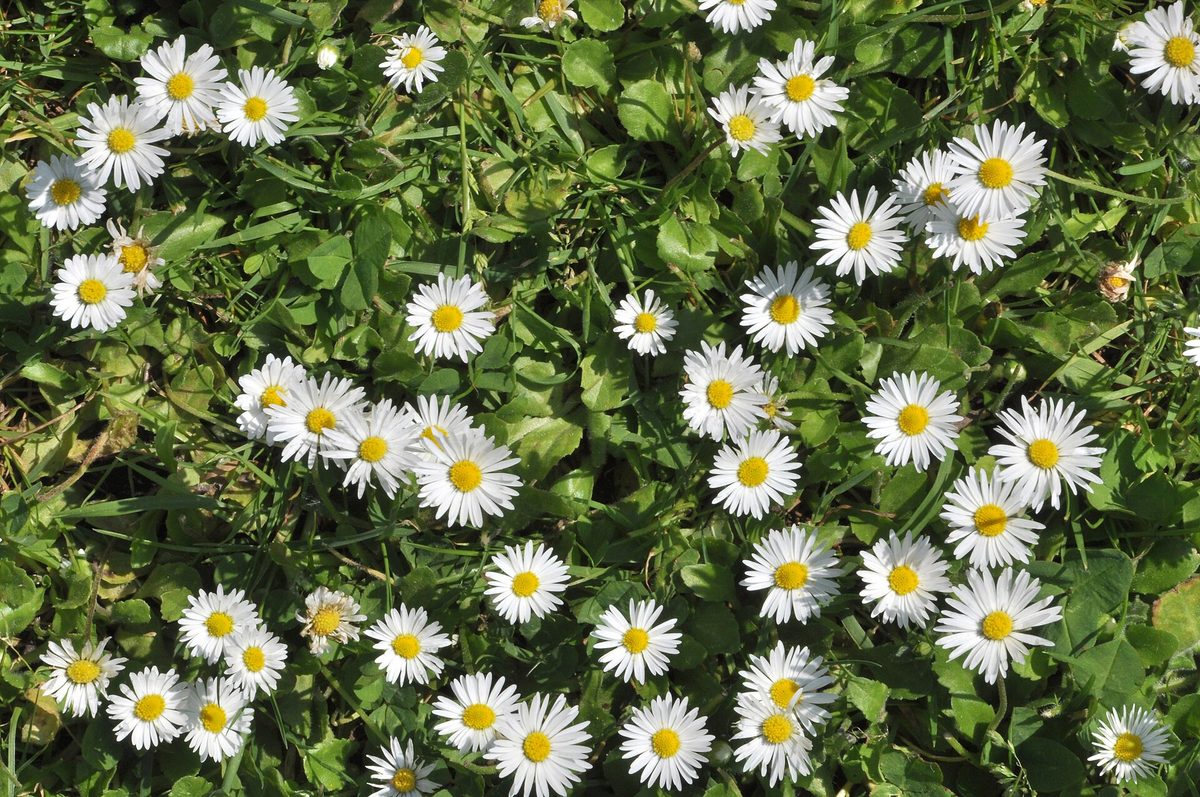
Photo: Marc Ryckaert (MJJR), CC BY 3.0 via Wikimedia Commons

Quick facts
| Light: | Full sun and part shade (full sun preferred)11 source |
|---|---|
| Water: | Medium to wet21 source |
| Soil: | Well drained and moist21 source |
| Hardiness: | Zones 4a–8b21 source |
| Size: | 0.3–0.5 ft (0.08–0.15 m) × 0.3–0.8 ft (0.08–0.23 m)21 source |
| Growth rate: | Rapid21 source |
| Bloom: | May–Jul, Blue, yellow, pink, purple, red and white211 source |
| Cats: | Not documented by major sources |
| Dogs: | Not documented by major sources |
| Native range: | ALB, AUT, BAL, BGM, BLR, BLT, BUL, COR, CYP, CZE, DEN, EAI, FRA, GER, GRB, GRC, HUN, IRE, IRN, IRQ, ITA, KAZ, KGZ, KRI, KRY, LBS, MDR, MOR, NCS, NET, NOR, PAL, POL, POR, ROM, RUC, RUE, RUN, RUS, RUW, SAR, SIC, SPA, SWE, SWI, TCS, TKM, TUE, TUN, TUR, TZK, UKR, UZB, YUG4 |
| Family: | Asteraceae |
How much light does a Lawndaisy need?
Lawndaisy takes full sun or part shade outdoors, and full sun is the preferred setting. One source describes the species as often found growing in moist, fertile soils in full sun or partial shade. Choose a spot with full sun first, and use part shade as your second choice.
- Light: Full sun and part shade (full sun preferred)1
How often to water a Lawndaisy
Plan on medium to wet conditions for lawndaisy outdoors. The species is not drought tolerant. The listed range stretches from medium at the dry end to wet at the other. Its soil is listed as well drained and moist. The soil drainage entry reads good drainage.
- Water: Medium to wet2
Best soil for a Lawndaisy
Good drainage is the soil quality named for lawndaisy. Its soil is listed as both well drained and moist. One source describes the plant as often found growing in moist, fertile soils. The plant is also listed as liking heavy fertility. Soil moisture should sit within the medium to wet range for this species. The cited sources give no preferred soil pH, so this page states no pH range.
- Soil drainage: Well drained and moist2
Hardiness and temperature
Lawndaisy is listed for USDA zones 4a to 8b. Zone 4a is the cold end of that range, and zone 8b is the warm end. The listing steps through 4a, 4b, 5a, 5b and on to 8a and 8b. Within those zones the plant still needs medium to wet conditions.
- Hardiness: Zones 4a–8b2
Fertilizing a Lawndaisy
Lawndaisy is listed as a heavy feeder. A source for the species says it likes heavy fertility. The same species is described as a rapid grower. It is also often found growing in moist, fertile soils, according to one source. The record states how often it feeds only as heavy feeder.
- Fertilizer: Heavy feeder2
How to plant a Lawndaisy
Zones 4a through 8b are the listed range for planting lawndaisy. Choose a spot with full sun, or part shade if that is what you have. Leave room for a mature spread of 0.3 to 0.8 ft (0.08–0.23 m). The plant reaches 0.3 to 0.5 ft (0.08–0.15 m) tall. One source gives seed or division in spring and planting in fall. The bed should be well drained and moist.
- Hardiness: Zones 4a–8b2
Winter care
In zones 4a through 8b, lawndaisy is listed as hardy. Places colder than zone 4a fall outside that range. Places warmer than zone 8b also fall outside it. The plant is a herbaceous perennial. Check your own zone against the 4a to 8b range before you plant.
- Hardiness: Zones 4a–8b2
How to propagate a Lawndaisy
You can propagate lawndaisy by seed or by division. The source for the species gives both methods and ties them to spring. It adds that the plant goes in the ground in fall. Lawndaisy is a herbaceous perennial. Its mature spread is 0.3 to 0.8 ft (0.08–0.23 m). Seed and division are the two methods recorded here.
- Propagation: Seed and division2
Common problems
Five pests are listed: european pepper moth, root knot nematode, stem and bulb nematode, serpentine leafminer and spotted cucumber beetle. Diseases listed are rust, cotton root rot and stolbur phytoplasma. One source says root-knot nematodes, which show as galls, and rust may cause problems. The plant is reported resistant to deer.
| Problem | Kind |
|---|---|
| European pepper moth | Pest |
| Root knot nematode | Pest |
| Stem and bulb nematode | Pest |
| Serpentine leafminer | Pest |
| Spotted cucumber beetle | Pest |
| Rust | Disease |
| Cotton root rot | Disease |
| Stolbur phytoplasma | Disease |
Is Lawndaisy toxic to cats and dogs?
Recommended supplies
- Soil: a free-draining mix, and a pot with a drainage hole.
Questions and answers
- Does lawndaisy like sun or shade?
- It takes full sun or part shade, and full sun is preferred. One source describes it as often found growing in moist, fertile soils in full sun or partial shade.
- Is lawndaisy drought tolerant?
- The species is not drought tolerant, and its water need runs from medium to wet. Its soil is listed as well drained and moist. The drainage entry itself reads good drainage.
- How big does lawndaisy get?
- Mature height is 0.3 to 0.5 ft (0.08–0.15 m). Mature spread is 0.3 to 0.8 ft (0.08–0.23 m). The growth rate is listed as rapid.
Sources
- Penn State Extension. https://extension.psu.edu/lawn-and-turfgrass-weeds-english-daisy. Accessed 14 October 2026.
- NC State Extension Gardener Plant Toolbox. https://plants.ces.ncsu.edu/plants/bellis-perennis/. Accessed 14 October 2026.
- EPPO Global Database. https://gd.eppo.int/taxon/BELPE/pests. Accessed 14 October 2026.
- Royal Botanic Gardens, Kew (World Checklist of Vascular Plants). https://sftp.kew.org/pub/data-repositories/WCVP/wcvp.zip. Accessed 4 June 2026.
How this page was made
- Written with AI assistance from the sources listed on this page. AI is never the source of a fact.