Cardinalflower (Lobelia cardinalis)
Formerly Lobelia fulgens, Lobelia graminea, Lobelia cordigera
To keep cardinalflower alive, give it full sun if you can, though it also accepts part shade and full shade, and keep its soil medium to wet. The ASPCA lists the plant as toxic to cats and also toxic to dogs. It is hardy in zones 3a–9b, and it grows 4–5 ft (1.22–1.52 m) tall.
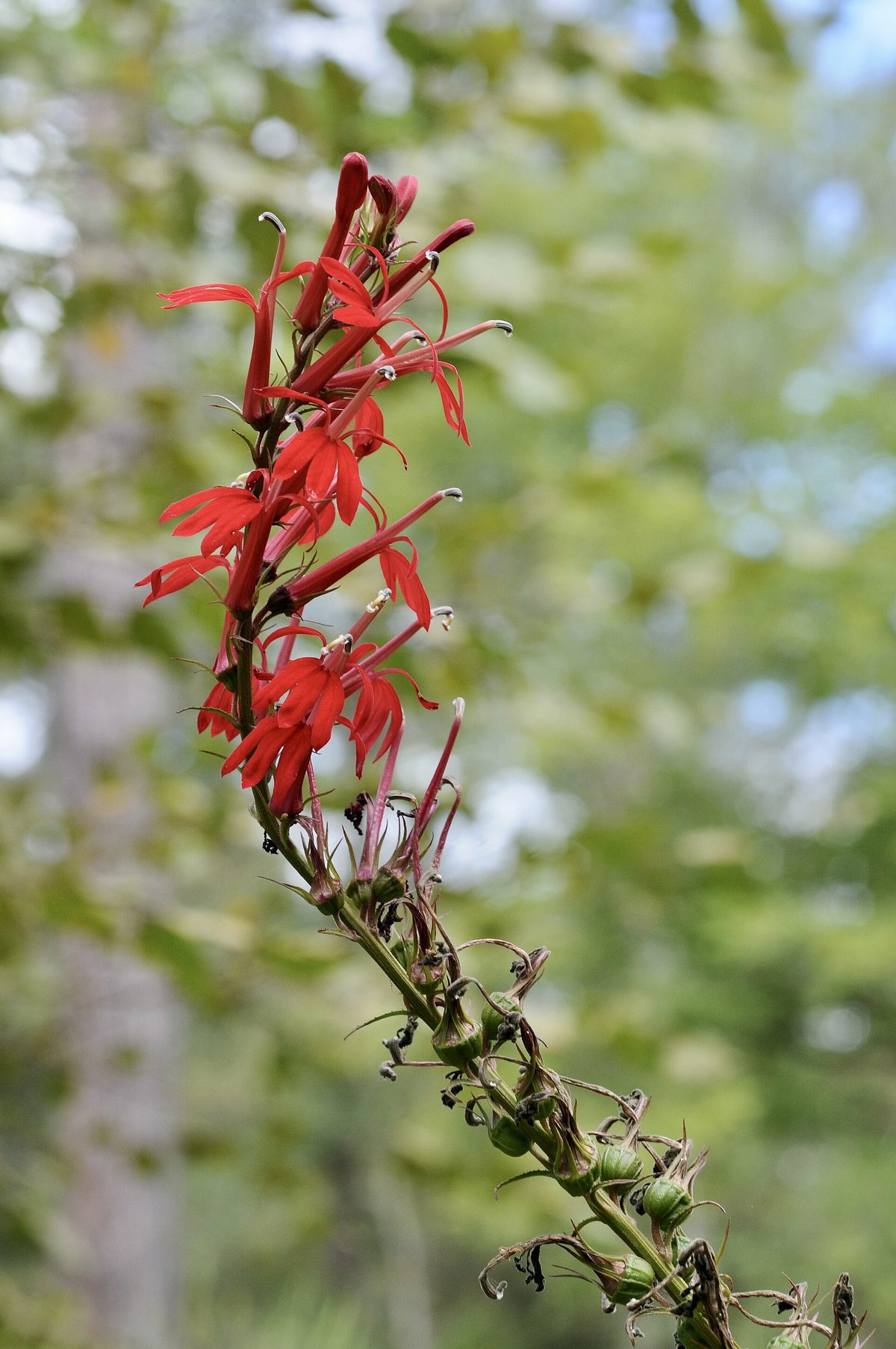
Photo: sonnia hill, CC BY 2.0 via Wikimedia Commons

Quick facts
| Light: | Full sun, part shade and full shade (full sun preferred)123 |
|---|---|
| Water: | Medium to wet24 |
| Soil: | Moist and occasionally wet24 |
| Hardiness: | Zones 3a–9b25 |
| Size: | 4–5 ft (1.22–1.52 m) × 1–2 ft (0.3–0.61 m)8241 source |
| Bloom: | Jul–Oct, Red, pink and white215941 source |
| Cats: | Toxic to cats (1 source) 7 |
| Dogs: | Toxic to dogs (1 source) 7 |
| Native range: | ALA, ARI, ARK, BLZ, CAL, CLM, CNT, COL, COS, DEL, ELS, FLA, GEO, GUA, HON, ILL, INI, IOW, KAN, KTY, LOU, MAI, MAS, MIC, MIN, MRY, MSI, MSO, MXC, MXE, MXG, MXN, MXS, MXT, NBR, NCA, NEB, NEV, NIC, NWH, NWJ, NWM, NWY, OHI, OKL, ONT, PAN, PEN, QUE, RHO, SCA, TEN, TEX, UTA, VER, VRG, WDC, WIS, WVA10 |
| Family: | Campanulaceae |
How much light does a Cardinalflower need?
Cardinalflower takes full sun, part shade or full shade outdoors. Full sun is the preferred exposure, which means six or more hours of direct sunlight a day. Part shade and full shade are also listed. That gives you a choice of spots, from an open bed to a shaded corner.
How often to water a Cardinalflower
The recorded water need for cardinalflower runs from medium to wet. The soil should never be allowed to dry out. Brief flooding is tolerated. Moderately moist to wet soil is described as where it grows best. No cited source gives a watering schedule in days, so judge by the condition of the soil instead.
Best soil for a Cardinalflower
The recorded soil drainage is moist and occasionally wet. Soil that stays moist suits the plant, and a soil that dries out does not. Organically rich soil is the type described for its best growth. It also tolerates brief flooding. Moist and occasionally wet describe the drainage, and dry soil is not among the recorded conditions. No cited source records a preferred soil pH, so this page gives none.
Hardiness and temperature
USDA hardiness zones 3a–9b are the range recorded for this plant. That range reaches from the cold end at zone 3a to the warm end at zone 9b. No cited source records a minimum temperature, so the zone range is the only cold guide here. Humidity needs are not documented either.
How to plant a Cardinalflower
Cardinalflower is recorded for USDA zones 3a to 9b. Allow for a mature height of 4–5 ft (1.22–1.52 m) and a width of 1–2 ft (0.3–0.61 m). Its habit is erect. Choose a spot with full sun if you can, and with soil that will not dry out. No cited source gives a planting time relative to frost, so this page does not name one.
Winter care
Cardinalflower is recorded as hardy from zone 3a at the cold end. Zones colder than 3a fall outside the recorded range. The plant type is recorded as herbaceous perennial. No cited source records a minimum temperature or gives winter protection steps, so this page lists none.
How to propagate a Cardinalflower
The recorded propagation methods are seed, division and layering. Layering is described as bending a stem down into the mud and fastening it with a rock or sticks. Seed, division and layering are all listed, so you have three routes to a new plant. How to divide the plant, or when to sow seed, is not documented on this page.
- Propagation: Seed, division and layering1
Common problems
Slugs and snails are the pests recorded for cardinalflower. Snails and slugs may damage the foliage. The disease recorded is tobacco ringspot virus. The virus is recorded under the name Nepovirus nicotianae for Lobelia. No cited source gives treatment steps for either problem.
| Problem | Kind |
|---|---|
| Slugs and snails | Pest |
| Snails | Pest |
| Tobacco ringspot virus | Disease |
Is Cardinalflower toxic to cats and dogs?
The ASPCA lists cardinalflower as toxic to cats. It also lists the plant as toxic to dogs. Because the listing for each animal is toxic, the position for cats and the position for dogs match. No cited source on this page states which parts of the plant are involved or how severe the effects are. This site covers cats and dogs for pet toxicity, so other animals are not addressed here.
Pet-safe alternatives
Recommended supplies
- Soil: a mix that holds moisture without staying wet.
Questions and answers
- Is cardinalflower toxic to cats and dogs?
- The ASPCA lists cardinalflower as toxic to cats and toxic to dogs. No cited source on this page names the parts involved or a severity. Cats and dogs are the only animals this site covers.
- How much sun does cardinalflower need?
- Full sun is preferred, and part shade and full shade are also listed. Full sun is described as six or more hours of direct sunlight a day. That range lets you place it in a bright bed or a shadier one.
- How big does cardinalflower grow?
- Its mature height is 4–5 ft (1.22–1.52 m), with a width of 1–2 ft (0.3–0.61 m). Its habit is erect. Its flowers are red, pink or white.
Sources
- Lady Bird Johnson Wildflower Center. https://www.wildflower.org/plants/result.php?id_plant=loca2. Accessed 14 October 2026.
- NC State Extension Gardener Plant Toolbox. https://plants.ces.ncsu.edu/plants/lobelia-cardinalis/. Accessed 14 October 2026.
- Penn State Extension. https://extension.psu.edu/rain-garden-plants-cardinal-flower. Accessed 14 October 2026.
- Clemson Cooperative Extension Home & Garden Information Center. https://hgic.clemson.edu/cardinal-flower/. Accessed 14 October 2026.
- Chicago Botanic Garden. https://www.chicagobotanic.org/plant-information/plant-finder/lobelia-cardinalis-cardinal-flower. Accessed 14 October 2026.
- EPPO Global Database. https://gd.eppo.int/taxon/LOBCA/pests. Accessed 14 October 2026.
- ASPCA Animal Poison Control Center. https://www.aspca.org/pet-care/aspca-poison-control/toxic-and-non-toxic-plants/cardinal-flower. Accessed 14 October 2026.
- NC State Extension Gardener Plant Toolbox. https://plants.ces.ncsu.edu/plants/lobelia-cardinalis/common-name/cardinal-flower/. Accessed 1 November 2026.
- University of Wisconsin-Madison Division of Extension (Wisconsin Horticulture). https://hort.extension.wisc.edu/articles/cardinal-flower-lobelia-cardinalis/. Accessed 14 October 2026.
- Royal Botanic Gardens, Kew (World Checklist of Vascular Plants). https://sftp.kew.org/pub/data-repositories/WCVP/wcvp.zip. Accessed 4 June 2026.
How this page was made
- Written with AI assistance from the sources listed on this page. AI is never the source of a fact.