Pot Marigold (Calendula officinalis)
Formerly Calendula sinuata, Caltha officinalis, Calendula eriocarpa
Give pot marigold full sun, with part shade as a tolerated alternative, and water it at a medium level. The ASPCA lists Calendula officinalis as non-toxic to cats and to dogs. Pet Poison Helpline also considers it non-toxic following ingestion. Slugs, snails, aphids and whiteflies are the pests to watch for.
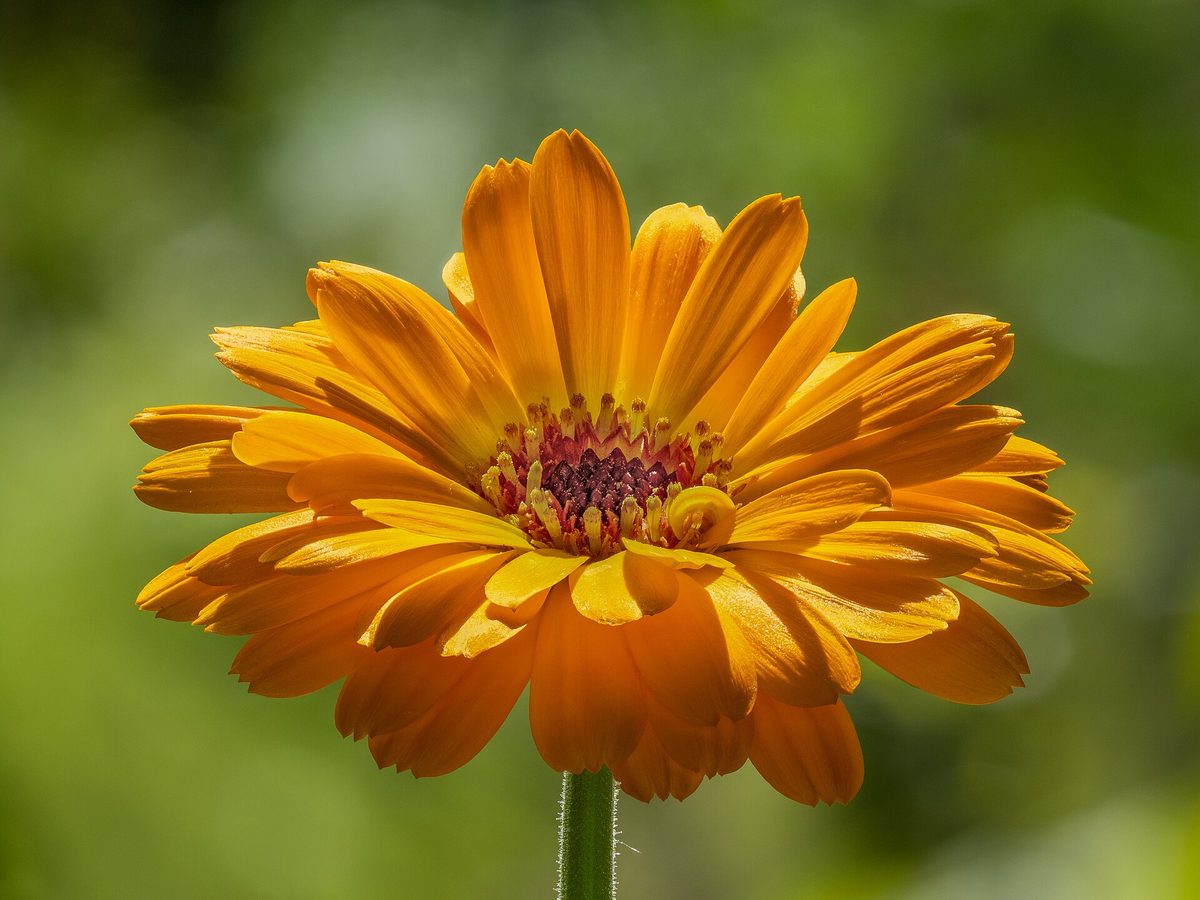
Photo: Ermell, CC BY-SA 4.0 via Wikimedia Commons

Quick facts
| Light: | Full sun and part shade (full sun preferred)12 |
|---|---|
| Water: | Medium31 source |
| Soil: | Well drained and moist12 |
| Hardiness: | Zones 2a–11b11 source |
| Size: | 1–2 ft (0.3–0.61 m) × 1–2 ft (0.3–0.61 m)91 source |
| Bloom: | Yellow, orange and red11 source |
| Cats: | Non-toxic to cats 78 |
| Dogs: | Non-toxic to dogs 78 |
| Native range: | SPA10 |
| Family: | Asteraceae |
How much light does a Pot Marigold need?
Pot marigold does best in full sun, meaning 6 or more hours of direct sunlight a day. Part shade is also listed as an acceptable setting for this plant. It is also described as easy to grow in any well-drained soil in full sun. Full sun is the preferred exposure, with part shade as the second option.
How often to water a Pot Marigold
Medium is the water need listed for pot marigold. The plant is described as preferring moderate watering. That puts the minimum and the maximum water need at the same medium level. The soil it grows in is listed as well drained and moist. The same listing describes it as easy to grow in any well-drained soil in full sun.
- Water: Medium3
Best soil for a Pot Marigold
Well drained and moist are the two drainage descriptions listed for pot marigold soil. One extension source records good drainage for it. Another says it is easy to grow in any well-drained soil in full sun. No other drainage description appears in the record. Medium is the water level listed alongside that drainage. No cited source records a soil pH range for this plant, so that value is not documented here.
Hardiness and temperature
Pot marigold is listed for Zones 2a–11b. That range runs from 2a through 11b in half-zone steps. A source says it can tolerate cool temperatures and a moderate frost, to about 28.4 °F (-2 °C). The minimum temperature on file is 28.4 °F (-2 °C). No cited source records a humidity preference, so humidity is not documented here.
Pruning a Pot Marigold
For pot marigold, the pruning type listed is deadheading. No other pruning type is recorded on file. The plant reaches 1–2 ft (0.3–0.61 m) in height and the same in spread. Its flowers are yellow, orange and red. No cited source gives a timing or a cutting height, so those details are not documented.
- Pruning: Deadheading5
How to plant a Pot Marigold
Plant pot marigold in USDA Zones 2a–11b, the range listed for it. Allow for a mature spread of 1–2 ft (0.3–0.61 m) and a height of 1–2 ft (0.3–0.61 m). Give it full sun, with part shade as the second option. The soil listed is well drained and moist. The flowers are yellow, orange and red. Its native range is recorded as SPA, and in the lower 48 US states its status is introduced.
- Hardiness: Zones 2a–11b1
Winter care
A source says pot marigold can tolerate cool temperatures and a moderate frost, to about 28.4 °F (-2 °C). The listed hardiness range is Zones 2a–11b. No cited source gives a lower limit than 28.4 °F (-2 °C), so nothing colder is documented. No cited source describes mulching, covering or overwintering, so those steps are not documented here.
How to propagate a Pot Marigold
Seed is the recommended propagation strategy for pot marigold. Seed is also the one method recorded for this species, with no cuttings or division listed. No cited source gives sowing depth, spacing or timing, so those details are not documented here. A mature plant reaches 1–2 ft (0.3–0.61 m) in height and the same in spread.
- Propagation: Seed1
Common problems
Slugs, snails, aphids and whiteflies are the pests recorded for pot marigold. A source notes slugs and snails particularly on young plants. The diseases on file are powdery mildew, cucumber mosaic virus, root rot and smut. Pot marigold is described as susceptible to powdery mildew.
| Problem | Kind |
|---|---|
| Slugs and snails | Pest |
| Snails | Pest |
| Aphids | Pest |
| Whiteflies | Pest |
| Powdery mildew | Disease |
| Cucumber mosaic virus | Disease |
| Root rot | Disease |
| Smut | Disease |
Is Pot Marigold toxic to cats and dogs?
For cats, the ASPCA Animal Poison Control Center lists pot marigold, Calendula officinalis, as non-toxic. Pet Poison Helpline likewise considers it non-toxic following ingestion. For dogs, the ASPCA also lists it as non-toxic. Pet Poison Helpline gives the same non-toxic position for dogs following ingestion. This page covers cats and dogs only for pet toxicity. No particular plant part or severity is recorded in either listing.
Recommended supplies
- Soil: a free-draining mix, and a pot with a drainage hole.
Questions and answers
- Is pot marigold toxic to cats and dogs?
- The ASPCA lists Calendula officinalis as non-toxic to dogs and non-toxic to cats. Pet Poison Helpline also considers it non-toxic following ingestion.
- How much sun does pot marigold need?
- Full sun is preferred, meaning 6 or more hours of direct sunlight a day. Part shade is also listed as acceptable. It is also described as easy to grow in any well-drained soil in full sun.
- How cold can pot marigold get?
- A source says it can tolerate cool temperatures and a moderate frost, to about 28.4 °F (-2 °C). It is listed for Zones 2a–11b. That listing covers every half zone from 2a to 11b.
Sources
- NC State Extension Gardener Plant Toolbox. https://plants.ces.ncsu.edu/plants/calendula-officinalis/. Accessed 15 October 2026.
- University of Wisconsin-Madison Division of Extension (Wisconsin Horticulture). https://hort.extension.wisc.edu/articles/calendula-calendula-officinalis/. Accessed 15 October 2026.
- University of Wisconsin-Madison Division of Extension (Wisconsin Horticulture). https://hort.extension.wisc.edu/articles/calendula-calendula-officinalis. Accessed 15 October 2026.
- University of Missouri Extension. https://extension.missouri.edu/publications/g6629. Accessed 27 October 2026.
- Penn State Extension. https://extension.psu.edu/pruning-herbaceous-plants. Accessed 15 October 2026.
- UC Statewide Integrated Pest Management Program. https://ipm.ucanr.edu/agriculture/floriculture-and-ornamental-nurseries/pot-marigold/. Accessed 15 October 2026.
- ASPCA Animal Poison Control Center. https://www.aspca.org/pet-care/aspca-poison-control/toxic-and-non-toxic-plants/pot-marigold. Accessed 15 October 2026.
- Pet Poison Helpline. https://www.petpoisonhelpline.com/poison/marigold/. Accessed 15 October 2026.
- University of Florida IFAS Extension (EDIS). https://ask.ifas.ufl.edu/publication/FP087. Accessed 15 October 2026.
- Royal Botanic Gardens, Kew (World Checklist of Vascular Plants). https://sftp.kew.org/pub/data-repositories/WCVP/wcvp.zip. Accessed 4 June 2026.
How this page was made
- Written with AI assistance from the sources listed on this page. AI is never the source of a fact.