French Hydrangea (Hydrangea macrophylla)
Formerly Hydrangea opuloides, Hortensia macrophylla, Hydrangea hortensis
French hydrangea does best in part shade with medium to wet soil. It also accepts full shade, and it likes a site with good drainage. The ASPCA lists it as toxic to cats and to dogs. Plan your planting spot with that in mind.
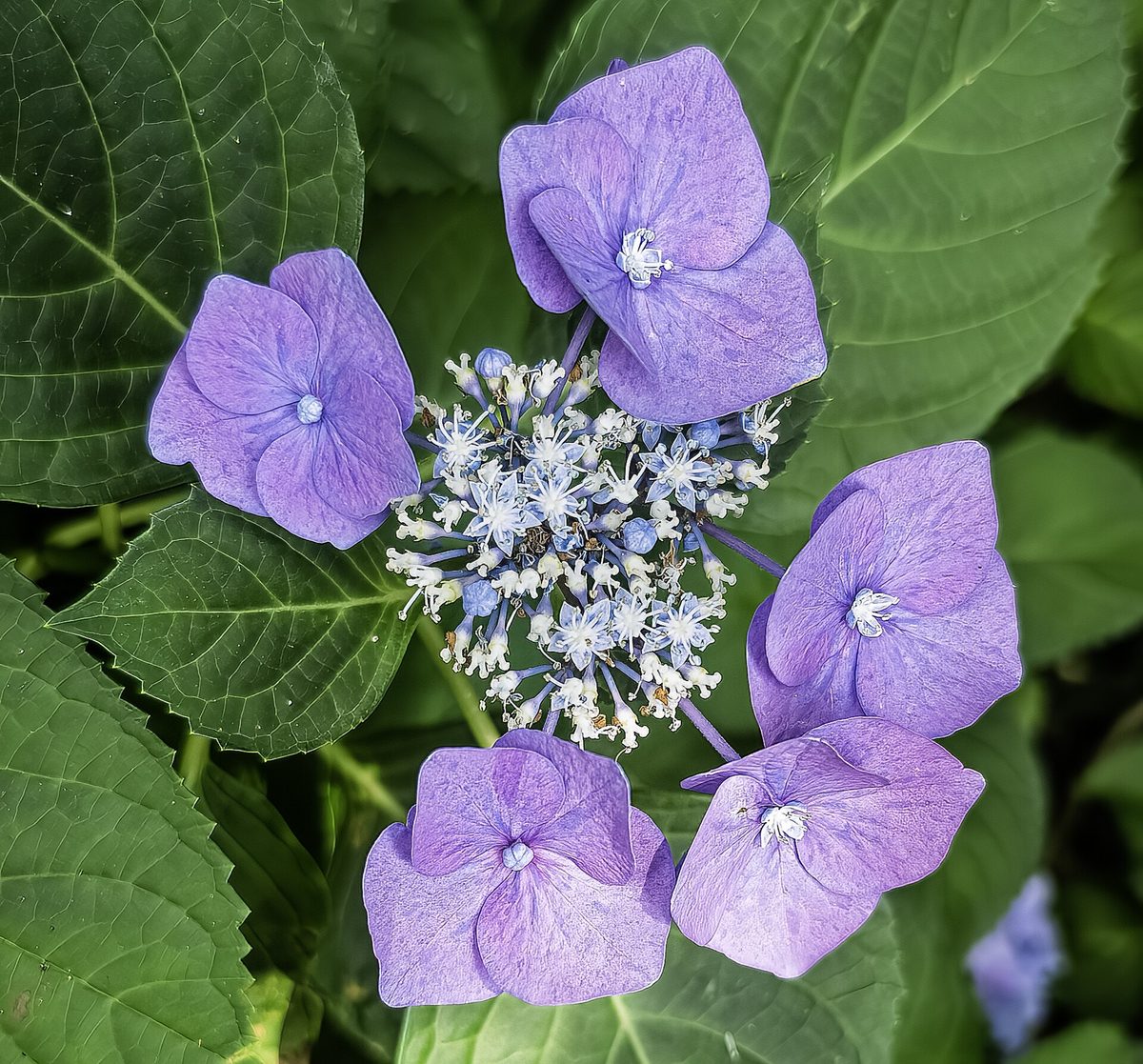
Photo: Didier Descouens, CC BY-SA 4.0 via Wikimedia Commons

Quick facts
| Light: | Part shade and full shade (part shade preferred)11 source |
|---|---|
| Water: | Medium to wet11 source |
| Soil: | Well drained, moist and occasionally wet11 source |
| Hardiness: | Zones 6a–11b11 source |
| Size: | 3–6 ft (0.91–1.83 m) × 3–6 ft (0.91–1.83 m)11 source |
| Growth rate: | Rapid11 source |
| Bloom: | Jul–Aug, White, pink, blue and purple891 |
| Cats: | Toxic to cats 67 |
| Dogs: | Toxic to dogs 67 |
| Native range: | JAP, KZN10 |
| Family: | Hydrangeaceae |
How much light does a French Hydrangea need?
Choose a site with dappled sunlight or partial shade for the best performance. Deep shade is also listed as an option for this shrub. The preferred setting recorded for it is part shade. Leave room for a mature shrub that is 3 to 6 ft (0.91 to 1.83 m) tall and wide.
- Light: Part shade and full shade (part shade preferred)1
How often to water a French Hydrangea
French hydrangea has a water need rated medium to wet. The source pairs this with a site that has good drainage. Soil that is occasionally wet is okay for this shrub. Its lowest listed need is medium, and its highest is wet. The listed soil conditions are well drained, moist and occasionally wet.
- Water: Medium to wet1
Best soil for a French Hydrangea
Soil with good drainage suits French hydrangea, and occasionally wet soil is okay. The listed drainage conditions are well drained, moist and occasionally wet. Its listed water need runs from medium to wet. The flower color ranges from white to pink, blue or purple, depending on the soil's acidity. The soil's acidity is the factor named for that change in flower color. Part shade is the preferred light for the shrub. No soil pH range is documented for this plant.
- Soil drainage: Well drained, moist and occasionally wet1
Hardiness and temperature
Outdoors, this shrub is listed for USDA zones 6a through 11b. Zone 6a is the coldest on that list, and zone 11b is the warmest. The recorded minimum temperature is 50 °F (10 °C). The source for that figure describes 50 to 60 °F (10 to 16 °C) as a cool night range for the plant. It is a woody, deciduous, perennial shrub.
How to plant a French Hydrangea
Check that your USDA zone falls between 6a and 11b before you plant. Leave room for a shrub that reaches 3 to 6 ft (0.91 to 1.83 m) tall and wide at maturity. It grows rapidly into a multi-stemmed shrub. Choose a site with part shade and good drainage, where occasionally wet soil is okay. The plant is deciduous.
- Hardiness: Zones 6a–11b1
Winter care
A woody, deciduous, perennial shrub, French hydrangea is listed for zones 6a through 11b. In zone 6a, the coldest zone listed, the plant is still within its recorded range. The minimum temperature on record is 50 °F (10 °C). That source describes 50 to 60 °F (10 to 16 °C) as a cool night range.
How to propagate a French Hydrangea
You can propagate this shrub by layering or by stem cutting. Division is a third method, and it works on old established clumps. Layering, stem cuttings and division are the three propagation methods recorded for French hydrangea. For division, use a shovel in early spring to divide old established clumps into smaller plants.
Common problems
French hydrangea can suffer leaf spot, bacterial wilt and powdery mildew under some conditions. Other diseases on record for this shrub are botrytis blight, armillaria root rot, damping off, rust and phytophthora root rot. In total, eight diseases are on record for this shrub, listed here in full.
| Problem | Kind |
|---|---|
| Aphids | Pest |
| Spider mites | Pest |
| Scale insects | Pest |
| Whiteflies | Pest |
| Nematodes | Pest |
| Foliage feeding caterpillars | Pest |
| Thrips | Pest |
| Leafminers | Pest |
| Powdery mildew | Disease |
| Leaf spot | Disease |
| Botrytis blight | Disease |
| Armillaria root rot | Disease |
| Damping off | Disease |
| Rust | Disease |
| Bacterial wilt | Disease |
| Phytophthora root rot | Disease |
Is French Hydrangea toxic to cats and dogs?
The ASPCA lists French hydrangea as toxic to cats. It also lists the plant as toxic to dogs. Pet Poison Helpline states that all parts of the hydrangea plant contain cyanide-containing compounds. The position is the same for each animal: toxic to cats and toxic to dogs. The Pet Poison Helpline statement covers every part of the plant. No severity rating is recorded for cats or dogs.
Pet-safe alternatives
Recommended supplies
- Soil: a free-draining mix, and a pot with a drainage hole.
Questions and answers
- Is French hydrangea toxic to cats and dogs?
- The ASPCA lists it as toxic to both cats and dogs. Pet Poison Helpline states that all parts of the hydrangea plant contain cyanide-containing compounds.
- How much light does French hydrangea need outdoors?
- It performs best in dappled sunlight, partial shade or deep shade. Part shade is the preferred setting. Plant it in a site with good drainage.
- Where will French hydrangea grow, and how big does it get?
- It is listed for USDA zones 6a through 11b. It is generally 3 to 6 ft (0.91 to 1.83 m) tall and wide at maturity. It grows rapidly into a multi-stemmed shrub.
Sources
- NC State Extension Gardener Plant Toolbox. https://plants.ces.ncsu.edu/plants/hydrangea-macrophylla/. Accessed 14 October 2026.
- University of Missouri Extension. https://extension.missouri.edu/publications/g6511. Accessed 27 October 2026.
- Clemson Cooperative Extension Home & Garden Information Center. https://hgic.clemson.edu/factsheet/hydrangea-care-in-south-carolina/. Accessed 31 October 2026.
- UC Statewide Integrated Pest Management Program. https://ipm.ucanr.edu/home-and-landscape/hydrangea/. Accessed 14 October 2026.
- EPPO Global Database. https://gd.eppo.int/taxon/HYEMA/pests. Accessed 14 October 2026.
- ASPCA Animal Poison Control Center. https://www.aspca.org/pet-care/aspca-poison-control/toxic-and-non-toxic-plants/hortensia. Accessed 14 October 2026.
- Pet Poison Helpline. https://www.petpoisonhelpline.com/poison/hydrangea/. Accessed 14 October 2026.
- University of Wisconsin-Madison Division of Extension (Wisconsin Horticulture). https://hort.extension.wisc.edu/articles/summer-flowering-trees-shrubs-and-vines/. Accessed 27 October 2026.
- Chicago Botanic Garden. https://www.chicagobotanic.org/plant-information/plant-finder/hydrangea-macrophylla-tokyo-delight-lacecap-hydrangea. Accessed 27 October 2026.
- Royal Botanic Gardens, Kew (World Checklist of Vascular Plants). https://sftp.kew.org/pub/data-repositories/WCVP/wcvp.zip. Accessed 4 June 2026.
How this page was made
- Written with AI assistance from the sources listed on this page. AI is never the source of a fact.