Hollyleaved Barberry (Berberis aquifolium)
Formerly Mahonia aquifolium, Mahonia moseri, Mahonia brevipes
Hollyleaved barberry is an evergreen shrub that grows best in light shade, with part shade preferred. It is rated for USDA zones 5a–8b and reaches 3–6 ft (0.91–1.83 m) tall. The ASPCA lists it as non-toxic to both cats and dogs.
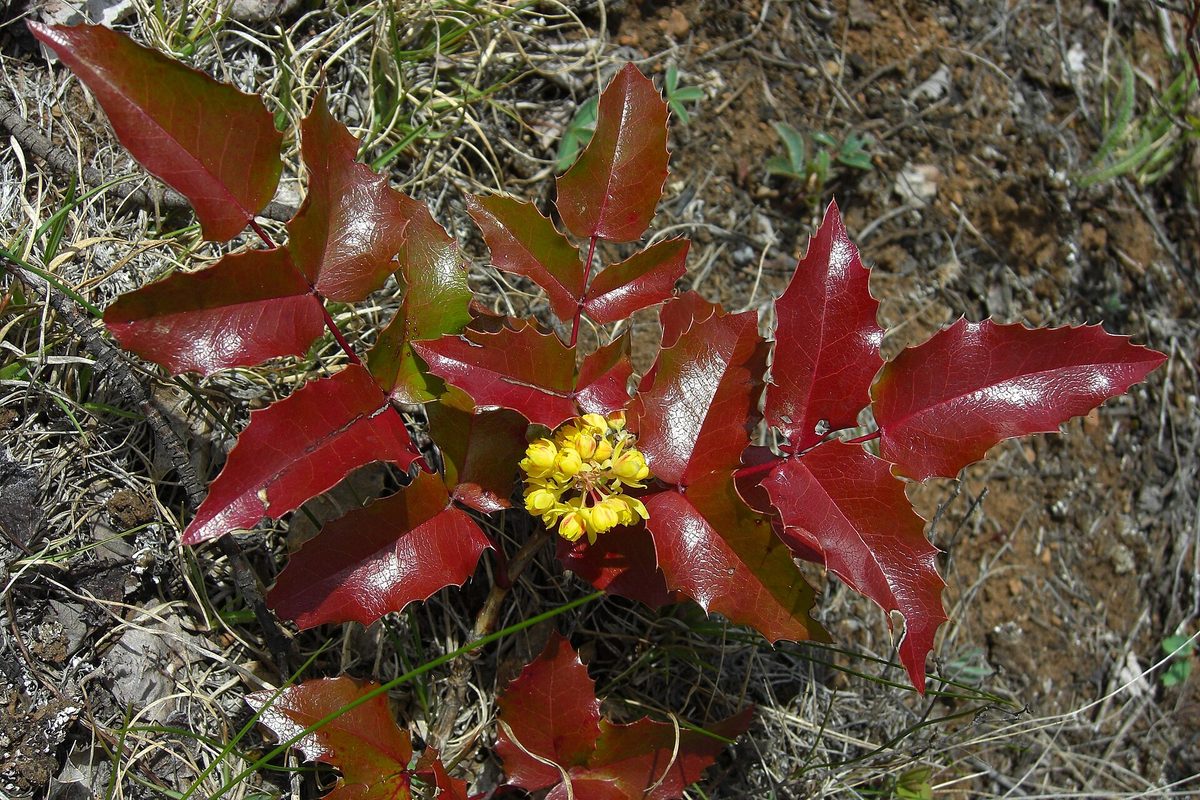
Photo: Jason Hollinger, CC BY 2.0 via Wikimedia Commons

Quick facts
| Light: | Part shade and full shade (part shade preferred)12 |
|---|---|
| Soil: | Well drained and moist12 |
| Hardiness: | Zones 5a–8b311 source |
| Size: | 3–6 ft (0.91–1.83 m) × 2–5 ft (0.61–1.52 m)671 |
| Growth rate: | Slow171 |
| Bloom: | Mar–Apr, Yellow8121 source |
| Cats: | Non-toxic to cats 51 |
| Dogs: | Non-toxic to dogs 51 |
| Native range: | BRC, CAL, IDA, MNT, ORE, WAS9 |
| Family: | Berberidaceae |
How much light does a Hollyleaved Barberry need?
Hollyleaved barberry grows best in light shade. Its color will bleach out if it grows in full sun. The plant's listed light range is part shade to full shade. Part shade is the preferred condition, and full shade is also listed. Choose a spot with light shade rather than full sun for the best color.
Best soil for a Hollyleaved Barberry
Hollyleaved barberry is listed for soil that is well drained and moist. The sources describe good drainage and moist, well-drained, acid loams. Loams that are acid, moist and well drained match that description. Drainage is the main soil factor the sources record for this shrub. A moist, well-drained, acid loam fits both drainage terms listed for this plant. Its listing pairs these soil terms with part shade as the preferred light.
Hardiness and temperature
Hollyleaved barberry is hardy in USDA zones 5a to 8b. The listed half-zones are 5a, 5b, 6a, 6b, 7a, 7b, 8a and 8b. The shrub is a broadleaf evergreen. It is native to the lower 48 US states. Zone 4 and colder fall outside the listed range.
How to plant a Hollyleaved Barberry
Check that your site is in USDA zones 5a to 8b before you plant. Leave room for a shrub that reaches 3–6 ft (0.91–1.83 m) tall. The spread is 2–5 ft (0.61–1.52 m) wide, in an upright form with few branches. Light shade suits it best, since its color bleaches out in full sun. Its listing also calls for good drainage.
Winter care
The shrub is a broadleaf evergreen. Its listed hardiness runs from zone 5a to zone 8b. Zone 5a is the coldest zone in that listing, and 8b is the warmest. Zones colder than 5a are outside the listed range. Zones warmer than 8b are also outside the listed range. The listing covers eight half-zones from 5a through 8b.
How to propagate a Hollyleaved Barberry
Seed, stem cuttings and division are the listed ways to propagate hollyleaved barberry. The listing names three methods: seed, stem cuttings and division. Stem cuttings are one of those methods, and the listing gives timing advice for them. The timing advice for cuttings refers to exposure to cold. Seed and division are listed without further detail.
- Propagation: Seed, stem cuttings and division2
Common problems
Recorded pests include Ceroplastes ceriferus, Pseudaulacaspis pentagona, Pseudococcus comstocki, Halyomorpha halys and Drosophila suzukii. The list continues with Malacosoma parallela, Xylosandrus compactus, Pochazia shantungensis and Cacoecimorpha pronubana. Recorded diseases are Puccinia graminis, Phytophthora ramorum and Phytophthora kernoviae. Each pest and disease name is recorded under the host name Berberis.
- Common pests: ceroplastes ceriferus, pseudaulacaspis pentagona, pseudococcus comstocki, halyomorpha halys, drosophila suzukii, malacosoma parallela, xylosandrus compactus, pochazia shantungensis and cacoecimorpha pronubana4
- Common diseases: puccinia graminis, phytophthora ramorum and phytophthora kernoviae4
| Problem | Kind |
|---|---|
| Ceroplastes ceriferus | Pest |
| Pseudaulacaspis pentagona | Pest |
| Pseudococcus comstocki | Pest |
| Halyomorpha halys | Pest |
| Drosophila suzukii | Pest |
| Malacosoma parallela | Pest |
| Xylosandrus compactus | Pest |
| Pochazia shantungensis | Pest |
| Cacoecimorpha pronubana | Pest |
| Puccinia graminis | Disease |
| Phytophthora ramorum | Disease |
| Phytophthora kernoviae | Disease |
Is Hollyleaved Barberry toxic to cats and dogs?
The ASPCA lists hollyleaved barberry as non-toxic to cats. The ASPCA also lists it as non-toxic to dogs. NC State's Plant Toolbox likewise marks it non-toxic for cats and for dogs. Cats and dogs are the two animals this site covers for pet toxicity. These listings cover cats and dogs separately, and each is recorded as non-toxic. For cats, the recorded position is non-toxic. For dogs, the recorded position is non-toxic.
Recommended supplies
- Soil: a free-draining mix, and a pot with a drainage hole.
Questions and answers
- Is hollyleaved barberry toxic to cats and dogs?
- The ASPCA lists hollyleaved barberry as non-toxic to cats and as non-toxic to dogs. NC State's Plant Toolbox also marks it non-toxic for cats and for dogs.
- How much light does hollyleaved barberry need?
- It grows best in light shade, and part shade is the preferred condition. Part shade and full shade are both listed. Its color will bleach out if it grows in full sun.
- How big does hollyleaved barberry get?
- It reaches 3–6 ft (0.91–1.83 m) tall and 2–5 ft (0.61–1.52 m) wide. Its growth rate is slow. It is an evergreen shrub with an upright form and few branches.
Sources
- NC State Extension Gardener Plant Toolbox. https://plants.ces.ncsu.edu/plants/berberis-aquifolium/. Accessed 14 October 2026.
- Lady Bird Johnson Wildflower Center, Native Plant Database. https://www.wildflower.org/plants/result.php?id_plant=MAAQ2. Accessed 14 October 2026.
- NC State Extension Gardener Plant Toolbox. https://plants.ces.ncsu.edu/plants/mahonia-aquifolium/. Accessed 14 October 2026.
- EPPO Global Database. https://gd.eppo.int/taxon/MAHAQ/pests. Accessed 14 October 2026.
- ASPCA Animal Poison Control Center. https://www.aspca.org/pet-care/aspca-poison-control/toxic-and-non-toxic-plants/oregon-grape. Accessed 14 October 2026.
- Cornell University CALS Woody Plants Database. https://woodyplants.cals.cornell.edu/plant/150. Accessed 14 October 2026.
- University of Florida IFAS Extension (EDIS). https://ask.ifas.ufl.edu/publication/FP375. Accessed 14 October 2026.
- Chicago Botanic Garden. https://www.chicagobotanic.org/plant-information/plant-finder/mahonia-aquifolium-oregon-grape-holly. Accessed 24 October 2026.
- Royal Botanic Gardens, Kew (World Checklist of Vascular Plants). https://sftp.kew.org/pub/data-repositories/WCVP/wcvp.zip. Accessed 4 June 2026.
How this page was made
- Written with AI assistance from the sources listed on this page. AI is never the source of a fact.