Cape Jasmine (Gardenia jasminoides)
Formerly Gardenia radicans, Gardenia angustifolia, Gardenia maruba
Cape jasmine (Gardenia jasminoides), an evergreen shrub, grows in part shade or full sun and needs medium water. Part shade is the preferred setting, and full sun is also listed. The ASPCA lists the plant as toxic to cats and toxic to dogs.
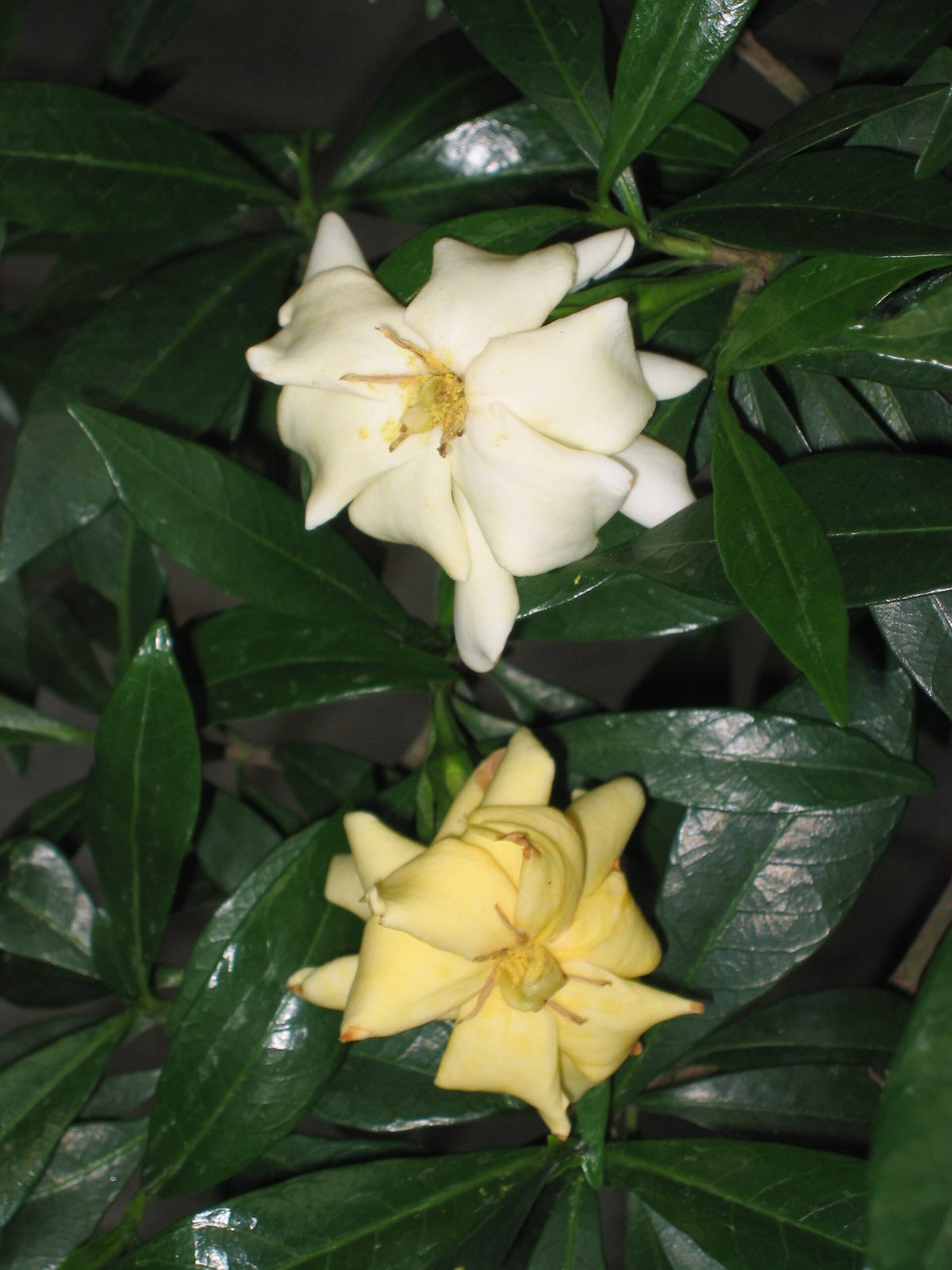
Photo: 阿橋 HQ, CC BY-SA 2.0 via Wikimedia Commons

Quick facts
| Light: | Part shade and full sun (part shade preferred)12 |
|---|---|
| Water: | Medium11 source |
| Soil: | Well drained, moist, occasionally dry and occasionally wet; pH 5–6.512 |
| Hardiness: | Zones 7b–11b11 source |
| Size: | 3–8 ft (0.91–2.44 m) × 4–8 ft (1.22–2.44 m)311 source |
| Growth rate: | Moderate131 |
| Bloom: | May–Jun, White and yellow3711 source |
| Cats: | Toxic to cats (1 source) 6 |
| Dogs: | Toxic to dogs (1 source) 6 |
| Native range: | CBD, CHC, CHH, CHN, CHS, EHM, JAP, LAO, TAI, THA, VIE8 |
| Family: | Rubiaceae |
How much light does a Cape Jasmine need?
Outdoors, this shrub does best in part shade, and full sun is also listed. Full sun means six or more hours of direct sunlight a day. For the best flower production, full sun, partial shade or shifting shade all work. Indoors, it prefers bright, indirect light or partial shade.
How often to water a Cape Jasmine
The water need for Cape jasmine is rated medium, with both the lowest and highest listed level at medium. The shrub is described as moderately drought-tolerant. Its soil rating includes occasionally dry and occasionally wet conditions. The same soil rating also includes moist and well drained conditions.
- Water: Medium1
Best soil for a Cape Jasmine
Drainage for this shrub is listed as well drained, moist, occasionally dry and occasionally wet. Good drainage is noted, and gardenias do best in well-drained soil amended with organic matter. An acidic soil pH between 5.0 and 6.5 is required for this shrub, or the foliage will yellow. Potted plants should be repotted every two to three years, using an acidic potting soil.
Hardiness and temperature
The listed hardiness range for this shrub runs from zone 7b to zone 11b. The plant is not cold hardy below about 28 °F (-2 °C). Cape jasmine is rated for high humidity. A pot can sit on a pebble tray filled with water to raise the humidity. Plants that need constant high humidity, such as gardenias, are best kept in kitchens or bathrooms.
Fertilizing a Cape Jasmine
Cape jasmine gets a light fertilizer feeding, once a year. Fertilize it lightly in the spring, once frost has passed. That one light feeding is the whole yearly schedule listed for this shrub. Wait until the last frost has passed before you fertilize.
- Fertilizer: Light, once a year (Mar–May)3
Pruning a Cape Jasmine
Cut after the shrub has finished flowering in summer. The pruning types listed are deadheading and light shaping. Straggly branches and faded flowers are what you remove. Maintenance for this shrub is rated high overall. The growth rate is medium.
- Pruning: Deadheading and Light shaping (Jun–Aug)3
How to plant a Cape Jasmine
Choose a spot in zones 7b to 11b, where the shrub is listed as hardy. Allow for a mature height of 3–8 ft (0.91–2.44 m), depending on the cultivar. Leave room for a width of 4–8 ft (1.22–2.44 m). The site should offer part shade or full sun, with well-drained soil that has a pH of 5 to 6.5. The plant is an evergreen shrub with a medium growth rate.
- Hardiness: Zones 7b–11b1
Winter care
Frost is the main limit, since gardenias are not cold hardy below about 28 °F (-2 °C). Zone 7b is the coldest zone in the listed range, and zone 11b is the warmest. It is a broadleaf evergreen. A potted plant kept indoors prefers bright, indirect light and high humidity. The feeding season in the record is spring only.
Care calendar
| Task | Jan | Feb | Mar | Apr | May | Jun | Jul | Aug | Sep | Oct | Nov | Dec |
|---|---|---|---|---|---|---|---|---|---|---|---|---|
| Fertilize | Fertilize in Mar | Fertilize in Apr | Fertilize in May | |||||||||
| Prune | Prune in Jun | Prune in Jul | Prune in Aug | |||||||||
| Bloom | Bloom in May | Bloom in Jun |
How to propagate a Cape Jasmine
Cape jasmine can be propagated three ways: stem cuttings, layering and grafting. Air layering is named as a form of layering. Grafting is also on the list, alongside cuttings and layering. Cuttings, air layers and grafting are each named as a way to propagate gardenia. Each of the three methods is on the list as a separate option.
Common problems
Pests recorded on Cape jasmine include aphids, scales, black scale, cottony cushion scale, mealybugs, whiteflies and spider mites. Nematodes, black vine weevil, fuller rose beetle and black twig borer are also listed. The omnivorous leafroller and the yellowstriped armyworm complete the pest list. Diseases recorded are armillaria root rot, phytophthora root rot, sooty mold and cotton root rot. Tomato spotted wilt virus and impatiens necrotic spot virus are also listed.
- Common pests: aphids, scales, black scale, cottony cushion scale, mealybugs, spider mites, whiteflies, nematodes, black vine weevil, fuller rose beetle, black twig borer, omnivorous leafroller and yellowstriped armyworm45
- Common diseases: armillaria root rot, phytophthora root rot, sooty mold, cotton root rot, tomato spotted wilt virus and impatiens necrotic spot virus45
| Problem | Kind |
|---|---|
| Aphids | Pest |
| Scales | Pest |
| Black scale | Pest |
| Cottony cushion scale | Pest |
| Mealybugs | Pest |
| Spider mites | Pest |
| Whiteflies | Pest |
| Nematodes | Pest |
| Black vine weevil | Pest |
| Fuller rose beetle | Pest |
| Black twig borer | Pest |
| Omnivorous leafroller | Pest |
| Yellowstriped armyworm | Pest |
| Armillaria root rot | Disease |
| Phytophthora root rot | Disease |
| Sooty mold | Disease |
| Cotton root rot | Disease |
| Tomato spotted wilt virus | Disease |
| Impatiens necrotic spot virus | Disease |
Is Cape Jasmine toxic to cats and dogs?
For cats, the ASPCA listing for this plant reads toxic. For dogs, the ASPCA listing also reads toxic. The two animals are listed separately on this page, and each position is the same. The ASPCA entry gives the wording Toxic to Dogs, Toxic to Cats, Toxic to Horses. Cape jasmine is therefore on the toxic list for both pets this site covers.
Pet-safe alternatives
Recommended supplies
- Soil: a free-draining mix, and a pot with a drainage hole.
- Humidity: it wants humid air; a pebble tray or a humidifier is the usual fix.
Questions and answers
- Is Cape jasmine toxic to cats and dogs?
- The ASPCA lists Cape jasmine as toxic to cats. It also lists the plant as toxic to dogs. Both positions are recorded separately, and both read toxic.
- How much sun does Cape jasmine need?
- Part shade is preferred, and full sun is also listed. Full sun means six or more hours of direct sunlight a day. Indoors, it prefers bright, indirect light.
- What soil pH does Cape jasmine need?
- An acidic soil pH between 5.0 and 6.5 is required, or the foliage will yellow. Gardenias do best in well-drained soil amended with organic matter.
Sources
- NC State Extension Gardener Plant Toolbox. https://plants.ces.ncsu.edu/plants/gardenia-jasminoides/. Accessed 14 October 2026.
- University of Florida IFAS Extension (EDIS). https://ask.ifas.ufl.edu/publication/EP338. Accessed 14 October 2026.
- Clemson Cooperative Extension Home & Garden Information Center. https://hgic.clemson.edu/factsheet/gardenia/. Accessed 21 October 2026.
- UC Statewide Integrated Pest Management Program. https://ipm.ucanr.edu/home-and-landscape/gardenia/. Accessed 14 October 2026.
- EPPO Global Database. https://gd.eppo.int/taxon/GADJA/pests. Accessed 14 October 2026.
- ASPCA Animal Poison Control Center. https://www.aspca.org/pet-care/aspca-poison-control/toxic-and-non-toxic-plants/gardenia. Accessed 14 October 2026.
- Chicago Botanic Garden. https://www.chicagobotanic.org/plant-information/plant-finder/gardenia-jasminoides-gardenia. Accessed 14 October 2026.
- Royal Botanic Gardens, Kew (World Checklist of Vascular Plants). https://sftp.kew.org/pub/data-repositories/WCVP/wcvp.zip. Accessed 4 June 2026.
How this page was made
- Written with AI assistance from the sources listed on this page. AI is never the source of a fact.