Lion's Ear (Leonotis leonurus)
Formerly Phlomis leonurus, Hemisodon leonurus, Leonurus superbus
Lion's ear is a shrub that grows best in full sun. It also tolerates part shade. Give it well-drained soil. It is listed for USDA zones 8a to 11b. Growth is rapid and maintenance is low. It reaches 3–6 ft (0.91–1.83 m) tall. Watering and the toxicity position for cats and dogs are not documented on this page.
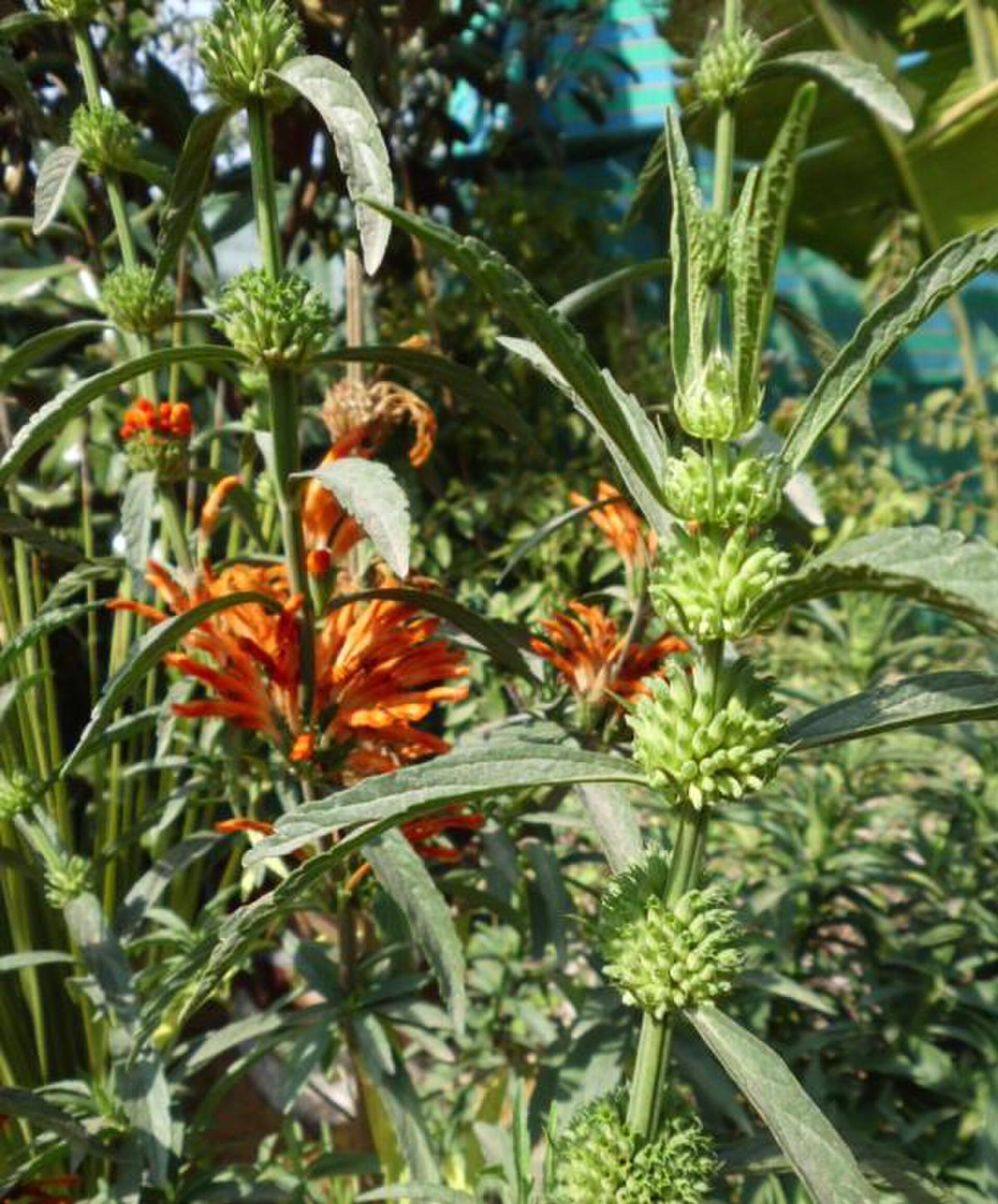
Photo: Hatem moushir, CC BY-SA 3.0 via Wikimedia Commons

Quick facts
| Light: | Full sun and part shade (full sun preferred)11 source |
|---|---|
| Soil: | Well drained; pH 6–811 source |
| Hardiness: | Zones 8a–11b11 source |
| Size: | 3–6 ft (0.91–1.83 m) × 1.5–3 ft (0.46–0.91 m)11 source |
| Growth rate: | Rapid11 source |
| Bloom: | May–Jun, Jul–Aug and Sep–Oct, Orange211 source |
| Cats: | Not documented by major sources |
| Dogs: | Not documented by major sources |
| Native range: | CPP, NAT, OFS, TVL3 |
| Family: | Lamiaceae |
How much light does a Lion's Ear need?
Lion's ear grows best in full sun, which means 6 or more hours of direct sunlight a day. It also tolerates part shade, though full sun is the preferred setting. Outdoors, these two light levels are the ones listed for this shrub. Choose a spot that offers one of those two light levels.
- Light: Full sun and part shade (full sun preferred)1
Best soil for a Lion's Ear
Lion's ear needs well-drained soil. The listed soil pH range is 6.0 to 8.0, which is neutral. Good drainage is the listed requirement for the soil. A pH anywhere between 6 and 8 falls inside the listed range. Drainage and pH are the two soil conditions recorded for this shrub. Well-drained soil is the only drainage class listed. Soil texture, organic matter and amendments are not documented on this page.
Hardiness and temperature
Lion's ear is listed for USDA hardiness zones 8a to 11b. The listing names zones 8a, 8b, 9a, 9b, 10a, 10b, 11a and 11b. Zone 7b and colder fall outside the listed range. Zone 8a is the coldest zone in the listing. Zone 11b is the warmest zone in the listing. It is a broadleaf evergreen shrub. No minimum temperature or humidity figure is documented on this page.
- Hardiness: Zones 8a–11b1
Pruning a Lion's Ear
Prune lion's ear once a year, after flowering. The purpose is to maintain a bushy, dense shape. The pruning type recorded is light shaping. Overall maintenance for this shrub is rated low. A mature plant is 3–6 ft (0.91–1.83 m) tall and 1.5–3 ft (0.46–0.91 m) wide.
- Pruning: Light shaping1
How to plant a Lion's Ear
Plant lion's ear in USDA zones 8a to 11b. Allow room for a mature height of 3–6 ft (0.91–1.83 m) and a width of 1.5–3 ft (0.46–0.91 m). Choose a site with full sun or part shade, and well-drained soil. The listed soil pH range is 6 to 8. The growth rate is rapid. Seeding in the garden happens before the last frost date.
- Hardiness: Zones 8a–11b1
Winter care
The recorded hardiness range for lion's ear is zones 8a to 11b. Zone 8a is the coldest zone in that listing. Gardeners in zone 7 and colder are outside the recorded range. It is a broadleaf evergreen shrub. Annual pruning after flowering is the shaping task listed for it. Maintenance is rated low. No minimum temperature or winter protection method is documented on this page.
- Hardiness: Zones 8a–11b1
How to propagate a Lion's Ear
You can propagate lion's ear from seed or from stem cuttings. The recorded advice is to propagate by green stem cutting or by seeding in the garden before the last frost date. Seeding is done outdoors, in the garden. Seed and stem cuttings are the two methods listed for this shrub.
- Propagation: Seed and stem cuttings1
Common problems
Four pests are recorded for lion's ear: whiteflies, spider mites, shot hole borer and mealybugs. Whiteflies and spider mites can be a problem for indoor plants. No known diseases are recorded for it. Deer leave this plant alone, and it is listed as rarely damaged by deer.
| Problem | Kind |
|---|---|
| Whiteflies | Pest |
| Spider mites | Pest |
| Shot hole borer | Pest |
| Mealybugs | Pest |
Is Lion's Ear toxic to cats and dogs?
Recommended supplies
- Soil: a free-draining mix, and a pot with a drainage hole.
Questions and answers
- How much sun does lion's ear need?
- It grows best in full sun, which means 6 or more hours of direct sunlight a day. It also tolerates part shade. Full sun is the preferred setting.
- How big does lion's ear get?
- A mature plant reaches 3–6 ft (0.91–1.83 m) in height. Its width is 1.5–3 ft (0.46–0.91 m). The growth rate is rapid.
- What do lion's ear flowers look like?
- The flowers are orange, hairy and tubular, in whorls with two lips. They appear from late spring through fall. Pruning after flowering maintains a bushy, dense shape.
Sources
- NC State Extension. https://plants.ces.ncsu.edu/plants/leonotis-leonurus/. Accessed 14 October 2026.
- Chicago Botanic Garden. https://www.chicagobotanic.org/plant-information/plant-finder/leonotis-leonurus-lions-tail. Accessed 21 October 2026.
- Royal Botanic Gardens, Kew (World Checklist of Vascular Plants). https://sftp.kew.org/pub/data-repositories/WCVP/wcvp.zip. Accessed 4 June 2026.
How this page was made
- Written with AI assistance from the sources listed on this page. AI is never the source of a fact.