Daylily (Hemerocallis fulva)
Also called Orange Daylily
Formerly Hemerocallis disticha, Hemerocallis aurantiaca, Gloriosa luxurians
Give this daylily full sun for best results, but know it also tolerates part shade. Its water needs run from dry to medium. The plant is toxic to cats, and the risk is described as potentially fatal. It is non-toxic to dogs.
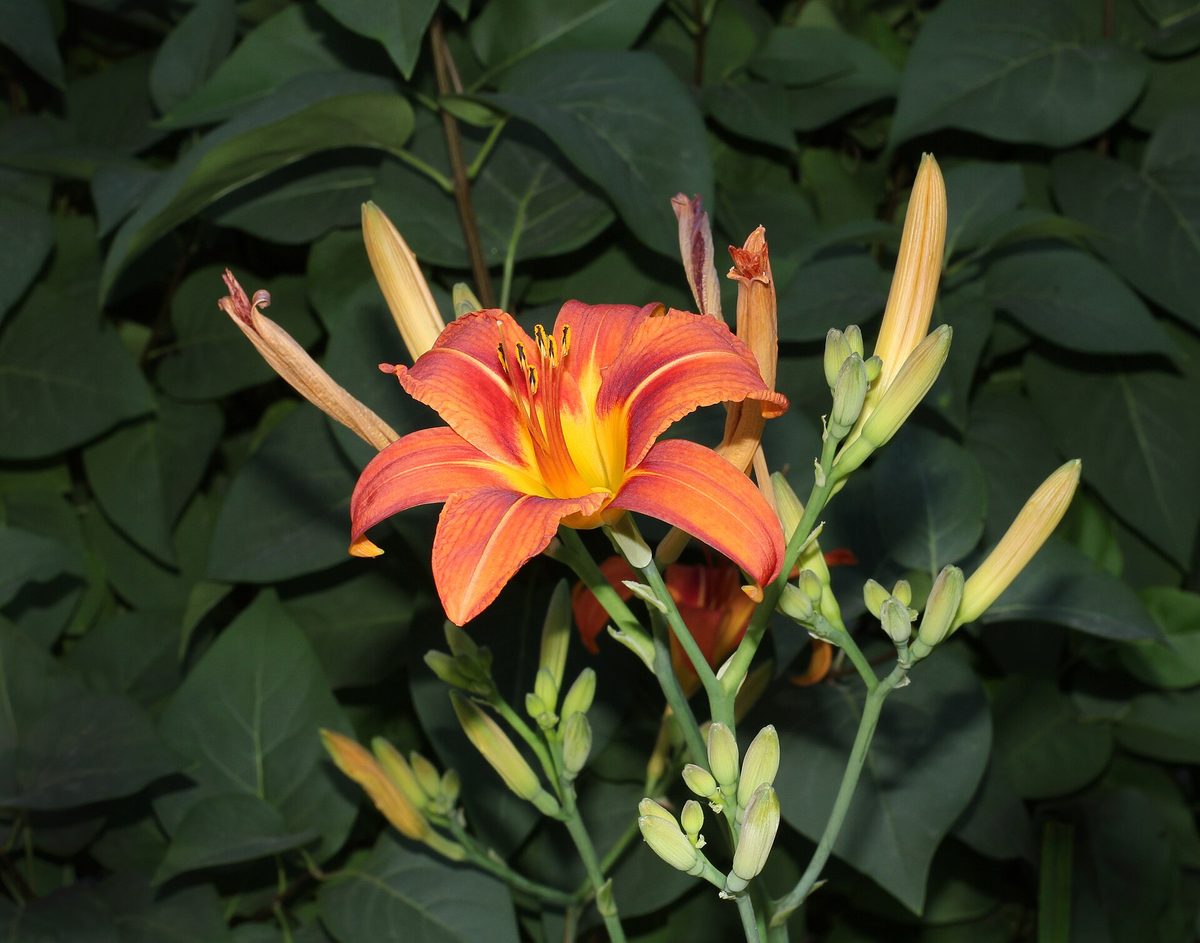
Photo: George Chernilevsky, Public domain via Wikimedia Commons

Quick facts
| Light: | Full sun and part shade (full sun preferred)12 |
|---|---|
| Water: | Dry to medium11 source |
| Soil: | Well drained; pH 6.2–6.8132 |
| Hardiness: | Zones 3a–8b11 source |
| Size: | 3–6 ft (0.91–1.83 m) × 2–2.5 ft (0.61–0.76 m)11 source |
| Growth rate: | Rapid111 source |
| Bloom: | Orange11 source |
| Cats: | Toxic to cats Severity reported: Potentially fatal 561 |
| Dogs: | Non-toxic to dogs 71 |
| Native range: | CHC, CHN, CHS, JAP, KOR, NNS, TAI8 |
| Family: | Asphodelaceae |
How much light does a Daylily need?
Give this daylily full sun for its best growth, though it also grows well in part shade. Full sun is the preferred exposure of the two. Outdoors, it needs at least two hours of direct sun a day to grow well. Part shade is still an acceptable spot for it outdoors. Up to six hours of direct sun a day also suits it well outdoors. Full sun to part shade is the exposure range given for this plant outdoors.
How often to water a Daylily
This daylily has only moderate water requirements, ranging from dry to medium. It tolerates soil that runs dry between waterings, up to soil that stays evenly moist. This plant also tolerates drought. Because its range runs down to dry soil, it does not need frequent watering outdoors. Dry to medium is the full range this plant's water needs cover outdoors. Even in a dry spell, this plant's water needs stay within that same range outdoors.
- Water: Dry to medium1
Best soil for a Daylily
This daylily needs well-drained soil, and it does best in ground with plenty of organic matter. It still tolerates poor soil as well. Soil pH should fall between 6.2 and 6.8. Within that band, a pH of 6.5 is considered optimal for this plant. It tolerates erosion as well. Average garden soil works fine, as long as it drains well.
Hardiness and temperature
This daylily is hardy in USDA zones 3a through 8b. That span runs from zone 3a at the cold end to zone 8b at the warm end. It also tolerates both heat and humidity. Hot, humid summers are within what this plant can handle outdoors. Hardiness zones and tolerance to heat and humidity are the temperature facts given for this plant.
- Hardiness: Zones 3a–8b1
Fertilizing a Daylily
Feed this daylily only lightly, not heavily. Apply fertilizer in March, July and September. That adds up to a light feeding schedule across the growing season rather than one heavy application. The three applications fall in early spring, midsummer, and early fall. March, July, and September are the only months given for feeding this plant.
- Fertilizer: Light, once a year (Mar, Jul, Sep)4
Pruning a Daylily
Deadhead this daylily by removing spent blooms and seedpods after it finishes flowering in summer. Doing this improves its appearance and encourages it to rebloom. Otherwise, only remove dead growth from the plant. Plan this work for March, and again in July and August. Deadheading and removing dead growth are the only two pruning tasks given for this plant.
- Pruning: Deadheading and Remove dead growth only (Mar, Jul–Aug)3
How to plant a Daylily
This daylily grows in USDA hardiness zones 3a through 8b. It is an herbaceous perennial with a spreading habit. At maturity, it reaches 3 to 6 ft (0.91-1.83 m) tall and 2 to 2.5 ft (0.61-0.76 m) wide. Space plants to allow for that mature width outdoors. This daylily also has a rapid growth rate outdoors. Height and width are the only size measurements given for this plant.
- Hardiness: Zones 3a–8b1
Winter care
This daylily is hardy outdoors through USDA zone 3a, its coldest zone. Its hardiness range runs all the way up to zone 8b on the warm end too. Below zone 3a, it is not rated as winter hardy outdoors. Zone 8b is the warmest zone in which it is still rated hardy. Zone 3a to 8b is the only cold-hardiness range given for this plant. That is the hardiness range given for planning winter care outdoors.
- Hardiness: Zones 3a–8b1
Care calendar
| Task | Jan | Feb | Mar | Apr | May | Jun | Jul | Aug | Sep | Oct | Nov | Dec |
|---|---|---|---|---|---|---|---|---|---|---|---|---|
| Fertilize | Fertilize in Mar | Fertilize in Jul | Fertilize in Sep | |||||||||
| Prune | Prune in Mar | Prune in Jul | Prune in Aug |
How to propagate a Daylily
Division is the usual way to propagate this daylily outdoors. Gardeners divide it to increase their supply of plants. You can also grow this daylily from seed. Of the two methods, division is the one named as more usual for this plant. Both ways are valid options for someone propagating it at home. This daylily can be propagated either way, by dividing a plant or by seed.
- Propagation: Division and seed3
Common problems
Several pests occasionally attack this daylily outdoors: flower thrips, two-spotted spider mites, aphids, daylily leafminer, and slugs and snails. These pests mainly feed on the foliage and flower buds. Slugs and snails are among the pests that can also show up on this plant. Aphids, thrips, and spider mites occasionally attack this plant's foliage and flower buds.
- Common pests: flower thrips, two spotted spider mites, aphids, daylily leafminer and slugs and snails2
| Problem | Kind |
|---|---|
| Flower thrips | Pest |
| Two spotted spider mites | Pest |
| Aphids | Pest |
| Daylily leafminer | Pest |
| Slugs and snails | Pest |
Is Daylily toxic to cats and dogs?
This daylily is toxic to cats, and that includes the leaves, stems, flowers, pollen, vase water, and roots. This risk for cats is described as potentially fatal. Hemerocallis is named, along with Lilium, as one of the two genera that carry this most serious risk for cats. This daylily is non-toxic to dogs. Potentially fatal is the only severity term given for this risk in cats.
Pet-safe alternatives
Recommended supplies
- Soil: a free-draining mix, and a pot with a drainage hole.
Questions and answers
- Is this daylily toxic to cats?
- Yes, this daylily is toxic to cats, and the risk is described as potentially fatal. That toxicity applies to the leaves, stems, flowers, pollen, vase water, and roots of the plant. It is non-toxic to dogs.
- How much sun does this daylily need?
- It grows best in full sun but also tolerates part shade outdoors. It needs at least two hours of direct sun a day to grow. Full sun is the exposure named as preferred for it.
- How do you propagate this daylily?
- Division is the usual way to propagate this daylily outdoors. You can also grow it from seed. Dividing it is also the way gardeners increase their supply of plants.
Sources
- NC State Extension Gardener Plant Toolbox. https://plants.ces.ncsu.edu/plants/hemerocallis-fulva/. Accessed 14 October 2026.
- University of Florida IFAS Extension (EDIS). https://ask.ifas.ufl.edu/publication/EP006. Accessed 14 October 2026.
- Clemson Cooperative Extension Home & Garden Information Center. https://hgic.clemson.edu/factsheet/daylily/. Accessed 14 October 2026.
- University of Florida IFAS Extension (EDIS). https://ask.ifas.ufl.edu/ep006. Accessed 14 October 2026.
- ASPCA Animal Poison Control Center. https://www.aspca.org/pet-care/aspca-poison-control/toxic-and-non-toxic-plants/orange-day-lily. Accessed 14 October 2026.
- Pet Poison Helpline. https://www.petpoisonhelpline.com/poison/day-lily/. Accessed 14 October 2026.
- ASPCA Animal Poison Control Center. https://www.aspca.org/pet-care/aspca-poison-control/toxic-and-non-toxic-plants/day-lilies-many-varieties. Accessed 14 October 2026.
- Royal Botanic Gardens, Kew (World Checklist of Vascular Plants). https://sftp.kew.org/pub/data-repositories/WCVP/wcvp.zip. Accessed 4 June 2026.
How this page was made
- Written with AI assistance from the sources listed on this page. AI is never the source of a fact.