Common Comfrey (Symphytum officinale)
Formerly Symphytum album, Symphytum majus, Symphytum molle
Comfrey grows best in full sun to part shade, needing at least 2 hours of direct sun a day. It tolerates soil moisture from dry to medium because of its deep taproot and root system. Toxicity to cats and dogs is not documented on this page.
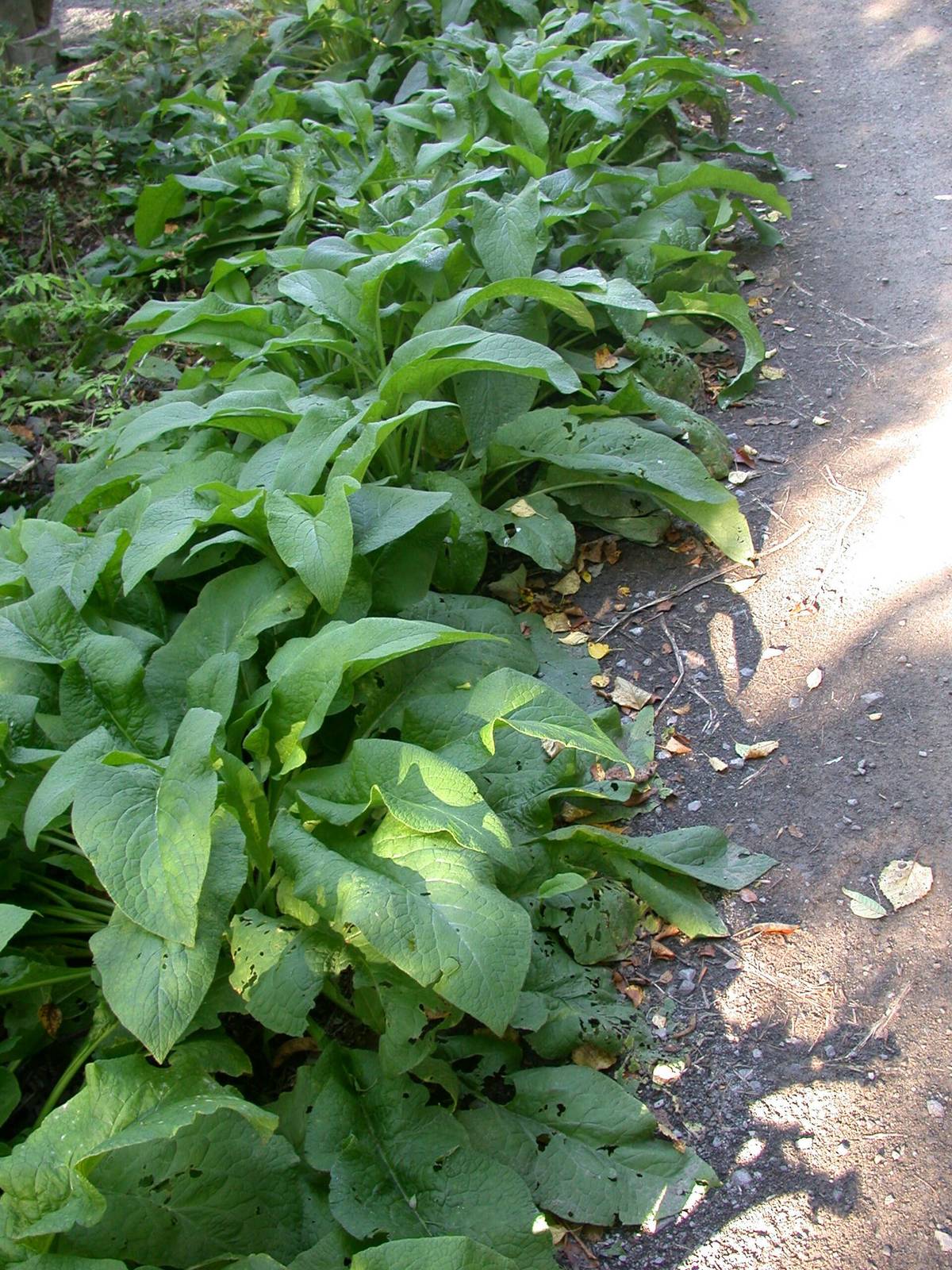
Photo: Wikimedia Commons contributor, CC BY-SA 4.0 via Wikimedia Commons

Quick facts
| Light: | Full sun and part shade (full sun preferred)12 |
|---|---|
| Water: | Dry to medium31 source |
| Soil: | Well drained, moist and occasionally dry; pH 6–7121 source |
| Hardiness: | Zones 4a–8b11 source |
| Size: | 1–3 ft (0.3–0.91 m) × 0.8–2.5 ft (0.23–0.76 m)11 source |
| Growth rate: | Rapid11 source |
| Bloom: | May–Jun, Pink, purple and white11 source |
| Cats: | Not documented by major sources |
| Dogs: | Not documented by major sources |
| Native range: | ALT, AUT, BGM, BLR, BUL, CZE, FRA, GER, GRB, HUN, ITA, KAZ, KRY, NCS, NET, POL, ROM, RUC, RUE, RUS, RUW, SAR, SIC, SPA, SWI, TUE, TUR, UKR, WSB, YUG4 |
| Family: | Boraginaceae |
How much light does a Common Comfrey need?
Grow this plant in full sun to part shade outdoors. Full sun is the preferred exposure, though it also grows well with part shade. It needs at least 2 hours of direct sunlight a day to grow well. Partial shade means direct sun for only part of the day, in a range of about 2 to 6 hours.
How often to water a Common Comfrey
Outdoors, give this plant soil moisture that ranges from dry to medium, since that is the range it tolerates. Its deep taproot and root system keep it from being prone to drought, though it still prefers moderate soil moisture overall. The soil should also offer good drainage, staying moist to occasionally dry. It is also reported to tolerate drought.
- Water: Dry to medium3
Best soil for a Common Comfrey
The soil this plant grows in should drain well and stay moist to occasionally dry. It should also be fertile and rich in organic matter, with a pH between 6 and 7. Good drainage matters most, and the soil can range from moist to occasionally dry. In practice, that means the ground can be well drained and moist, or sometimes on the dry side. It also tolerates clay soil.
Hardiness and temperature
This herbaceous perennial is hardy in USDA zones 4a through 8b. Within that range, it also grows quickly and keeps a spreading habit. No cited source on this page states a minimum winter temperature for it. Its hardiness listing covers zones from 4a up to 8b, the full range given.
- Hardiness: Zones 4a–8b1
How to plant a Common Comfrey
Plant this species in USDA hardiness zones 4a through 8b. Give each plant room to reach its mature size of 1 to 3 ft (0.3-0.91 m) tall and 0.8 to 2.5 ft (0.23-0.76 m) wide. Choose a spot with full sun to part shade, since that is the light range it prefers outdoors. Work good drainage into the soil, aiming for a pH between 6 and 7. It also has a spreading growth habit. It also grows at a rapid rate. In the US, it is classified as introduced.
- Hardiness: Zones 4a–8b1
Winter care
In winter, this plant stays hardy across USDA zones 4a through 8b. It is a herbaceous perennial, hardy within that zone range. No cited source on this page gives a minimum temperature it can survive. Its hardy range runs from zone 4a up to zone 8b, the same span given for its hardiness.
- Hardiness: Zones 4a–8b1
How to propagate a Common Comfrey
You can propagate this plant from seed, by division, or by taking root cuttings. All three, seed, division, and root cuttings, are documented ways to start new plants of this particular species. Division is the most specifically described of the three propagation methods. These are the three propagation methods documented for this plant species.
- Propagation: Seed, division and root cuttings1
Common problems
Slugs and snails are the pests recorded for this plant, and they may damage its foliage. Aside from that, no serious insect problems have been noted for it. No cited source on this page currently lists any diseases for it. It is also reported to resist deer.
- Common pests: slugs and snails1
| Problem | Kind |
|---|---|
| Slugs and snails | Pest |
| Snails | Pest |
Is Common Comfrey toxic to cats and dogs?
Recommended supplies
- Soil: a free-draining mix, and a pot with a drainage hole.
Questions and answers
- What kind of soil does this plant need?
- It needs soil with good drainage that ranges from moist to occasionally dry. A soil pH between 6 and 7 suits it best, according to the stated range.
- How much sun does this plant need outdoors?
- Grow it in full sun to part shade, with full sun as the preferred exposure. It needs at least 2 hours of direct sun a day.
- How do you propagate this plant?
- You can grow new plants from seed, by division, or by taking root cuttings. Division is the most specific method named for this plant species, among the three listed.
Sources
- NC State Extension Gardener Plant Toolbox. https://plants.ces.ncsu.edu/plants/symphytum-officinale/. Accessed 21 October 2026.
- Utah State University Extension. https://extension.usu.edu/yardandgarden/research/comfrey-in-the-garden. Accessed 21 October 2026.
- Utah State University Extension. https://extension.usu.edu/yardandgarden/research/comfrey-in-the-garden.php. Accessed 21 October 2026.
- Royal Botanic Gardens, Kew (World Checklist of Vascular Plants). https://sftp.kew.org/pub/data-repositories/WCVP/wcvp.zip. Accessed 4 June 2026.
How this page was made
- Written with AI assistance from the sources listed on this page. AI is never the source of a fact.