Pillpod Sandmat (Euphorbia hirta)
Formerly Chamaesyce hirta, Ditrita hirta, Desmonema hirta
Give pillpod sandmat full sun, though part shade and full shade are also listed, and keep its water at a medium level. Its soil should be well drained. It is an annual with a rapid growth rate. Both cats and dogs are listed as having a problem with this plant.
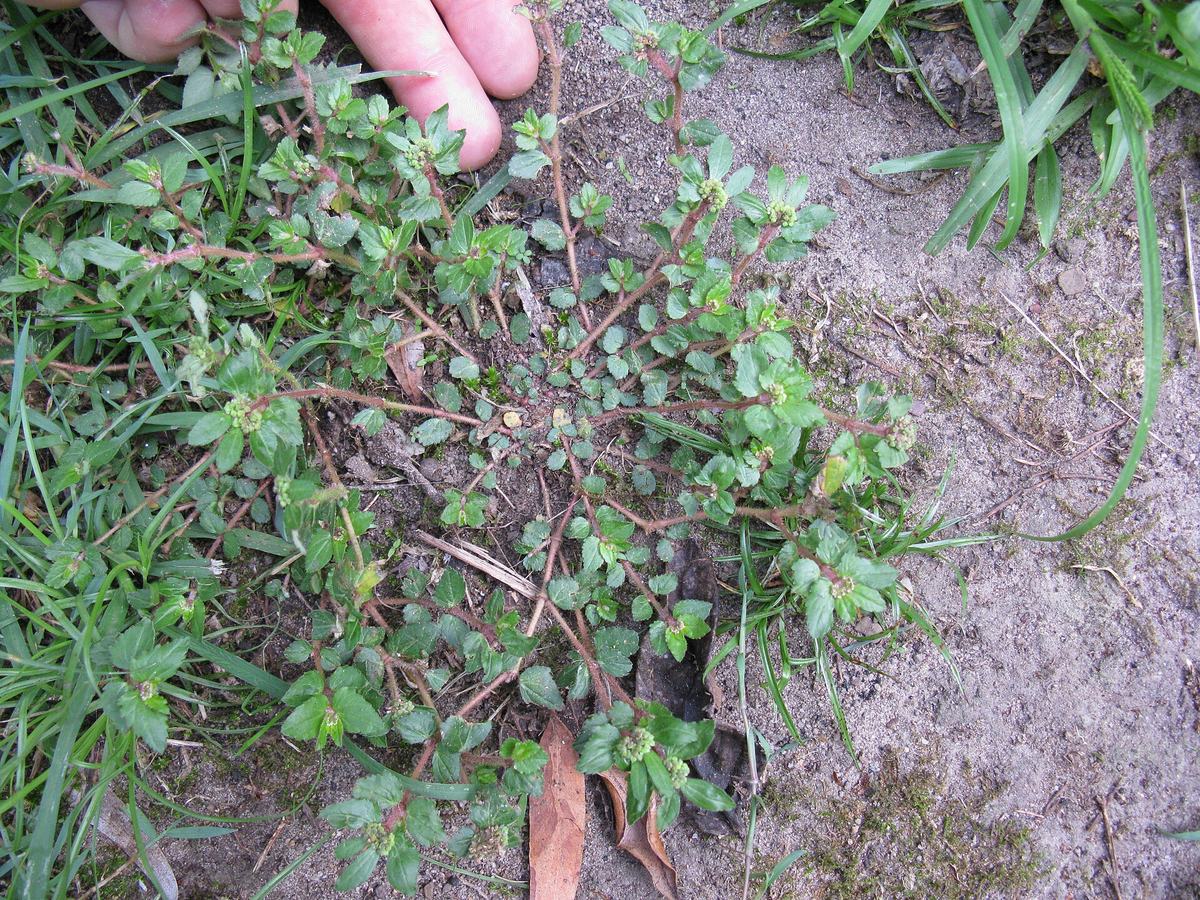
Photo: Harry Rose from South West Rocks, Australia, CC BY 2.0 via Wikimedia Commons

Quick facts
| Water: | Medium11 source |
|---|---|
| Soil: | Well drained, moist and occasionally dry11 source |
| Size: | 0.5–1 ft (0.15–0.3 m) × 1–2 ft (0.3–0.61 m)11 source |
| Growth rate: | Rapid1313 |
| Bloom: | Jun–Aug and Sep–Nov, White, red, green, brown and pink141 source |
| Cats: | Toxic to cats (1 source) 1 |
| Dogs: | Toxic to dogs (1 source) 1 |
| Native range: | AGE, AGW, ALA, ARI, ARU, BAH, BLZ, BOL, BZC, BZE, BZL, BZN, CAL, CLC, CLM, COS, CPI, CUB, DOM, ECU, ELS, FLA, FRG, GEO, GUA, HAI, HON, JAM, LEE, LOU, MSI, MXC, MXE, MXG, MXN, MXS, MXT, NCA, NEV, NIC, NLA, NWM, PAN, PAR, PER, PUE, SCA, SWC, TCI, TEX, TRT, UTA, VEN, VNA, WIN5 |
| Family: | Euphorbiaceae |
How often to water a Pillpod Sandmat
Pillpod sandmat needs a medium amount of water. Its source says it does require moderate amounts of water and well-drained soil. Medium is both the lowest and the highest water level recorded for it. No cited source gives a watering schedule for this plant.
- Water: Medium1
Best soil for a Pillpod Sandmat
Soil for pillpod sandmat is listed as well drained, moist and occasionally dry. The listing names moist and occasionally dry soil as separate entries. The source pairs moderate amounts of water with well-drained soil. No cited source records a soil pH for this plant. A preferred soil mix is not documented either.
How to propagate a Pillpod Sandmat
You can propagate pillpod sandmat from seed or from stem cuttings. Seed and stem cutting are the two methods recorded for it. The plant is listed as an annual with a rapid growth rate. Its mature height is 0.5–1 ft (0.15–0.3 m), and its spread is 1–2 ft (0.3–0.61 m). Sowing depth, timing and rooting steps are not documented, so this page does not give them.
Common problems
Aphids, mealybugs, spider mites, whiteflies and scale insects are the pests listed for pillpod sandmat. The source advises you to monitor for aphids, mealybugs and spider mites. Fungal diseases such as powdery mildew can occur. No cited source gives treatment steps for these pests or for the disease.
| Problem | Kind |
|---|---|
| Aphids | Pest |
| Mealybugs | Pest |
| Spider mites | Pest |
| Whiteflies | Pest |
| Scale insects | Pest |
| Powdery mildew | Disease |
Is Pillpod Sandmat toxic to cats and dogs?
Pillpod sandmat is listed as a problem for cats, and the toxicity value on record for cats is toxic. It is also listed as a problem for dogs, and the value on record for dogs is toxic. Keep this plant away from both cats and dogs. No cited source here names the plant parts involved, the signs, or a severity. This site covers cats and dogs only for pet toxicity.
Pet-safe alternatives
Recommended supplies
- Soil: a free-draining mix, and a pot with a drainage hole.
Questions and answers
- Is pillpod sandmat toxic to cats and dogs?
- It is listed as a problem for cats and as a problem for dogs, and the toxicity value for each is toxic. No cited source here names the plant parts involved or a severity.
- How much light does pillpod sandmat need?
- It can grow in full sun, part shade or full shade, with full sun preferred. One source says it prefers warm and sunny locations but can also grow in dense shade. No indoor light level is documented.
- How big does pillpod sandmat get?
- Its mature height is 0.5–1 ft (0.15–0.3 m), and its spread is 1–2 ft (0.3–0.61 m). It is listed as an annual with a rapid growth rate. In the US it is native in the lower 48 states and Puerto Rico, and introduced in Hawaii.
Sources
- NC State Extension Gardener Plant Toolbox. https://plants.ces.ncsu.edu/plants/euphorbia-hirta/. Accessed 14 October 2026.
- EPPO Global Database. https://gd.eppo.int/taxon/EPHHI/pests. Accessed 14 October 2026.
- UF/IFAS Extension (EDIS). https://ask.ifas.ufl.edu/publication/EP586. Accessed 14 October 2026.
- Lady Bird Johnson Wildflower Center. https://www.wildflower.org/plants/result.php?id_plant=CHHI3. Accessed 14 October 2026.
- Royal Botanic Gardens, Kew (World Checklist of Vascular Plants). https://sftp.kew.org/pub/data-repositories/WCVP/wcvp.zip. Accessed 4 June 2026.
How this page was made
- Written with AI assistance from the sources listed on this page. AI is never the source of a fact.