Silver Cock's Comb (Celosia argentea)
Formerly Celosia cristata, Celosia aurea, Celosia cernua
Check the top layer of soil before you water this plant, since it tolerates everything from dry to medium moisture. Give it full sun outdoors, though it also tolerates some part shade during the day. The ASPCA lists it as non-toxic to cats and to dogs.
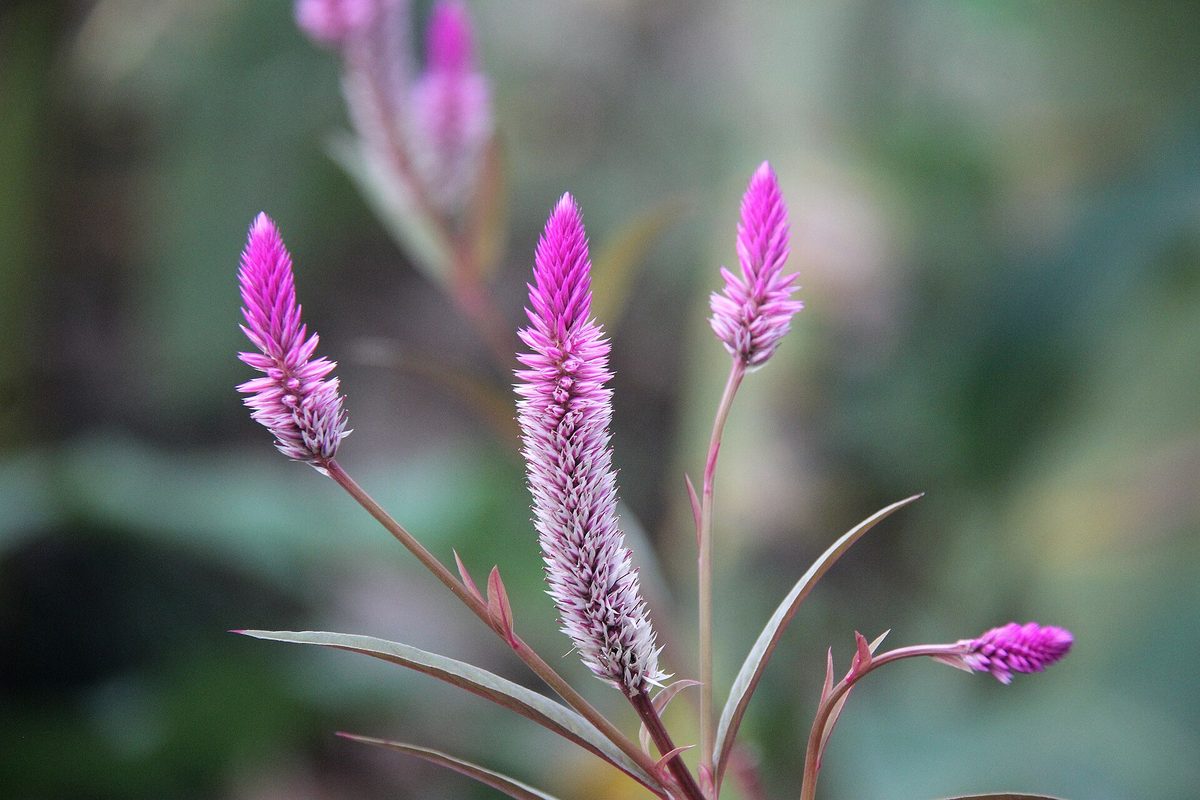
Photo: TheNuggeteer, CC BY-SA 4.0 via Wikimedia Commons

Quick facts
| Water: | Dry to medium11 source |
|---|---|
| Soil: | Well drained and occasionally dry; pH 6–8231 source |
| Size: | 0.7–1.5 ft (0.23–0.46 m) × 0.5–1 ft (0.15–0.3 m)321 source |
| Growth rate: | Rapid32 |
| Bloom: | May–Jun, Jul–Aug and Sep–Oct, Yellow, orange, pink, purple and red78231 source |
| Cats: | Non-toxic to cats 63 |
| Dogs: | Non-toxic to dogs 63 |
| Native range: | BEN, CAF, CHA, CMN, CON, EQG, ERI, ETH, GAB, GHA, GNB, GUI, IVO, KEN, LBR, MLW, NGA, NGR, SEN, SIE, SOM, SUD, TAN, UGA, ZAI, ZAM9 |
| Family: | Amaranthaceae |
How often to water a Silver Cock's Comb
This plant takes water across a dry-to-medium range, so let the top 1 to 2 inches (2.5-5 cm) of soil dry out between waterings. Well-drained soil suits it best, though it also tolerates soil that dries out from time to time. There's no fixed schedule to follow; just check the soil's top inch or two before you water again. Root rot appears on this plant's list of common diseases. Its native range spans parts of west, central, and east Africa, including countries such as Senegal, Ghana, Kenya, and Tanzania.
- Water: Dry to medium1
Best soil for a Silver Cock's Comb
Give silver cock's comb well-drained soil, since it also tolerates soil that dries out between waterings. Aim for a pH between 6.0 and 8.0, a range gardeners usually call neutral. That span runs from mildly acidic up through mildly alkaline. This plant grows best outdoors in full sun, and some sources also note it tolerating part shade. It's hardy in USDA zones 10a through 11a, with some sources listing a wider range down to zone 7b. In the US, this plant is considered introduced rather than native, both on the mainland and in Puerto Rico.
Pruning a Silver Cock's Comb
Pruning for silver cock's comb mainly means deadheading and some light shaping. On plumed and crested cultivars, pinch back the first flower as soon as it forms. Silver cock's comb grows in an upright, erect habit. Overall, this plant needs only low maintenance. Its flowers appear in several windows that span from May into October. This plant reaches a mature width of about 6 to 12 in (15-30 cm).
- Pruning: Deadheading and Light shaping4
How to propagate a Silver Cock's Comb
Silver cock's comb grows well from seed or from stem cuttings. For a cutting, take a piece 4 to 6 in (10-15 cm) long from the top of the plant. This species is an annual, completing its life cycle in a single growing season. It spreads to about 6 to 12 in (15-30 cm) wide at maturity, so give new plants that much room. Its blooms range across yellow, orange, pink, purple, and red depending on the cultivar.
- Propagation: Seed and stem cuttings1
Common problems
Watch for aphids and spider mites on silver cock's comb, along with thrips, slugs, and snails. Other pests on record include leafminers, root-knot nematodes, armyworms, and the sweet potato weevil. On the disease side, this plant can develop root rot. It is also listed as susceptible to beet curly top virus, tomato spotted wilt virus, and tobacco ringspot virus.
| Problem | Kind |
|---|---|
| Aphids | Pest |
| Spider mites | Pest |
| Snails | Pest |
| Slugs and snails | Pest |
| Thrips | Pest |
| Fall armyworm | Pest |
| Leafminers | Pest |
| Root knot nematode | Pest |
| Sweet potato weevil | Pest |
| Armyworms | Pest |
| Root rot | Disease |
| Beet curly top virus | Disease |
| Tomato spotted wilt virus | Disease |
| Tobacco ringspot virus | Disease |
Is Silver Cock's Comb toxic to cats and dogs?
Non-toxic is the position both the ASPCA and NC State Extension take on silver cock's comb for cats. Both sources also list it as non-toxic to dogs. No part of this plant is flagged as a toxicity concern for either pet by these sources. You can grow silver cock's comb indoors or out without this plant appearing on either organization's toxic list. NC State Extension tags this plant with its own non-toxic label for both cats and dogs in its plant database.
Recommended supplies
- Soil: a free-draining mix, and a pot with a drainage hole.
Questions and answers
- Is silver cock's comb toxic to cats or dogs?
- Silver cock's comb is listed as non-toxic to both cats and dogs by the ASPCA and by NC State Extension. The ASPCA page confirms this for cats, and a separate entry confirms the same for dogs.
- How often should I water silver cock's comb?
- Water once the soil's top inch or two (2.5-5 cm) feels dry to the touch. This plant tolerates moisture levels anywhere from dry to medium, so there is no fixed schedule to follow. This plant also does best in well-drained soil. Root rot is listed among its common diseases.
- How do you propagate silver cock's comb?
- You can start new plants from seed or from a stem cutting. Cut a 4 to 6 in (10-15 cm) piece from the top of the plant to start a cutting.
Sources
- University of Minnesota Extension. https://extension.umn.edu/garden-and-home/yard-and-garden/gardening-in-minnesota/celosia. Accessed 14 October 2026.
- University of Florida IFAS Extension (EDIS). https://ask.ifas.ufl.edu/publication/FP114. Accessed 14 October 2026.
- NC State Extension Gardener Plant Toolbox. https://plants.ces.ncsu.edu/plants/celosia-argentea/. Accessed 14 October 2026.
- University of Florida IFAS Extension (EDIS). https://ask.ifas.ufl.edu/fp114. Accessed 24 October 2026.
- EPPO Global Database. https://gd.eppo.int/taxon/CEOAR/pests. Accessed 14 October 2026.
- ASPCA Animal Poison Control Center. https://www.aspca.org/pet-care/aspca-poison-control/toxic-and-non-toxic-plants/woolflower. Accessed 14 October 2026.
- Chicago Botanic Garden. https://www.chicagobotanic.org/plant-information/plant-finder/celosia-argentea-asian-garden-asian-garden-celosia. Accessed 21 October 2026.
- Chicago Botanic Garden. https://www.chicagobotanic.org/plant-information/plant-finder/celosia-argentea-celbofirosa-cockscomb. Accessed 21 October 2026.
- Royal Botanic Gardens, Kew (World Checklist of Vascular Plants). https://sftp.kew.org/pub/data-repositories/WCVP/wcvp.zip. Accessed 4 June 2026.
How this page was made
- Written with AI assistance from the sources listed on this page. AI is never the source of a fact.