Madagascar Periwinkle (Catharanthus roseus)
Formerly Lochnera rosea, Vinca rosea, Pervinca rosea
Catharanthus roseus is a rapid-growing annual or herbaceous perennial with an erect, spreading or trailing habit, growing 0.5 to 1.5 ft (0.15-0.46 m) tall. It blooms from July through September in colors including yellow, pink, purple, white, red, orange and blue. It can take soil from dry to medium. It is toxic to both cats and dogs.
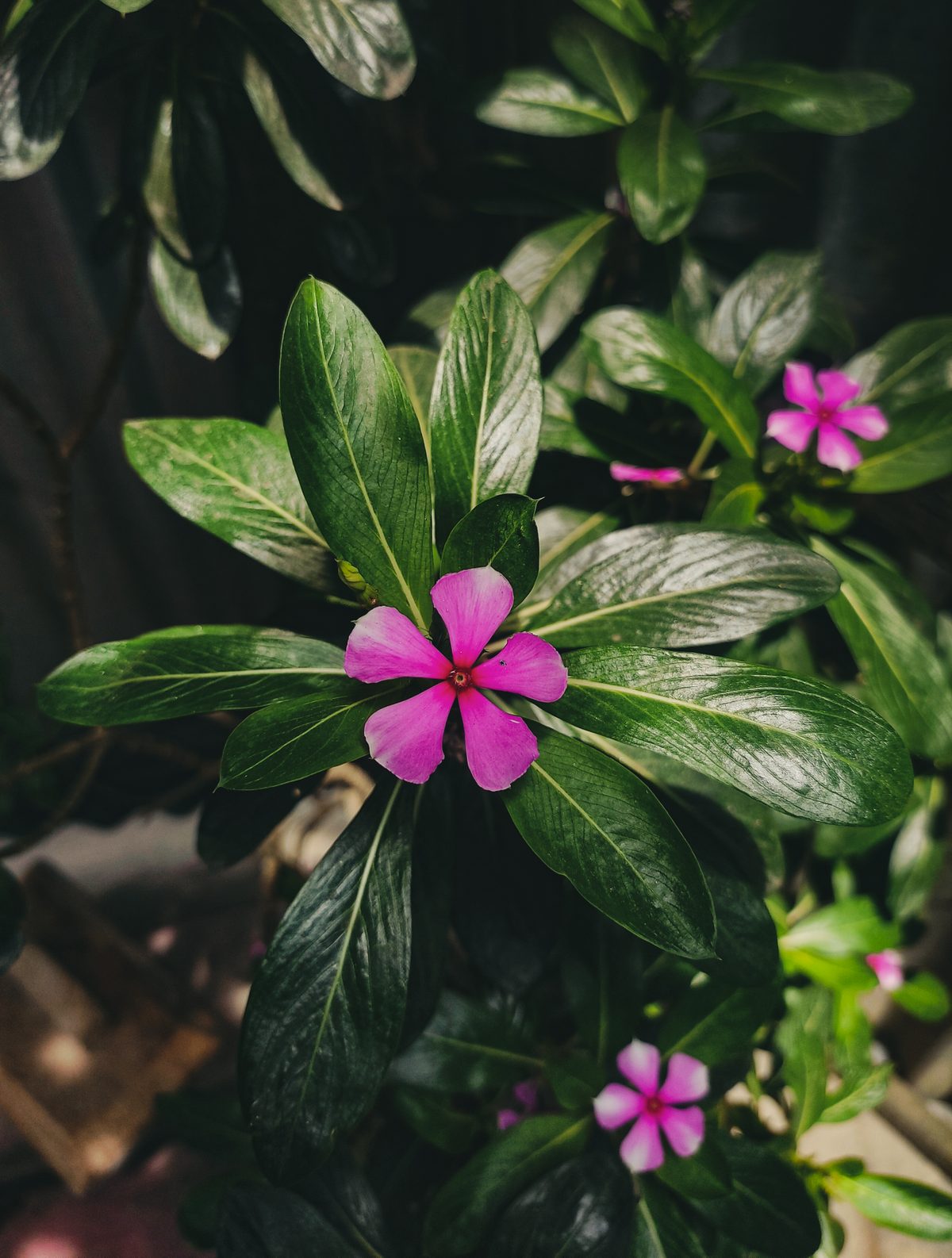
Photo: Tanvir Rahat, CC BY-SA 4.0 via Wikimedia Commons

Quick facts
| Water: | Dry to medium11 source |
|---|---|
| Soil: | Well drained and occasionally dry; pH 5.5–612 |
| Size: | 0.5–1.5 ft (0.15–0.46 m) × 0.7–1 ft (0.2–0.3 m)11 source |
| Growth rate: | Rapid1144 |
| Bloom: | Jul–Sep, Yellow, pink, purple, white, red, orange and blue1821 source |
| Cats: | Toxic to cats (1 source) 7 |
| Dogs: | Toxic to dogs (1 source) 7 |
| Native range: | MDG9 |
| Family: | Apocynaceae |
How often to water a Madagascar Periwinkle
Catharanthus roseus can be watered on a schedule that keeps the soil dry to medium in moisture. At the drier end of that range, it shows moderate to high drought tolerance. The soil should also drain well, though this plant can tolerate soil that stays occasionally dry. Soil that drains well suits it, and it does not need to be kept wet at all times.
- Water: Dry to medium1
Best soil for a Madagascar Periwinkle
Catharanthus roseus grows best in soil that stays moist and drains well. It also tolerates soil that runs occasionally dry instead of staying evenly moist at all times. A soil pH between 5.5 and 6 suits this plant best, matching the well-drained organic soils it is often grown in. It can also tolerate soil with a pH higher than that range.
Fertilizing a Madagascar Periwinkle
Catharanthus roseus does not need fertilizer through the growing season. It is a very light feeder, which is why regular feeding is not required. You can leave fertilizer out of its care routine entirely without causing any problems for the plant. No feeding schedule is necessary for this plant across the growing season.
- Fertilizer: Not needed3
Pruning a Madagascar Periwinkle
Spent flowers on Catharanthus roseus do not need deadheading to produce more blooms. The plant also does not need pinching to keep a tidy growth habit. Overall, no deadheading or pinching is ever needed to keep this plant looking tidy. There is no pruning task you need to add to its care.
- Pruning: No pruning needed2
How to propagate a Madagascar Periwinkle
Catharanthus roseus can be propagated from seed or from stem cuttings. Cuttings taken from this plant typically take about 3 to 4 weeks to root. Both seed and cutting propagation are standard methods used for this species. Seed-grown plants and cutting-grown plants are both valid ways to start Catharanthus roseus at home.
Common problems
Catharanthus roseus can attract pests such as aphids, black scale, scales, spider mites, weevils and whiteflies. Diseases recorded on this plant include aster yellows, powdery mildew, several root and crown rots, verticillium wilt, leaf spot, gray mold and tomato spotted wilt virus. Watch for these pests and diseases when growing Catharanthus roseus.
- Common pests: aphids, black scale, scales, spider mites, weevils and whiteflies5
- Common diseases: aster yellows, powdery mildew, root stem crown rot, verticillium wilt, phytophthora root rot, pythium root rot, leaf spot, rhizoctonia root rot, gray mold, black root rot and tomato spotted wilt virus56
| Problem | Kind |
|---|---|
| Aphids | Pest |
| Black scale | Pest |
| Scales | Pest |
| Spider mites | Pest |
| Weevils | Pest |
| Whiteflies | Pest |
| Aster yellows | Disease |
| Powdery mildew | Disease |
| Root stem crown rot | Disease |
| Verticillium wilt | Disease |
| Phytophthora root rot | Disease |
| Pythium root rot | Disease |
| Leaf spot | Disease |
| Rhizoctonia root rot | Disease |
| Gray mold | Disease |
| Black root rot | Disease |
| Tomato spotted wilt virus | Disease |
Is Madagascar Periwinkle toxic to cats and dogs?
Catharanthus roseus is toxic to both cats and dogs. The ASPCA lists this plant as toxic for both of these pets. This plant is not safe for either pet to eat. Keep cats and dogs away from Catharanthus roseus to avoid the risk it poses to them. Both cats and dogs are named specifically in the ASPCA's toxic plant listing for this species. This makes Catharanthus roseus a plant that pet owners should keep away from curious cats and dogs.
Pet-safe alternatives
Recommended supplies
- Soil: a free-draining mix, and a pot with a drainage hole.
Questions and answers
- Is Catharanthus roseus toxic to cats or dogs?
- Yes, the ASPCA lists Catharanthus roseus as toxic to both cats and dogs, so keep the plant out of reach of your pets. Treat it as unsafe for both cats and dogs to chew on or eat.
- How much water does Catharanthus roseus need?
- It can grow in soil that ranges from dry to medium in moisture, and it shows a moderate to high tolerance for drought. The soil it grows in can also drain well without staying wet.
- How do you propagate Catharanthus roseus?
- You can start new Catharanthus roseus plants from seed or from stem cuttings, and the cuttings typically take about 3 to 4 weeks to root. Both seed-grown and cutting-grown plants are standard ways gardeners start this species.
Sources
- NC State Extension Gardener Plant Toolbox. https://plants.ces.ncsu.edu/plants/catharanthus-roseus/. Accessed 12 October 2026.
- Clemson Cooperative Extension Home & Garden Information Center. https://hgic.clemson.edu/factsheet/annual-vinca/. Accessed 12 October 2026.
- University of Minnesota Extension. https://extension.umn.edu/flowers/vinca. Accessed 1 November 2026.
- University of Florida IFAS Extension (EDIS). https://ask.ifas.ufl.edu/publication/FP112. Accessed 12 October 2026.
- UC Statewide Integrated Pest Management Program. https://ipm.ucanr.edu/home-and-landscape/vinca-myrtle-periwinkle/. Accessed 12 October 2026.
- Clemson Cooperative Extension Home & Garden Information Center. https://hgic.clemson.edu/factsheet/vinca-diseases/. Accessed 12 October 2026.
- ASPCA Animal Poison Control Center. https://www.aspca.org/pet-care/aspca-poison-control/toxic-and-non-toxic-plants/vinca. Accessed 12 October 2026.
- University of Minnesota Extension. https://extension.umn.edu/garden-and-home/yard-and-garden/gardening-in-minnesota/vinca. Accessed 1 November 2026.
- Royal Botanic Gardens, Kew (World Checklist of Vascular Plants). https://sftp.kew.org/pub/data-repositories/WCVP/wcvp.zip. Accessed 4 June 2026.
How this page was made
- Written with AI assistance from the sources listed on this page. AI is never the source of a fact.