Spilanthes (Acmella oleracea)
Formerly Spilanthes oleracea, Bidens fusca, Cotula dichotoma
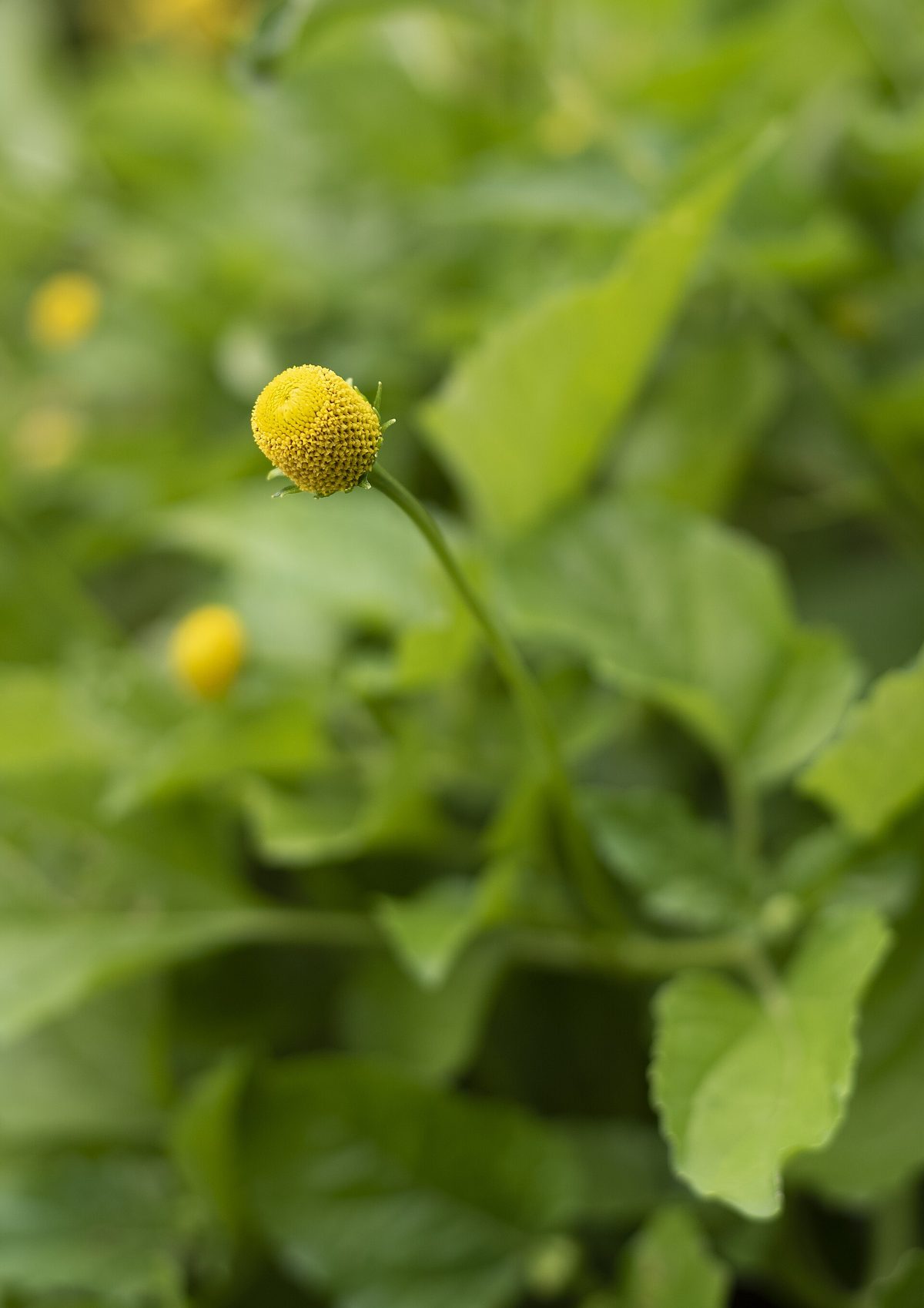
Photo: Sixflashphoto, CC BY-SA 4.0 via Wikimedia Commons

Quick facts
| Soil: | Well drained and moist11 source |
|---|---|
| Size: | 1–1.5 ft (0.3–0.46 m) × 1–1.5 ft (0.3–0.46 m)11 source |
| Growth rate: | Rapid11 source |
| Bloom: | Jun–Nov, Yellow, orange and red11 source |
| Cats: | Not documented by major sources |
| Dogs: | Not documented by major sources |
| Native range: | BZL2 |
| Family: | Asteraceae |
Best soil for a Spilanthes
Spilanthes (Acmella oleracea) is listed for soil that is well drained and moist. The drainage entry in its source reads Good Drainage. Those two descriptions are recorded together for this plant. A mature plant reaches 1 to 1.5 ft (0.3–0.46 m) in height. Its spread is also 1 to 1.5 ft (0.3–0.46 m).
- Soil drainage: Well drained and moist1
Temperature and humidity
Humidity is recorded as high for spilanthes, the common name for Acmella oleracea. In its native environment, the relative humidity is 85%, a figure the source gives alongside heavy rainfall. The average temperature there is 82 °F (28 °C). The USDA hardiness zones listed for this plant run from 9a to 11b.
How to propagate a Spilanthes
Spilanthes can be propagated by seed or by stem cuttings. No other propagation method is listed for it. The plant type is recorded as annual, and its growth rate is listed as rapid. Its native range is recorded with the code BZL.
- Propagation: Seed and stem cuttings1
Common problems
The listing for spilanthes records no significant pest problems. It records no significant disease problems either. No individual pests or diseases are named for this plant. Full sun is preferred outdoors, and part shade is also listed.
Is Spilanthes toxic to cats and dogs?
Recommended supplies
- Soil: a free-draining mix, and a pot with a drainage hole.
- Humidity: it wants humid air; a pebble tray or a humidifier is the usual fix.
Questions and answers
- How much sun does spilanthes need outdoors?
- Full sun is preferred, which the source defines as 6 or more hours of direct sunlight a day. Part shade is also listed, meaning direct sun for only part of the day, 2 to 6 hours. The soil is described as well drained and moist.
- Where can spilanthes grow outdoors?
- It is listed for USDA hardiness zones 9a to 11b. Humidity in its native environment is recorded as high, at 85%, with an average temperature of 82 °F (28 °C).
- How big does spilanthes get?
- A mature plant is 1 to 1.5 ft (0.3–0.46 m) tall and the same in width. Its growth rate is listed as rapid, and it is classed as an annual.
Sources
- NC State Extension Gardener Plant Toolbox. https://plants.ces.ncsu.edu/plants/acmella-oleracea/. Accessed 14 October 2026.
- Royal Botanic Gardens, Kew (World Checklist of Vascular Plants). https://sftp.kew.org/pub/data-repositories/WCVP/wcvp.zip. Accessed 4 June 2026.
How this page was made
- Written with AI assistance from the sources listed on this page. AI is never the source of a fact.