Prayerplant (Maranta leuconeura)
Formerly Maranta massangeana, Calathea leuconeura, Maranta depressa
Keep prayerplant in bright, indirect light indoors, and keep the soil evenly moist. Let the soil dry between waterings during winter, and give the plant high humidity. No verified toxicity record for cats is on file for this plant, and none is on file for dogs either.
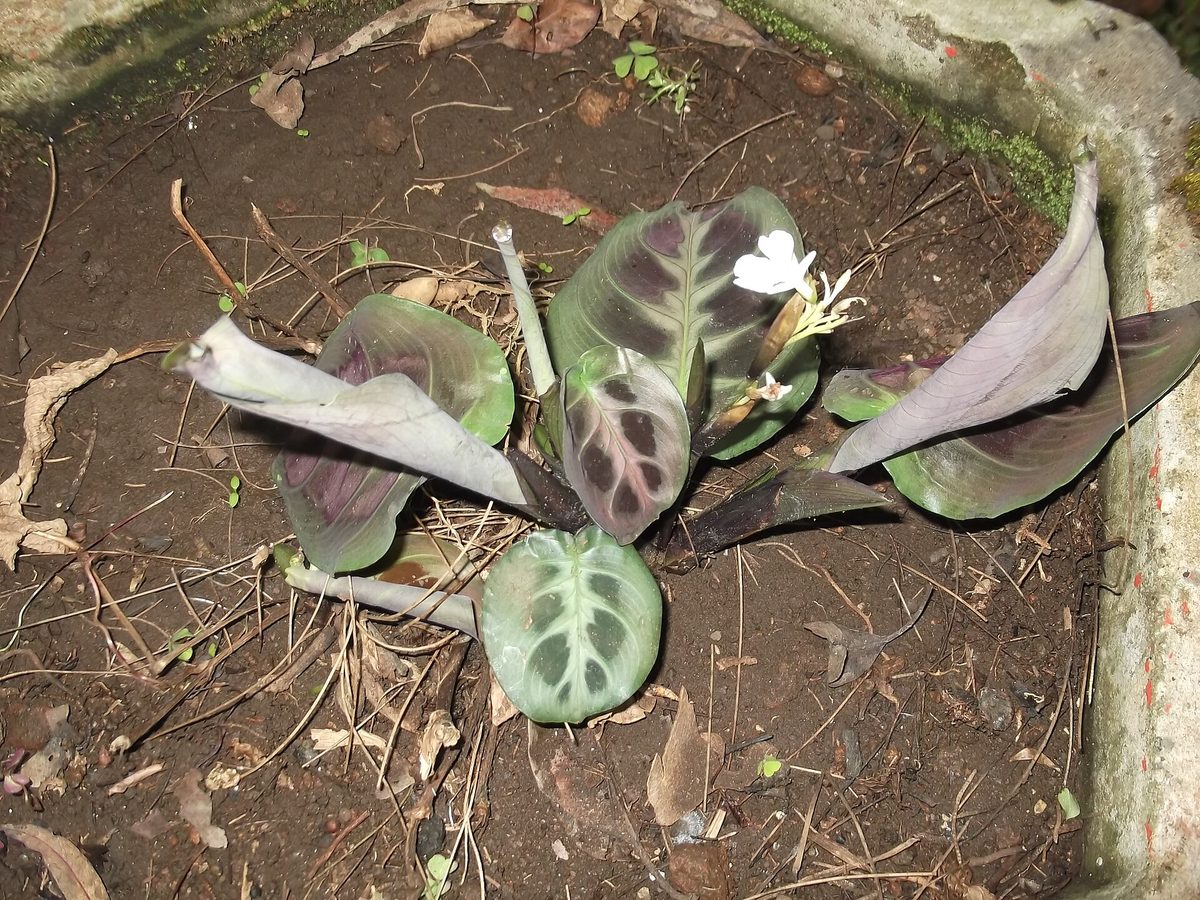
Photo: Yercaud-elango, CC BY-SA 4.0 via Wikimedia Commons

Quick facts
| Light: | Bright, indirect light; tolerates low light and medium light11 source |
|---|---|
| Water: | Dry to wet21 source |
| Soil: | Well drained and moist; pH 6–6131 source |
| Minimum temperature: | 64.4 °F (18 °C)41 source |
| Size: | 0.5–1 ft (0.15–0.3 m) × 0.5–2 ft (0.15–0.61 m)11 source |
| Bloom: | Purple and white11 source |
| Cats: | Not documented by major sources |
| Dogs: | Not documented by major sources |
| Native range: | BZC, BZE, BZL5 |
| Family: | Marantaceae |
How much light does a Prayerplant need?
When you grow prayerplant indoors, place it in bright, indirect light. It also tolerates low light and medium light. Outdoors, part shade is the preferred setting, and full shade is also listed. The source describes the outdoor setting as dappled sunlight, with shade through the upper canopy all day. Outdoor growing is listed for USDA zones 11a and 11b.
- Light: Bright, indirect light; tolerates low light and medium light1
How often to water a Prayerplant
Keep the soil of a prayerplant evenly moist. During winter, allow the soil to dry between waterings. The recorded water range runs from dry to medium at the low end up to medium to wet at the high end. Root rot may occur with poorly drained soils, so check the soil's condition and its drainage before you add more water.
- Water: Dry to wet2
Best soil for a Prayerplant
Prayerplant grows in soil that is well drained and moist. The NC State Extension Gardener Plant Toolbox notes that root rot may occur with poorly drained soils. Penn State Extension advises that you maintain a soil pH near 6. The same source says to use micronutrients or iron chelate to avoid iron deficiency. The plant reaches 0.5–1 ft (0.15–0.3 m) tall, and its spread is 0.5–2 ft (0.15–0.61 m).
Temperature and humidity
Prayerplant requires high humidity. The NC State Extension Gardener Plant Toolbox suggests a humidified room or a pot standing in a tray of wet pebbles. University of Illinois Extension pairs warm temperatures with high humidity. For temperature, University of Missouri Extension mentions 65 degrees at night, and the minimum on file is 64.4 °F (18 °C). Outdoors, the listed hardiness is USDA zones 11a to 11b.
How to propagate a Prayerplant
You can propagate prayerplant by division. The source specifically names rhizomatous division. Root cuttings are also listed as a method. The methods recorded for this plant are division and root cuttings, and no other method is on file. The plant spreads horizontally, with a mature spread of 0.5–2 ft (0.15–0.61 m).
- Propagation: Division and root cuttings1
Common problems
The NC State Extension Gardener Plant Toolbox reports no serious insect or disease problems. Occasional spider mites and mealybugs can be an issue. Aphids and root knot nematode are also listed among the pests. The diseases listed are cucumber mosaic virus, helminthosporium leaf spot and root rot. Root rot may occur with poorly drained soils.
| Problem | Kind |
|---|---|
| Spider mites | Pest |
| Mealybugs | Pest |
| Aphids | Pest |
| Root knot nematode | Pest |
| Cucumber mosaic virus | Disease |
| Helminthosporium leaf spot | Disease |
| Root rot | Disease |
Is Prayerplant toxic to cats and dogs?
Recommended supplies
- Light: bright, indirect light, such as near an east window; a full-spectrum grow light substitutes where no window does.
- Soil: a free-draining mix, and a pot with a drainage hole.
- Humidity: it wants humid air; a pebble tray or a humidifier is the usual fix.
Questions and answers
- How much light does a prayerplant need?
- Indoors, prayerplant does best in bright, indirect light, and it also tolerates low light and medium light. Outdoors, part shade is the preferred setting, and full shade is also listed.
- Does a prayerplant need high humidity?
- Prayerplant requires high humidity. The NC State Extension Gardener Plant Toolbox suggests a humidified room or a pot standing in a tray of wet pebbles. The minimum temperature on file is 64.4 °F (18 °C).
- How should I water a prayerplant?
- Keep the soil evenly moist, but allow it to dry between waterings during winter. Root rot may occur with poorly drained soils, so the soil should be well drained as well as moist.
Sources
- NC State Extension Gardener Plant Toolbox. https://plants.ces.ncsu.edu/plants/maranta-leuconeura/. Accessed 14 October 2026.
- University of Illinois Extension. https://extension.illinois.edu/houseplants/prayer-plant. Accessed 14 October 2026.
- Penn State Extension. https://extension.psu.edu/maranta-diseases. Accessed 14 October 2026.
- University of Missouri Extension. https://extension.missouri.edu/publications/g6510. Accessed 27 October 2026.
- Royal Botanic Gardens, Kew (World Checklist of Vascular Plants). https://sftp.kew.org/pub/data-repositories/WCVP/wcvp.zip. Accessed 4 June 2026.
How this page was made
- Written with AI assistance from the sources listed on this page. AI is never the source of a fact.