Inchplant (Tradescantia zebrina)
Formerly Zebrina pendula, Cyanotis vittata, Cyanotis zebrina
Inchplant stays healthy indoors with medium light and soil that is allowed to dry out between waterings. Its moisture needs range from dry to medium, with less water needed in winter. This plant is low maintenance and grows at a fast rate. It is listed as toxic to both cats and dogs.
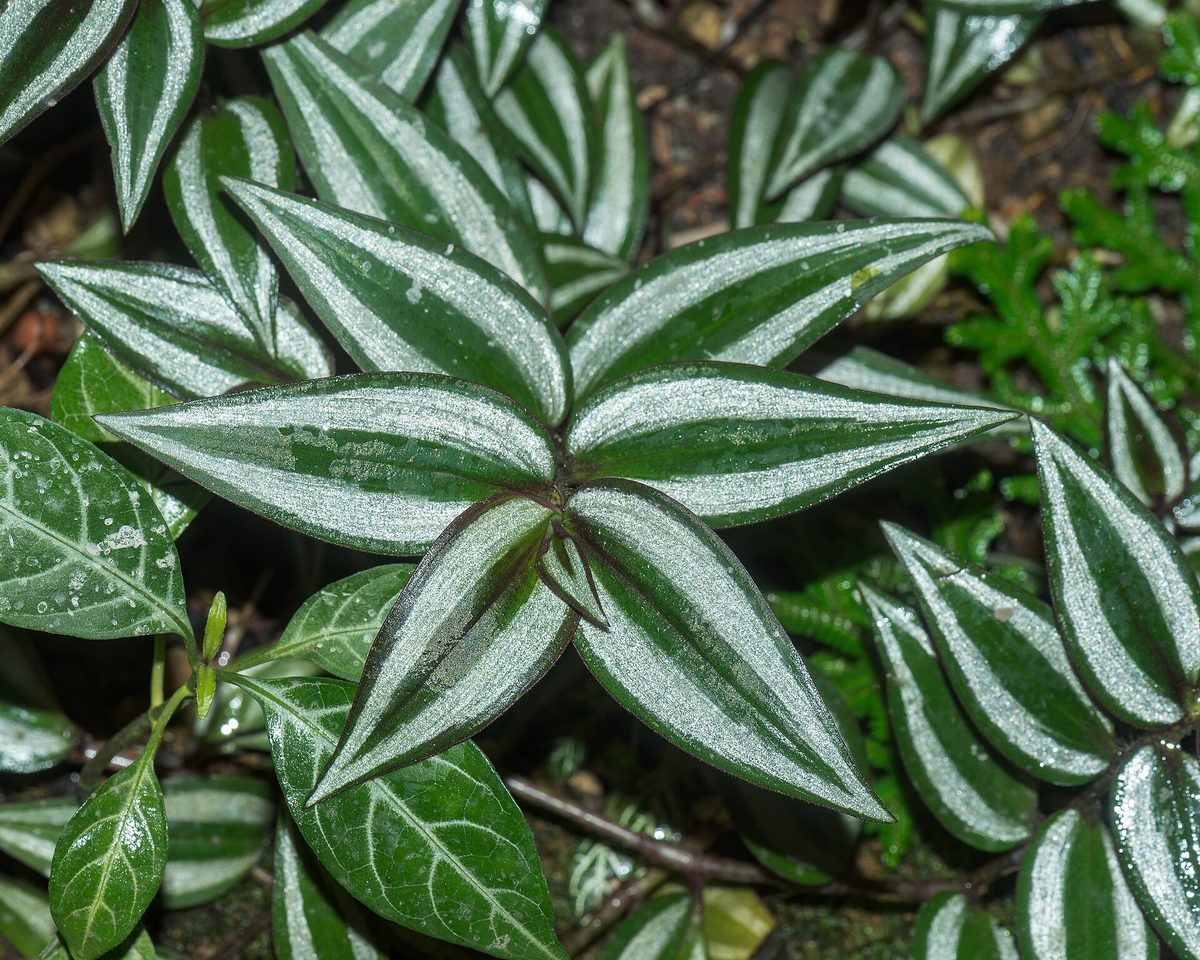
Photo: Flocci Nivis, CC BY 4.0 via Wikimedia Commons

Quick facts
| Light: | Medium light11 source |
|---|---|
| Water: | Dry to medium21 source |
| Minimum temperature: | 55.4 °F (13 °C)31 source |
| Size: | 0.5–0.8 ft (0.15–0.23 m) × 1–2 ft (0.3–0.61 m)21 source |
| Growth rate: | Rapid21 source |
| Bloom: | Jan–Dec, Blue, pink and purple21 source |
| Cats: | Toxic to cats (1 source) 2 |
| Dogs: | Toxic to dogs (1 source) 2 |
| Native range: | BLZ, CLM, COS, ELS, GUA, HON, MXC, MXE, MXG, MXN, MXS, MXT, NIC, PAN5 |
| Family: | Commelinaceae |
How much light does an Inchplant need?
Give inchplant a spot with medium indoor light, since indoor measurements place its requirement between about 100 and 150 footcandles. Outdoors, this plant performs best with full sun, meaning six hours or more of direct sunlight every day. It also tolerates part shade and does best in filtered sunlight. Full sun is therefore the preferred outdoor condition, with part shade and filtered light as tolerated alternatives. Indoors, no other light level is listed as tolerated for this plant beyond medium light.
- Light: Medium light1
How often to water an Inchplant
This plant's moisture needs fall between dry and medium, so let the top layer of soil dry out before you water again. Water it regularly through the warmer months, then cut back on watering once winter arrives. Soil that stays soggy for long periods can lead to root rot and stem rot. This means checking how dry the soil feels rather than watering on a fixed schedule.
- Water: Dry to medium2
Temperature and humidity
Nighttime temperatures should stay at or above 55.4°F (13°C), since that is the coldest reading reported for this plant indoors. Outdoors, it is hardy in USDA zones 9a through 11b, and gardeners use it as a groundcover across zones 9 to 11. Humidity levels are flexible for this plant, since it tolerates average home humidity as well as higher, more humid conditions. In the United States, it is recorded as introduced in Hawaii, the lower 48 states and Puerto Rico.
Pruning an Inchplant
This plant tolerates heavy pruning and has a rapid growth rate, and pinching back the stems promotes denser, fuller foliage. Removing leggy growth also gives you stem cuttings, which you can use afterward to propagate new plants from this species. Overall, this plant needs only low maintenance. Mature plants reach 0.5 to 0.8 ft (0.15-0.23 m) tall and spread 1 to 2 ft (0.3-0.61 m) wide.
- Pruning: Light shaping4
How to propagate an Inchplant
You can propagate inchplant from stem cuttings taken from the plant. Removing leggy growth from the plant provides material for these cuttings, which you can then use to propagate and start new plants. This plant has a trailing, creeping habit, and it can be used as a groundcover. It also grows at a rapid rate.
- Propagation: Stem cuttings2
Common problems
Watch this plant for aphids, mealybugs, scale, whiteflies and spider mites, since these pests can become a problem if left unchecked. Soggy soil can lead to root rot and stem rot. Leaf spot is also listed as a disease that can affect this plant. Together, these are the pests and diseases recorded for inchplant.
| Problem | Kind |
|---|---|
| Aphids | Pest |
| Mealybugs | Pest |
| Scale insects | Pest |
| Whiteflies | Pest |
| Spider mites | Pest |
| Root rot | Disease |
| Stem rot | Disease |
| Leaf spot | Disease |
Is Inchplant toxic to cats and dogs?
Inchplant is listed as toxic to cats. It is also listed as toxic to dogs. Cats are named specifically as an animal this plant is a problem for. Dogs are named in the same way, as a separate animal this plant is toxic to. This toxic rating applies to inchplant specifically, under both of its listed animal categories: cats and dogs.
Pet-safe alternatives
Recommended supplies
- Light: a bright room out of direct sun; a full-spectrum grow light makes up the difference in a darker one.
Questions and answers
- Is inchplant toxic to cats and dogs?
- Yes, inchplant is listed separately as toxic to cats and as toxic to dogs. Both listings mark the whole plant as a toxicity concern for each animal.
- How much light does inchplant need indoors?
- Indoors, inchplant needs medium light, which falls between roughly 100 and 150 footcandles on a light meter. Outdoors, it performs best in full sun but also tolerates part shade and filtered sunlight.
- How should you water inchplant?
- Water inchplant so its moisture stays between dry and medium, letting the soil surface dry out before you water again. Cut back on watering during the winter months, since the plant needs less moisture then.
Sources
- Clemson Cooperative Extension Home & Garden Information Center. https://hgic.clemson.edu/factsheet/indoor-plants-cleaning-fertilizing-containers-light-requirements/. Accessed 15 October 2026.
- NC State Extension Gardener Plant Toolbox. https://plants.ces.ncsu.edu/plants/tradescantia-zebrina/. Accessed 14 October 2026.
- University of Missouri Extension. https://extension.missouri.edu/publications/g6510?p=1. Accessed 27 October 2026.
- University of Wisconsin-Madison Division of Extension (Wisconsin Horticulture). https://hort.extension.wisc.edu/articles/tradescantia-zebrina/. Accessed 30 October 2026.
- Royal Botanic Gardens, Kew (World Checklist of Vascular Plants). https://sftp.kew.org/pub/data-repositories/WCVP/wcvp.zip. Accessed 4 June 2026.
How this page was made
- Written with AI assistance from the sources listed on this page. AI is never the source of a fact.