Poison Hemlock (Conium maculatum)
Formerly Coriandrum maculatum, Sium conium, Conium cicuta
Poison hemlock prefers full sun, also grows in part shade, and suits medium to wet conditions. It is a herbaceous perennial with a rapid growth rate. The ASPCA lists it as toxic to cats and toxic to dogs, and Pet Poison Helpline calls it highly toxic. In the lower 48 US states it is recorded as introduced.
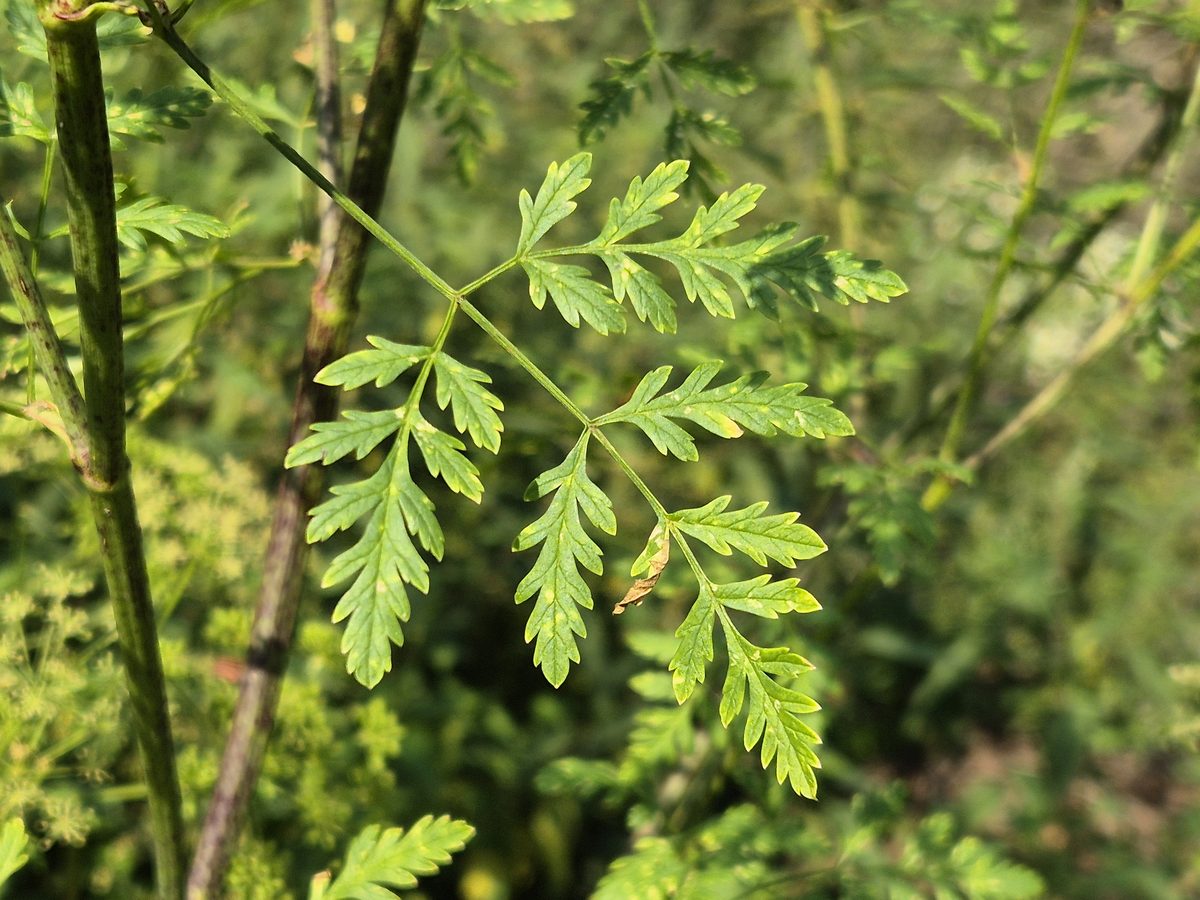
Photo: Stefan.lefnaer, CC BY-SA 4.0 via Wikimedia Commons

Quick facts
| Light: | Full sun and part shade (full sun preferred)112 |
|---|---|
| Water: | Medium to wet31 source |
| Soil: | Moist11 source |
| Size: | 6–10 ft (1.83–3.05 m) × 4–5 ft (1.22–1.52 m)11 source |
| Growth rate: | Rapid111 source |
| Bloom: | White, purple and pink127 |
| Cats: | Toxic to cats 561 |
| Dogs: | Toxic to dogs 561 |
| Native range: | AFG, ALB, ALG, AUT, BAL, BGM, BLR, BLT, BUL, CHX, COR, CYP, CZE, DEN, EAI, ETH, FIN, FRA, GER, GRC, HUN, IRN, IRQ, ITA, KAZ, KGZ, KRI, KRY, LBS, LBY, MOR, NCS, NET, PAK, PAL, POL, POR, ROM, RUC, RUE, RUN, RUS, RUW, SAR, SAU, SIC, SPA, SWE, SWI, TCS, TKM, TUE, TUN, TUR, TZK, UKR, UZB, WHM, YEM, YUG8 |
| Family: | Apiaceae |
How much light does a Poison Hemlock need?
Full sun is the preferred light for poison hemlock. The source defines full sun as at least six hours of direct sun per day. The plant also grows in partial shade, which the same source defines as direct sunlight only part of the day, between two and six hours. Those two exposures are the only light levels recorded for it. A site with six hours of sun or more meets the preferred level, and a site with two to six hours meets the shadier one.
How often to water a Poison Hemlock
Poison hemlock suits conditions from medium to wet. Utah State University Extension reports that it occurs on wet soils. The same source says it is often found along ditches, in low-lying waste places and along roadsides. It also tolerates poorly drained soils. No watering schedule in days is documented for this plant.
- Water: Medium to wet3
Best soil for a Poison Hemlock
Moist is the soil drainage recorded for poison hemlock. On wet soils, Utah State University Extension says it is usually found with a water table. Poorly drained ground is something the plant tolerates, according to that source. No soil pH is documented for this plant. No soil amendments or potting mixes are documented either.
- Soil drainage: Moist1
How to propagate a Poison Hemlock
Seed is the only propagation method recorded for poison hemlock. University of Minnesota Extension says the plant produces round, rigid seeds in abundant quantities. The same source describes two seeds per capsule that split at maturity. No cutting or division methods are documented. Sowing depth and germination conditions are not documented either.
- Propagation: Seed2
Common problems
EPPO Global Database lists several pests for poison hemlock: Graphocephala atropunctata, Platynota stultana, Aphrophora permutata, Margarodes vitis and Naupactus xanthographus. Two diseases are listed as well: Xylella fastidiosa and tomato spotted wilt virus. No symptoms, damage descriptions or treatments are documented for any of them.
| Problem | Kind |
|---|---|
| Graphocephala atropunctata | Pest |
| Platynota stultana | Pest |
| Aphrophora permutata | Pest |
| Margarodes vitis | Pest |
| Naupactus xanthographus | Pest |
| Xylella fastidiosa | Disease |
| Tomato spotted wilt virus | Disease |
Is Poison Hemlock toxic to cats and dogs?
The ASPCA lists poison hemlock as toxic to cats. It also lists the plant as toxic to dogs. Pet Poison Helpline describes poison hemlock as a highly toxic plant that rapidly causes neurologic signs in dogs and cats. For cats, the position on this page is toxic. For dogs, the position is also toxic. This page covers cats and dogs only, and it does not document which parts of the plant are toxic.
Pet-safe alternatives
Recommended supplies
- Soil: a mix that holds moisture without staying wet.
Questions and answers
- Is poison hemlock toxic to cats and dogs?
- The ASPCA lists this plant as toxic to cats, and it lists the plant as toxic to dogs as well. Pet Poison Helpline calls it a highly toxic plant that rapidly causes neurologic signs in dogs and cats. The recorded position for both cats and dogs is toxic.
- What growing conditions does poison hemlock like?
- Full sun is preferred, which means six or more hours of direct sunlight a day. It also grows in partial shade, where direct sunlight lasts only two to six hours. Its recorded moisture range runs from medium to wet, and its recorded soil drainage is moist. It tolerates poorly drained soils.
- How big does poison hemlock get, and what do its flowers look like?
- The recorded spread is 4–5 ft (1.22–1.52 m), and the growth rate is rapid. No mature height is documented. The flowers are white with five small petals, clustered in an umbrella shape at the tips of branches. In the lower 48 US states the plant is recorded as introduced.
Sources
- NC State Extension Gardener Plant Toolbox. https://plants.ces.ncsu.edu/plants/conium-maculatum/. Accessed 23 September 2026.
- University of Minnesota Extension. https://extension.umn.edu/natural-resources/forestry-and-wildlife/invasive-species/poison-hemlock. Accessed 23 September 2026.
- Utah State University Extension. https://extension.usu.edu/rangeplants/forbs-herbaceous/poison-hemlock. Accessed 23 September 2026.
- EPPO Global Database. https://gd.eppo.int/taxon/COIMA/pests. Accessed 23 September 2026.
- ASPCA Animal Poison Control Center. https://www.aspca.org/pet-care/aspca-poison-control/toxic-and-non-toxic-plants/poison-hemlock. Accessed 23 September 2026.
- Pet Poison Helpline. https://www.petpoisonhelpline.com/poison/poison-hemlock/. Accessed 23 September 2026.
- Penn State Extension. https://extension.psu.edu/poison-hemlock. Accessed 30 October 2026.
- Royal Botanic Gardens, Kew (World Checklist of Vascular Plants). https://sftp.kew.org/pub/data-repositories/WCVP/wcvp.zip. Accessed 4 June 2026.
How this page was made
- Written with AI assistance from the sources listed on this page. AI is never the source of a fact.