Hollyhock (Alcea rosea)
Formerly Althaea rosea, Alcea annua, Alcea cretica
Give hollyhock a full-sun spot outdoors, with at least six hours of direct light each day, to keep it growing well. The ASPCA lists hollyhock as non-toxic to cats, and the same listing names it as non-toxic to dogs as well.
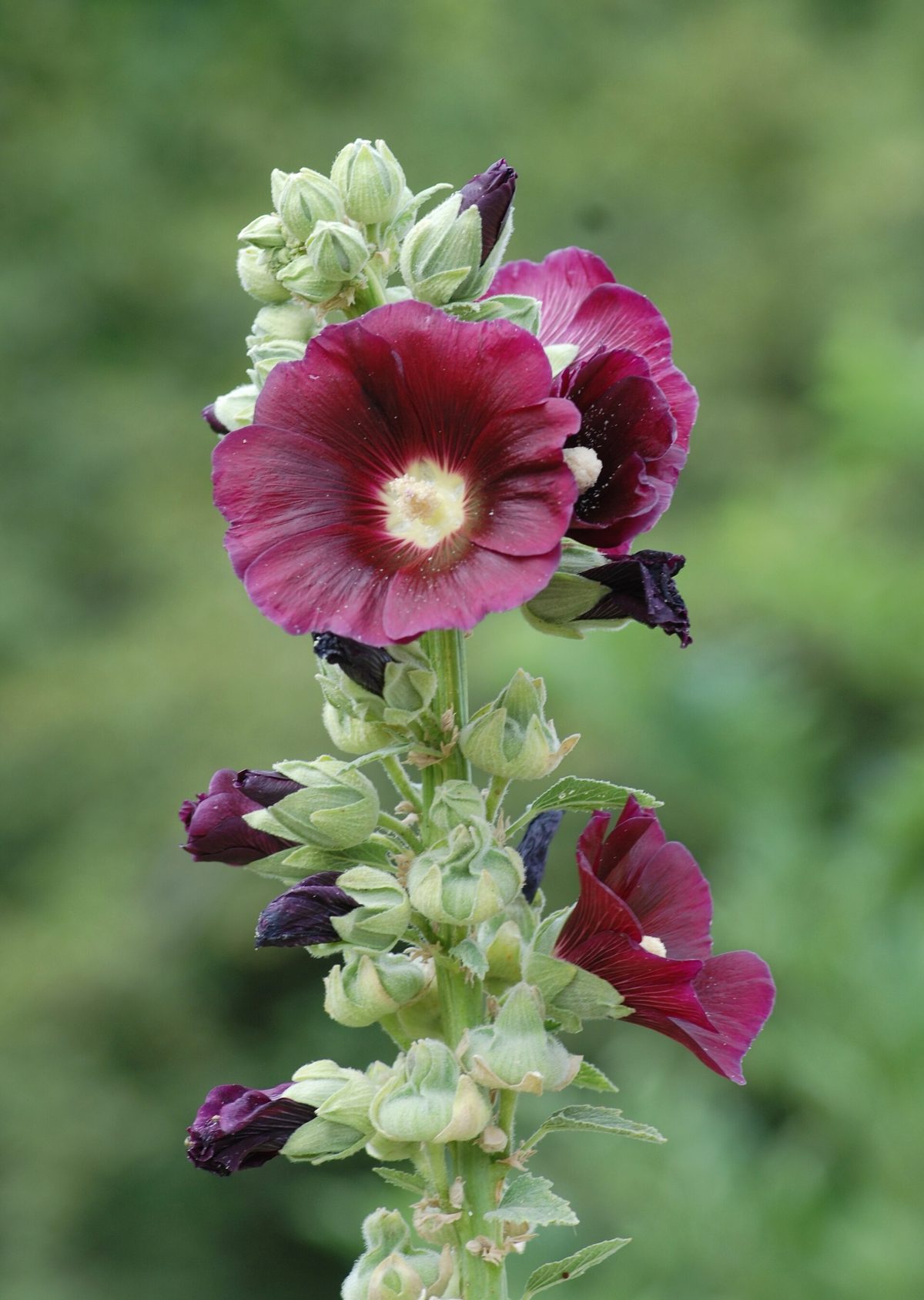
Photo: Alvesgaspar, CC BY-SA 3.0 via Wikimedia Commons

Quick facts
| Light: | Full sun11 source |
|---|---|
| Soil: | Well drained and moist12 |
| Hardiness: | Zones 5a–9b11 source |
| Size: | 5–8 ft (1.52–2.44 m) × 1–2 ft (0.3–0.61 m)11 source |
| Growth rate: | Rapid11 source |
| Bloom: | Jun–Aug, Pink, purple, red, white and yellow121 source |
| Cats: | Non-toxic to cats 41 |
| Dogs: | Non-toxic to dogs 41 |
| Family: | Malvaceae |
How much light does a Hollyhock need?
Outdoors, give hollyhock a spot in full sun, with at least six hours of direct sunlight each and every single day. Full sun is the only light level recorded for this species, so pick an open spot with no shade when you plant it outdoors.
- Light: Full sun1
Best soil for a Hollyhock
Hollyhock does best in soil that drains well yet stays moist, the kind described as moist, well-drained sandy to clay loam. Other extension guidance echoes this, listing the plant's preferred soil conditions simply as moist and well-drained. Choose a planting site where water moves through the soil freely but the ground does not dry out completely, matching that recorded preference.
Hardiness and temperature
Hollyhock is rated cold hardy outdoors across USDA plant hardiness zones 5a through 9b, the full range of half-zones documented for it overall. Check your own USDA zone against that 5a-to-9b range before planting outdoors, since zones outside it fall outside this hardiness rating entirely.
- Hardiness: Zones 5a–9b1
Pruning a Hollyhock
Pinch back hollyhock's main stem early in the growing season to produce a bushier, shorter plant. That light shaping also makes the plant less likely to need staking later in the season. Hollyhock can grow 5 to 8 ft (1.52-2.44 m) tall.
- Pruning: Light shaping2
How to plant a Hollyhock
Plant hollyhock outdoors anywhere within USDA zones 5a through 9b. Space plants 1 to 2 ft (0.3 to 0.61 m) apart so each one has room to reach its mature width. Mature hollyhock reaches 5 to 8 ft (1.52-2.44 m) tall, so choose a planting spot with enough height clearance as well as width. Prepare the planting site with soil that is moist and well-drained, the same conditions this species is documented growing in.
- Hardiness: Zones 5a–9b1
Winter care
In USDA zones 5a through 9b, hollyhock survives winter outdoors as part of its documented hardiness range. Gardeners in zones colder than 5a or warmer than 9b fall outside the documented range for this plant's winter hardiness rating outdoors. That range is the only cold-hardiness information documented for hollyhock.
- Hardiness: Zones 5a–9b1
How to propagate a Hollyhock
Seed is the recommended method for propagating hollyhock, and it is the only method documented for this species. Left in the garden, hollyhock can also self-sow, since new plants may sprout on their own from its seeds. This species also has a rapid growth rate. Plants grown from that seed eventually reach 5 to 8 ft (1.52-2.44 m) tall and 1 to 2 ft (0.3-0.61 m) wide.
Common problems
Watch for slugs, spider mites and Japanese beetles on hollyhock, which can all be a problem for this plant. Rust, leaf spot and anthracnose are the diseases most commonly reported on hollyhock. Of these, rust is described as the main disease problem affecting the plant.
| Problem | Kind |
|---|---|
| Slugs and snails | Pest |
| Spider mites | Pest |
| Japanese beetles | Pest |
| Rust | Disease |
| Leaf spot | Disease |
| Anthracnose | Disease |
Is Hollyhock toxic to cats and dogs?
The ASPCA's Animal Poison Control Center lists hollyhock as non-toxic to cats. The same ASPCA listing also names hollyhock as non-toxic to dogs as well. NC State Extension's Plant Toolbox also records the species as non-toxic for both cats and dogs, each noted separately. No toxic effect in cats or dogs is reported for hollyhock in either of these two listings.
Recommended supplies
- Soil: a free-draining mix, and a pot with a drainage hole.
Questions and answers
- Is hollyhock toxic to cats or dogs?
- No, the ASPCA's Animal Poison Control Center lists hollyhock as non-toxic to cats, and the same listing names it as non-toxic to dogs. NC State Extension's Plant Toolbox also records it as non-toxic for both pets.
- How much sun does hollyhock need?
- Hollyhock needs full sun outdoors, meaning at least six hours of direct sunlight each day, to grow well. Choose an outdoor spot with that much open exposure before you plant it.
- What pests and diseases affect hollyhock?
- Hollyhock can attract slugs, spider mites and Japanese beetles, which are documented as problems for this plant. Rust, leaf spot and anthracnose are the diseases most often reported, with rust described as the main one.
Sources
- NC State Extension Gardener Plant Toolbox. https://plants.ces.ncsu.edu/plants/alcea-rosea/. Accessed 15 November 2026.
- University of Illinois Extension. https://extension.illinois.edu/flowers/hollyhock. Accessed 15 November 2026.
- Clemson Cooperative Extension Home & Garden Information Center. https://hgic.clemson.edu/factsheet/hibiscus/. Accessed 15 November 2026.
- ASPCA Animal Poison Control Center. https://www.aspca.org/pet-care/aspca-poison-control/toxic-and-non-toxic-plants/hollyhock. Accessed 15 November 2026.
How this page was made
- Written with AI assistance from the sources listed on this page. AI is never the source of a fact.