Queen Anne's Lace (Daucus carota)
Formerly Daucus communis, Daucus gingidium, Daucus gingidium
Give Queen Anne's lace full sun, though part shade is also listed, and plant it in well drained soil. The ASPCA lists it as non-toxic to both cats and dogs. No cited source gives a watering rule, and that part is not documented.
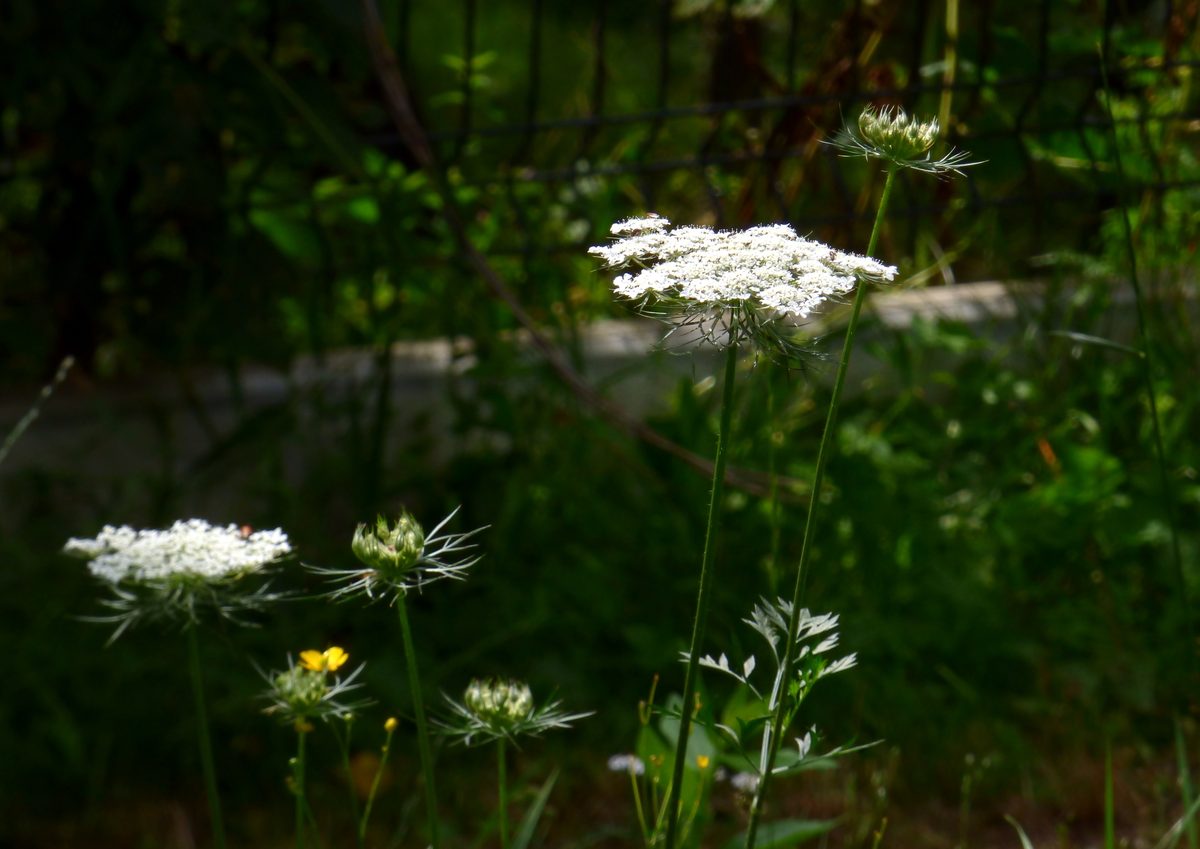
Photo: Niepokój Zbigniew, CC BY-SA 4.0 via Wikimedia Commons

Quick facts
| Light: | Full sun and part shade (full sun preferred)11 source |
|---|---|
| Soil: | Well drained, moist and occasionally dry12 |
| Hardiness: | Zones 4a–11b11 source |
| Size: | 2–4 ft (0.61–1.22 m)11 source |
| Growth rate: | Rapid11 source |
| Bloom: | Jul–Oct, White and purple11 source |
| Cats: | Non-toxic to cats 56 |
| Dogs: | Non-toxic to dogs 56 |
| Native range: | AFG, ALB, ALG, AUT, AZO, BAL, BGM, BLR, BLT, BUL, CHC, CHS, CNY, COR, CVI, CYP, CZE, DEN, EAI, ERI, ETH, FRA, GER, GRB, GRC, HUN, IRE, IRN, IRQ, ITA, KAZ, KGZ, KRI, KRY, LBS, LBY, MDR, MOR, NCS, NEP, NET, NOR, PAK, PAL, POL, POR, ROM, RUC, RUE, RUS, RUW, SAR, SIC, SPA, SWE, SWI, TCS, TKM, TUE, TUN, TUR, TZK, UKR, UZB, WHM, YUG7 |
| Family: | Apiaceae |
How much light does a Queen Anne's Lace need?
Queen Anne's lace prefers full sun, which the source describes as six or more hours of direct sunlight a day. Part shade is also listed as an acceptable light level for this plant. Plant it in the sunniest part of your garden if you want to match the preferred setting.
- Light: Full sun and part shade (full sun preferred)1
Best soil for a Queen Anne's Lace
The soil drainage listed for this plant is well drained, moist and occasionally dry. Both moist and occasionally dry conditions are recorded alongside good drainage. University of Minnesota Extension notes that heavier clay soils are fine as long as the soil is well drained and not compacted. No cited source gives a soil pH range, so that figure is not documented here.
Hardiness and temperature
Queen Anne's lace is listed for USDA hardiness zones 4a through 11b. No cited source records a minimum temperature, so that figure is not documented. Humidity needs are not documented in the cited sources either. The plant is treated as a cool-season grower, doing best in the cool temperatures of spring and fall.
- Hardiness: Zones 4a–11b1
How to plant a Queen Anne's Lace
Plant Queen Anne's lace in USDA zones 4a through 11b, the range listed for it. Start it from seed, the only recorded method. Pick a spot in full sun, or in part shade, with well drained soil. Mature height is 2 to 4 ft (0.61–1.22 m). The plant is a cool-season grower, best in the cool temperatures of spring and fall. Spacing and sowing depth are not documented in the cited sources.
- Hardiness: Zones 4a–11b1
Winter care
Winter hardiness is recorded as USDA zones 4a through 11b. Zone 4a is the coldest zone listed, and 11b is the warmest. The plant is described as a cool-season grower, doing best in the cool temperatures of spring and fall. No cited source gives a minimum temperature, a protection method or mulching advice, so those details are not documented.
- Hardiness: Zones 4a–11b1
When and how to harvest Queen Anne's Lace
For fresh use, harvest the roots before they exceed about 1 inch (2.5 cm) in diameter. That works out to roughly 65 to 75 days after planting. Days to maturity are listed as 65 to 75 days from seed. Cool-season growth is listed, with the best growth in the cool temperatures of spring and fall.
How to propagate a Queen Anne's Lace
Seed is the recommended propagation strategy for Queen Anne's lace. It is the only propagation method recorded for this plant. From seed, the plant is listed as reaching maturity in 65 to 75 days. Its growth rate is listed as rapid. No cited source gives sowing depth, spacing or germination time, so those details are not documented.
- Propagation: Seed1
Common problems
Recorded pests include aphids, carrot rust fly, cutworms, darkling beetles, flea beetles, garden symphylans, grasshoppers, nematodes, seedcorn maggot, vegetable weevil, whiteflies and wireworms. Recorded diseases are bacterial soft rot, beet leafhopper virescence agent, cavity spot, damping off, root dieback, leaf spots, powdery mildew and white mold.
- Common pests: aphids, carrot rust fly, cutworms, darkling beetles, flea beetles, garden symphylans, grasshoppers, nematodes, seedcorn maggot, vegetable weevil, whiteflies and wireworms4
- Common diseases: bacterial soft rot, beet leafhopper virescence agent, cavity spot, damping off, root dieback, leaf spots, powdery mildew and white mold4
| Problem | Kind |
|---|---|
| Aphids | Pest |
| Carrot rust fly | Pest |
| Cutworms | Pest |
| Darkling beetles | Pest |
| Flea beetles | Pest |
| Garden symphylans | Pest |
| Grasshoppers | Pest |
| Nematodes | Pest |
| Seedcorn maggot | Pest |
| Vegetable weevil | Pest |
| Whiteflies | Pest |
| Wireworms | Pest |
| Bacterial soft rot | Disease |
| Beet leafhopper virescence agent | Disease |
| Cavity spot | Disease |
| Damping off | Disease |
| Root dieback | Disease |
| Leaf spots | Disease |
| Powdery mildew | Disease |
| White mold | Disease |
Is Queen Anne's Lace toxic to cats and dogs?
The ASPCA lists this plant as non-toxic to dogs and non-toxic to cats. For cats, the NC State Extension Gardener Plant Toolbox also marks it as non-toxic. For dogs, the same Plant Toolbox also marks it as non-toxic. This page covers cats and dogs only, and the position for each is stated separately above. These are the only toxicity positions recorded here, and other animals are outside the scope of this site.
Recommended supplies
- Soil: a free-draining mix, and a pot with a drainage hole.
Questions and answers
- Is Queen Anne's lace toxic to cats and dogs?
- The ASPCA lists it as non-toxic to dogs and non-toxic to cats. The NC State Extension Gardener Plant Toolbox also marks it as non-toxic for both cats and dogs. Other animals are outside the scope of this page.
- How much sun does Queen Anne's lace need?
- Full sun is preferred, which the source describes as six or more hours of direct sunlight a day. Part shade is also listed as an acceptable light level. The soil drainage recorded for it is well drained, moist and occasionally dry.
- How long does Queen Anne's lace take to grow from seed?
- Days to maturity are listed as 65 to 75 days from seed. Seed is the only propagation method recorded for this plant. It grows best in the cool temperatures of spring and fall.
Sources
- NC State Extension Gardener Plant Toolbox. https://plants.ces.ncsu.edu/plants/daucus-carota/. Accessed 24 September 2026.
- University of Minnesota Extension. https://extension.umn.edu/garden-and-home/yard-and-garden/gardening-in-minnesota/growing-carrots-and-parsnips. Accessed 27 October 2026.
- University of Maryland Extension. https://extension.umd.edu/resource/growing-carrots-home-garden. Accessed 12 October 2026.
- UC Statewide Integrated Pest Management Program. https://ipm.ucanr.edu/home-and-landscape/carrot/. Accessed 12 October 2026.
- ASPCA Animal Poison Control Center. https://www.aspca.org/pet-care/aspca-poison-control/toxic-and-non-toxic-plants/carrot-flower. Accessed 21 October 2026.
- NC State Extension Gardener Plant Toolbox. https://plants.ces.ncsu.edu/plants/daucus-carota-subsp-sativus/. Accessed 21 October 2026.
- Royal Botanic Gardens, Kew (World Checklist of Vascular Plants). https://sftp.kew.org/pub/data-repositories/WCVP/wcvp.zip. Accessed 4 June 2026.
How this page was made
- Written with AI assistance from the sources listed on this page. AI is never the source of a fact.