Purple Foxglove (Digitalis purpurea)
Formerly Digitalis alba, Digitalis carnea, Digitalis miniana
Grow foxglove outdoors in full sun to part shade, with soil moisture kept at medium to wet. This plant is toxic to both cats and dogs. Full sun is the better of the two light options for this plant, and the soil should not be allowed to dry out.
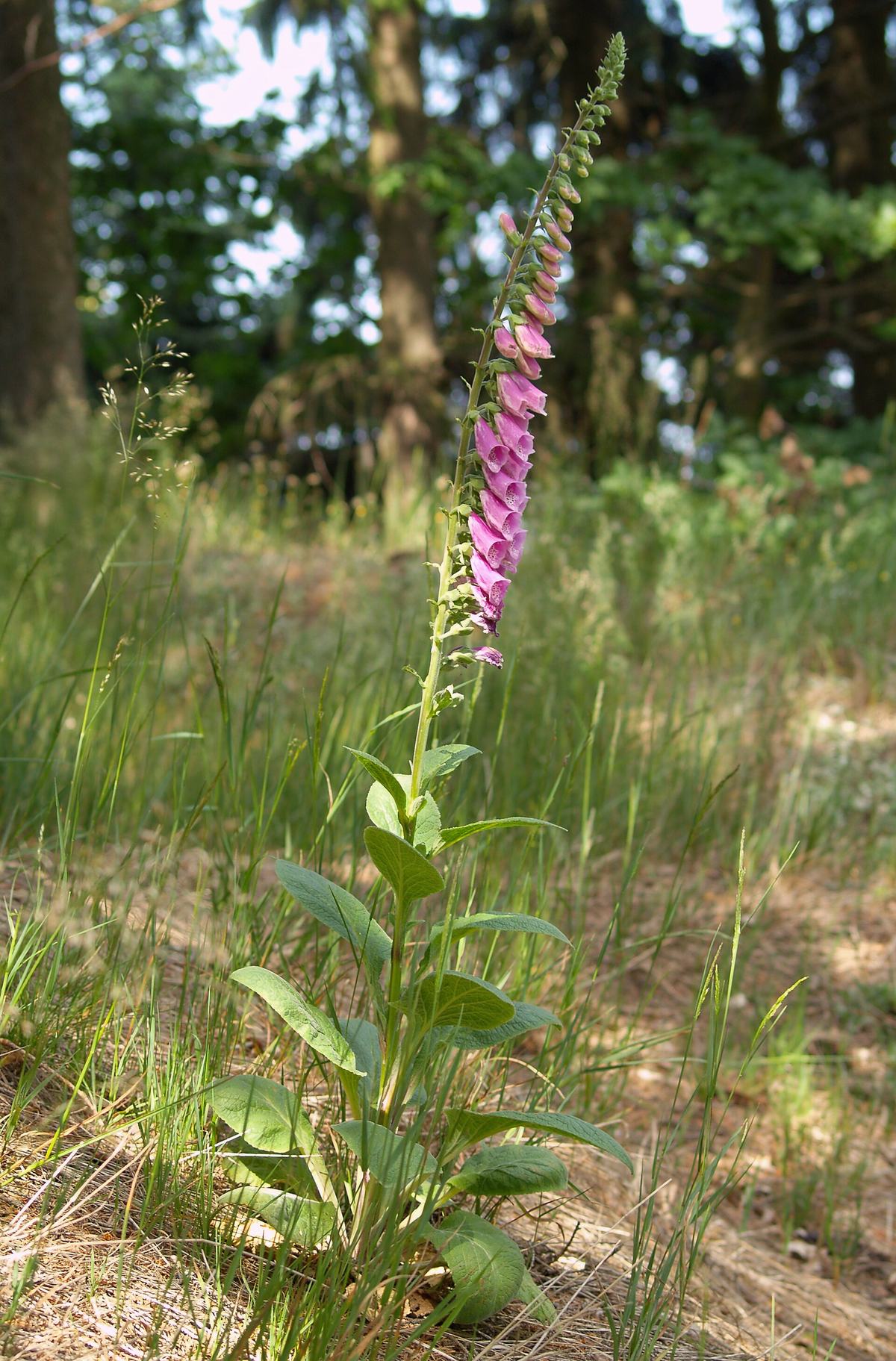
Photo: Jörg Hempel, CC BY-SA 3.0 via Wikimedia Commons

Quick facts
| Light: | Full sun and part shade (full sun preferred)123 |
|---|---|
| Water: | Medium to wet134 |
| Soil: | Well drained and moist1435 |
| Hardiness: | Zones 4a–9b123 |
| Size: | 2–5 ft (0.61–1.52 m) × 1–2.5 ft (0.3–0.76 m)41 source |
| Growth rate: | Moderate131 source |
| Bloom: | Purple, white and pink23 |
| Cats: | Toxic to cats 61 |
| Dogs: | Toxic to dogs 63 |
| Native range: | BGM, COR, CZE, FRA, GER, GRB, IRE, MOR, POR, SAR, SPA, SWE7 |
| Family: | Plantaginaceae |
How much light does a Purple Foxglove need?
Give foxglove full sun to part shade outdoors. Full sun means six or more hours of direct sunlight a day. Of the two light levels, full sun is the better choice for this plant. Part shade, sometimes called light shade, also works for this plant outdoors.
How often to water a Purple Foxglove
Outdoors, foxglove needs soil moisture that ranges from medium to wet. It grows best in soil that stays moist and drains well, with soil rich in organic matter. The soil should not be allowed to dry out for any length of time. Good drainage matters as much as keeping the soil moist for this plant.
Best soil for a Purple Foxglove
Foxglove grows best in soil that drains well while also staying moist most of the time. The plant prefers soil that is high in organic matter, and this should not be allowed to dry out. Good drainage matters here just as much as keeping the soil from drying out completely. Soil that holds too much water without draining is not a match for what this plant needs.
Hardiness and temperature
This plant's USDA hardiness rating runs from zone 4a through zone 9b outdoors, a wide span. Zone 4a marks the coldest end of that range, and zone 9b the warmest end most sources use for this plant. A zone 4a winter is far colder than a zone 9b winter, and this plant's range spans both.
Pruning a Purple Foxglove
You can deadhead foxglove by cutting down all but one or two flower spikes before they go to seed. Leaving one or two spikes lets the plant produce seed while you remove the rest. Deadheading is the pruning method listed for this species.
- Pruning: Deadheading5
How to plant a Purple Foxglove
Plant foxglove outdoors in USDA zones 4a through 9b, where it is hardy. Space plants roughly 1 to 2.5 ft (0.3-0.76 m) apart to match their mature spread. At maturity, this plant reaches about 2 to 5 ft (0.61-1.52 m) tall. Choose a planting spot with full sun to part shade, since that is what this plant takes outdoors.
Winter care
Within its USDA zone 4a to 9b range, foxglove can survive outdoors through winter. In zones colder than 4a, winter temperatures go beyond what this plant is documented to handle outdoors. In zones warmer than 9b, outdoor winters fall outside the same documented range. Zone 4a to 9b is the full outdoor hardiness range recorded for this plant.
How to propagate a Purple Foxglove
The only propagation method documented for foxglove is growing it from seed. Seed of this plant needs light to germinate, so you should not cover it with soil when you sow. Leaving the seed uncovered and exposed to light is what allows it to sprout. No method besides growing from seed is listed for this plant.
Common problems
Fungal diseases are a problem for foxglove. Aphids, Japanese beetles, and mealybugs are the pests listed for this plant. These problems are the only pests and diseases documented for this plant. No other insects or diseases are listed in the sources checked.
| Problem | Kind |
|---|---|
| Aphids | Pest |
| Japanese beetles | Pest |
| Mealybugs | Pest |
| Fungal diseases | Disease |
Is Purple Foxglove toxic to cats and dogs?
Both cats and dogs can be poisoned by foxglove, according to the sources checked for this page. The ASPCA's Animal Poison Control Center includes foxglove on its list of plants that are toxic to dogs and toxic to cats. NC State Extension's Plant Toolbox separately names it a problem for cats and a problem for dogs. That means exposure is a concern for the two pets this page covers, cats and dogs.
Pet-safe alternatives
Recommended supplies
- Soil: a free-draining mix, and a pot with a drainage hole.
Questions and answers
- Is foxglove toxic to cats and dogs?
- Foxglove is toxic to both cats and dogs, and the ASPCA lists it as toxic to each of them. NC State Extension also names it a problem for cats and for dogs.
- How much sun does foxglove need outdoors?
- Foxglove does best in full sun to part shade outdoors, with full sun as the preferred option. Full sun means six or more hours of direct sunlight a day.
- What kind of soil moisture does foxglove need?
- This plant needs soil moisture from medium to wet, in soil that drains well but is also kept moist. The soil should be rich in organic matter and should not be allowed to dry out.
Sources
- NC State Extension Gardener Plant Toolbox. https://plants.ces.ncsu.edu/plants/digitalis-purpurea/common-name/foxglove/. Accessed 14 October 2026.
- University of Wisconsin-Madison Division of Extension. https://hort.extension.wisc.edu/articles/common-foxglove-digitalis-purpurea/. Accessed 14 October 2026.
- NC State Extension Gardener Plant Toolbox. https://plants.ces.ncsu.edu/plants/digitalis-purpurea/. Accessed 14 October 2026.
- University of Minnesota Extension. https://extension.umn.edu/garden-and-home/yard-and-garden/gardening-in-minnesota/gardening-in-the-shade. Accessed 14 October 2026.
- Clemson Cooperative Extension HGIC. https://hgic.clemson.edu/foxglove/. Accessed 14 October 2026.
- ASPCA Animal Poison Control Center. https://www.aspca.org/pet-care/aspca-poison-control/toxic-and-non-toxic-plants/foxglove. Accessed 14 October 2026.
- Royal Botanic Gardens, Kew (World Checklist of Vascular Plants). https://sftp.kew.org/pub/data-repositories/WCVP/wcvp.zip. Accessed 4 June 2026.
How this page was made
- Written with AI assistance from the sources listed on this page. AI is never the source of a fact.