Common Mullein (Verbascum thapsus)
Formerly Thapsus linnaei, Verbascum majus, Thapsus montanum
Common mullein grows best in full sun and tolerates part shade. Its water need runs from dry to medium. It does not tolerate wet soils. The soil should be well drained. The plant is listed for hardiness zones 3a–9b. It is described as a herbaceous perennial. Pet toxicity for cats and dogs is not documented on this page.
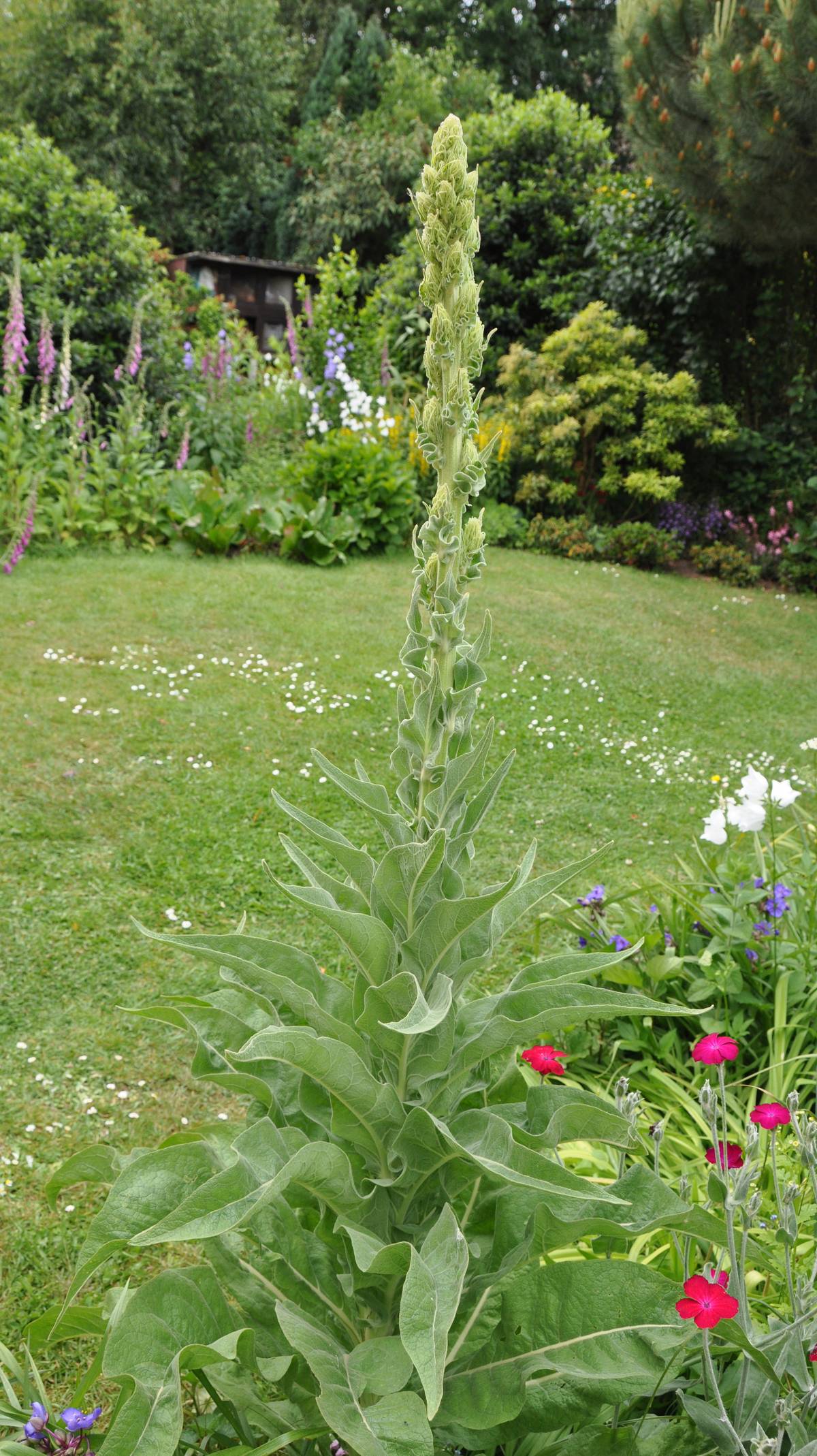
Photo: Marc Ryckaert (MJJR), CC BY 3.0 via Wikimedia Commons

Quick facts
| Light: | Full sun and part shade (full sun preferred)12 |
|---|---|
| Water: | Dry to medium11 source |
| Soil: | Well drained and occasionally dry11 source |
| Hardiness: | Zones 3a–9b11 source |
| Size: | 3–10 ft (0.91–3.05 m) × 2–3 ft (0.61–0.91 m)11 source |
| Growth rate: | Rapid11 source |
| Bloom: | Yellow12 |
| Cats: | Not documented by major sources |
| Dogs: | Not documented by major sources |
| Native range: | AFG, ALT, AUT, AZO, BAL, BGM, BLR, BLT, CHC, CHT, CHX, COR, CZE, DEN, EHM, FIN, FRA, GER, GRB, HUN, IRE, IRK, IRN, ITA, KAZ, KGZ, KRA, KRY, MON, NCS, NEP, NET, NOR, PAK, POL, POR, ROM, RUC, RUE, RUN, RUS, RUW, SAR, SIC, SPA, SWE, SWI, TCS, TKM, TUR, TZK, UKR, WHM, WSB, YUG4 |
| Family: | Scrophulariaceae |
How much light does a Common Mullein need?
Common mullein prefers full sun, though it tolerates some shade. Part shade is listed as an acceptable condition alongside full sun. One source describes the plant as occurring primarily in disturbed soils in full sun. The plant's listed preference also includes a slightly acidic to neutral pH and well-drained soil.
How often to water a Common Mullein
Water needs for common mullein run from dry to medium. It does not tolerate wet soils, so check the soil before you water it again. Aim for soil that stays within that dry to medium range rather than soaking wet. Its listed soil drainage is well drained and occasionally dry.
- Water: Dry to medium1
Best soil for a Common Mullein
Common mullein is listed for well-drained soil that is occasionally dry. Its preferred pH is slightly acidic to neutral. The plant does not tolerate wet soils. One source describes it as occurring primarily in disturbed soils in full sun. The plant is also described as a herbaceous biennial or short-lived perennial with a deep tap root.
Hardiness and temperature
Common mullein is listed for USDA hardiness zones 3a through 9b. The listing names each half zone in that span, from 3a and 3b up to 9a and 9b. A grower in zone 3a and a grower in zone 9b both fall inside the range listed for the plant. The display form of the range is Zones 3a–9b.
- Hardiness: Zones 3a–9b1
How to plant a Common Mullein
Plant common mullein within hardiness zones 3a–9b. Allow for a spread of 2–3 ft (0.61–0.91 m) per plant. Expect a mature height of 3–10 ft (0.91–3.05 m). Pick a site in full sun, which is the listed preference, or in part shade. Choose well-drained ground that is occasionally dry, because the plant does not tolerate wet soils. Its growth rate is listed as rapid.
- Hardiness: Zones 3a–9b1
Winter care
Winter hardiness for common mullein is listed as zones 3a through 9b. In zone 3a, the coldest zone in that listing, the plant is still inside its recorded range. In zone 9b, the warmest zone listed, the same holds. One source describes it as a herbaceous biennial or short-lived perennial. Another lists it as a herbaceous perennial.
- Hardiness: Zones 3a–9b1
How to propagate a Common Mullein
Seed is the recommended propagation method for common mullein. One source tells you to surface sow seed. Seed is the only method on the list for this plant, and no cutting, division or other technique is recorded. The mature height listed for the plant is 3–10 ft (0.91–3.05 m), which is worth knowing when you sow.
Common problems
The pests listed for common mullein are spider mites, slugs and snails, and mullein weevil. Spider mites are a problem in hot weather. Slugs and snails are occasional problems. Two diseases are listed, tomato spotted wilt virus and Texas root rot. The virus is recorded under the EPPO code TSWV00.
| Problem | Kind |
|---|---|
| Spider mites | Pest |
| Slugs and snails | Pest |
| Mullein weevil | Pest |
| Tomato spotted wilt virus | Disease |
| Texas root rot | Disease |
Is Common Mullein toxic to cats and dogs?
Recommended supplies
- Soil: a free-draining mix, and a pot with a drainage hole.
Questions and answers
- What color are common mullein flowers?
- Common mullein has yellow flowers. One source describes small yellow, rarely white, five-petaled flowers. Gold or yellow is also given as the color. The plant is listed as a herbaceous perennial that prefers full sun.
- Is common mullein native to the United States?
- The native status for the lower 48 states, Alaska and Hawaii is introduced. Its native range record lists region codes such as FRA, GER, ITA and TUR. The record gives the codes and nothing more about the range.
- How tall does common mullein grow?
- The mature height is listed as 3–10 ft (0.91–3.05 m). The mature spread is 2–3 ft (0.61–0.91 m). The growth rate is listed as rapid. It is described as a herbaceous perennial.
Sources
- NC State Extension Gardener Plant Toolbox. https://plants.ces.ncsu.edu/plants/verbascum-thapsus/. Accessed 23 September 2026.
- Wisconsin Horticulture (UW-Madison Division of Extension). https://hort.extension.wisc.edu/articles/common-mullein-verbascum-thapsus/. Accessed 23 September 2026.
- EPPO Global Database. https://gd.eppo.int/taxon/VESTH/pests. Accessed 24 September 2026.
- Royal Botanic Gardens, Kew (World Checklist of Vascular Plants). https://sftp.kew.org/pub/data-repositories/WCVP/wcvp.zip. Accessed 4 June 2026.
How this page was made
- Written with AI assistance from the sources listed on this page. AI is never the source of a fact.