Rose Campion (Silene coronaria)
Formerly Lychnis coronaria, Agrostemma coronaria, Lychnis coriacea
Rose campion grows in full sun or part shade. Full sun is the preferred light. Its water range runs from dry to medium. Soil should be well drained. The flowers are pink, purple or white. Plants reach 2–3 ft (0.61–0.91 m) tall. Pet toxicity for cats and dogs is not documented on this page.
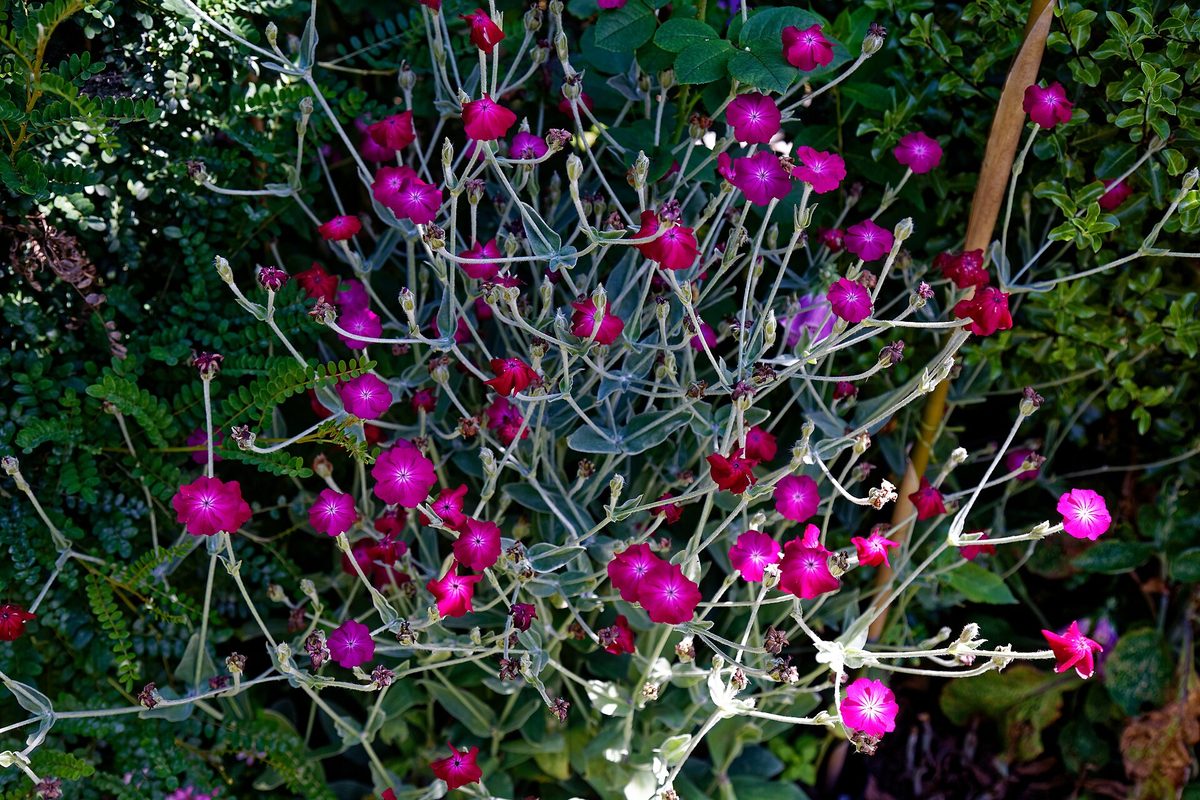
Photo: Acabashi, CC BY-SA 4.0 via Wikimedia Commons

Quick facts
| Light: | Full sun and part shade (full sun preferred)12 |
|---|---|
| Water: | Dry to medium21 source |
| Soil: | Well drained and occasionally dry12 |
| Hardiness: | Zones 4a–10b11 source |
| Size: | 2–3 ft (0.61–0.91 m) × 1.3–2 ft (0.41–0.61 m)12 |
| Growth rate: | Moderate11 source |
| Bloom: | Pink, purple and white21 source |
| Cats: | Not documented by major sources |
| Dogs: | Not documented by major sources |
| Native range: | ALB, BUL, CZE, GRC, HUN, IRN, ITA, KAZ, KRY, ROM, TCS, TUE, TUR, TZK, UKR, WHM, YUG3 |
| Family: | Caryophyllaceae |
How much light does a Rose Campion need?
Full sun is the preferred light for rose campion, meaning 6 or more hours of direct sunlight a day. Part shade is the second light level listed for it, after full sun. The plant prefers fairly dry, well-drained conditions in either full sun or partial shade. Full sun and part shade are the only two light levels listed.
How often to water a Rose Campion
Rose campion needs water at levels from dry to medium. A fairly dry, well-drained setting is the preferred one. Soil that is well drained and occasionally dry suits it. It will also tolerate clay and moist soil. No watering schedule in days is documented for this plant.
- Water: Dry to medium2
Best soil for a Rose Campion
Well-drained soil that is occasionally dry suits this plant. Good drainage is listed for rose campion. It prefers fairly dry, well-drained conditions in full sun or partial shade. It will also tolerate clay and moist soil. Clay and moist soil are tolerated rather than preferred. The moisture range listed for the plant runs from dry to medium. Together, these facts describe a plant that favors the drier side of the soil range.
Hardiness and temperature
Rose campion is rated for USDA hardiness zones 4a–10b. That span runs from zone 4a to zone 10b in half-zone steps. Zone 4a is the coldest zone listed, and zone 10b is the warmest. A gardener in zone 4 and one in zone 9 are both inside the listed range.
- Hardiness: Zones 4a–10b1
Pruning a Rose Campion
Deadheading is the pruning task recorded for this plant. Taking off the spent blooms will encourage continuous flowering. Regular deadheading is advised for that effect. The flowers you are removing are pink, purple or white. The mounds they sit on reach 2 to 3 ft (0.61–0.91 m) tall in later years.
How to plant a Rose Campion
Check that your USDA hardiness zone falls between 4a and 10b before you plant rose campion. Allow room for a width of 1.3–2 ft (0.41–0.61 m) per plant. The plant reaches 2–3 ft (0.61–0.91 m) tall. Pick a spot with full sun, which means 6 or more hours of direct sunlight a day. Part shade is also accepted. Choose well-drained soil. In the lower 48 US states, its native status is recorded as introduced.
- Hardiness: Zones 4a–10b1
Winter care
Rose campion is rated for zones 4a through 10b, which is a wide span of zones. Zone 4a is the coldest zone in the listed range. Zone 10b is the warmest zone listed. If you garden in zone 3 or colder, your zone falls outside the listed range.
- Hardiness: Zones 4a–10b1
How to propagate a Rose Campion
Propagation of rose campion is by seed or by stem cuttings. The stem cuttings named are basal cuttings. Seeds and basal cuttings are both described as ways to propagate it. Basal cuttings can also be taken, as an option besides seed. The plant has a moderate growth rate and a width of 1.3–2 ft (0.41–0.61 m).
Common problems
Slugs are the pest recorded for rose campion. They may be problematic, even though the plant is generally insect and disease-free. That description covers insects and diseases in general, and slugs are the named exception. No other individual insect pest is named in the record.
- Common pests: slugs1
| Problem | Kind |
|---|---|
| Slugs and snails | Pest |
Is Rose Campion toxic to cats and dogs?
Recommended supplies
- Soil: a free-draining mix, and a pot with a drainage hole.
Questions and answers
- How much sun does rose campion need?
- Full sun is preferred, meaning 6 or more hours of direct sunlight a day. It also grows in part shade. In either case it prefers fairly dry, well-drained conditions.
- How do you propagate rose campion?
- Rose campion may be propagated by seed or by basal cuttings, which are a type of stem cutting. Both methods are listed for the plant. Basal cuttings can also be taken in addition to growing from seed.
- How tall does rose campion get?
- It reaches 2–3 ft (0.61–0.91 m) tall, with a width of 1.3–2 ft (0.41–0.61 m). The flowers are pink, purple or white. Its growth rate is moderate.
Sources
- NC State Extension. https://plants.ces.ncsu.edu/plants/silene-coronaria/. Accessed 21 October 2026.
- University of Wisconsin-Madison Division of Extension. https://hort.extension.wisc.edu/articles/rose-campion-lychnis-coronaria/. Accessed 21 October 2026.
- Royal Botanic Gardens, Kew (World Checklist of Vascular Plants). https://sftp.kew.org/pub/data-repositories/WCVP/wcvp.zip. Accessed 4 June 2026.
How this page was made
- Written with AI assistance from the sources listed on this page. AI is never the source of a fact.