Eggplant (Solanum melongena)
Formerly Solanum trongum, Solanum esculentum, Solanum pseudoundatum
Keep eggplant in full sun and give it medium to wet water. Pet Poison Helpline describes eggplant as mildly poisonous, and it is recorded as toxic to both cats and dogs. It is a warm-season plant that reaches 2–4 ft (0.61–1.22 m) tall.
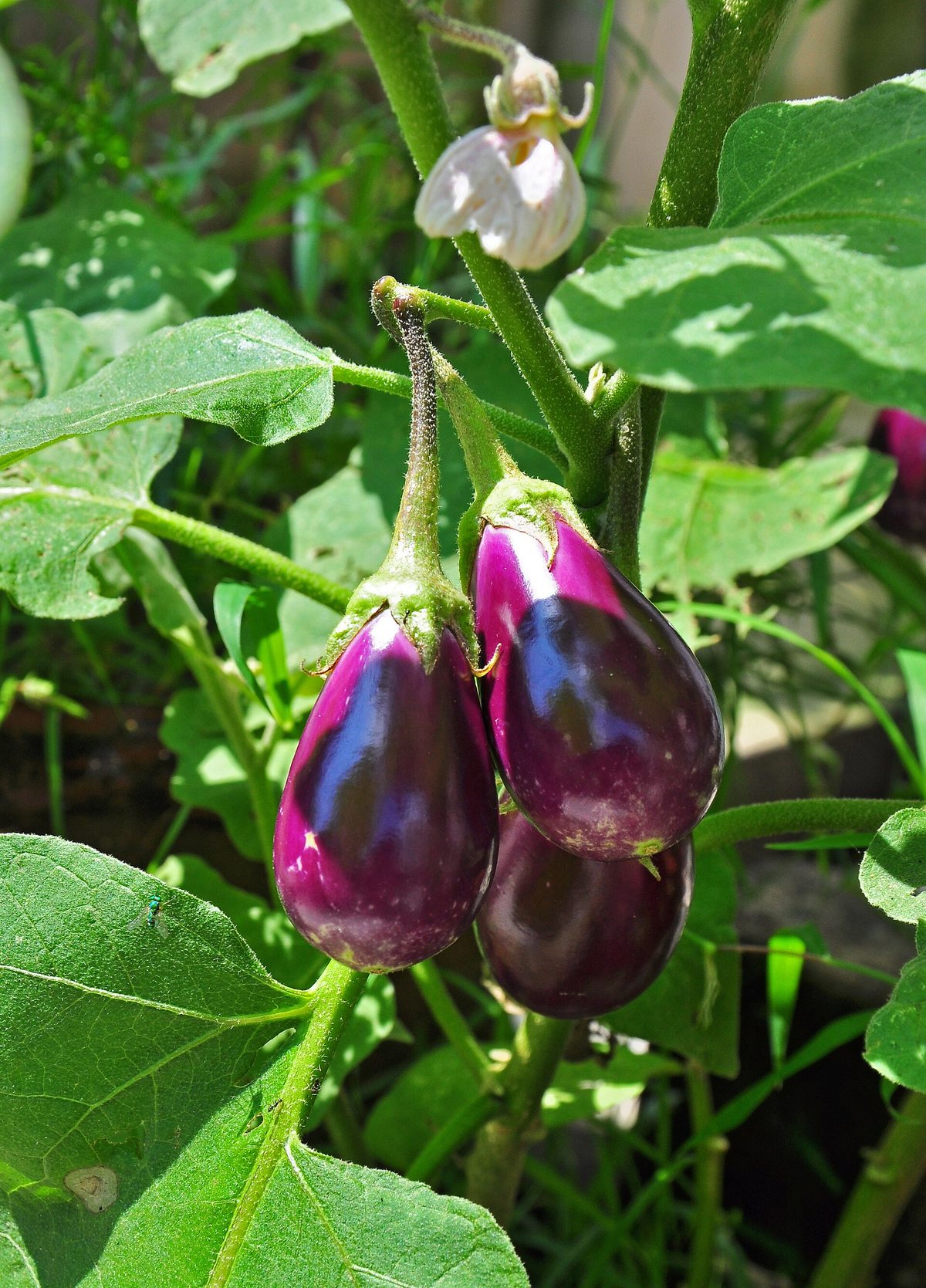
Photo: Joydeep, CC BY-SA 3.0 via Wikimedia Commons

Quick facts
| Light: | Full sun12 |
|---|---|
| Water: | Medium to wet11 source |
| Soil: | Well drained and moist; pH 6–6.5131 source |
| Hardiness: | Zones 9a–12b11 source |
| Size: | 2–4 ft (0.61–1.22 m) × 1–3 ft (0.3–0.91 m)11 source |
| Growth rate: | Moderate111 source |
| Bloom: | Purple11 source |
| Cats: | Toxic to cats (1 source) Severity reported: Mild 6 |
| Dogs: | Toxic to dogs (1 source) 6 |
| Native range: | ASS, BAN, BOR, CHC, CHH, CHS, EHM, IND, JAW, LAO, LSI, MAU, MDG, MLY, MYA, PAK, PHI, REU, SCS, SRL, SUL, THA, VIE, WHM7 |
| Family: | Solanaceae |
How much light does an Eggplant need?
Eggplant wants full sun outdoors. NC State Extension describes that as six or more hours of direct sunlight a day. Iowa State Extension also places it in full sun. Indoors, the light rating is direct sun, and no tolerance for lower light is recorded. Full sun is the only outdoor light level listed for this plant.
How often to water an Eggplant
Eggplant's water need ranges from medium to wet. NC State Extension says it prefers moist, well-drained soils. The drainage record lists both well drained and moist. Medium to wet is the full range recorded, with medium as the low end and wet as the high end.
- Water: Medium to wet1
Best soil for an Eggplant
Eggplant grows in soil that is well drained and moist. NC State Extension says it prefers fertile, sandy and loamy soils. Clemson Extension advises following the results of a soil test to keep the pH between 6.0 and 6.5. That puts the target at pH 6–6.5. A soil test is the tool Clemson Extension names for working within that range. Well drained and moist are listed together in the soil record.
Hardiness and temperature
Eggplant is a warm-season plant. Clemson Extension says it grows best when temperatures are between 70 and 85 °F (21–29 °C). NC State Extension lists hardiness zones 9a to 12b. University of Maryland Extension calls it a very tender warm-season annual.
- Hardiness: Zones 9a–12b1
Fertilizing an Eggplant
Eggplant is listed as a heavy feeder, with its fertilizer need recorded under that single label. University of Maryland Extension notes a high requirement for nutrients. NC State Extension also describes its preferred soil as fertile. It rates the growth rate as medium and the maintenance as medium.
- Fertilizer: Heavy feeder4
Pruning an Eggplant
The pruning type recorded for eggplant is light shaping. University of Maryland Extension suggests you nip back the growing tip to encourage branching. Light shaping is the only pruning type recorded for this plant. NC State Extension rates its maintenance as medium. Plants reach 2–4 ft (0.61–1.22 m) tall and 1–3 ft (0.3–0.91 m) wide.
- Pruning: Light shaping4
How to plant an Eggplant
Plant eggplant in full sun. Allow 1–3 ft (0.3–0.91 m) of width for each plant. NC State Extension lists hardiness zones 9a to 12b. Days to maturity are counted from transplant. The soil should be well drained and moist, with a pH of 6–6.5. Plants reach 2–4 ft (0.61–1.22 m) tall.
- Hardiness: Zones 9a–12b1
Winter care
Eggplant is listed for hardiness zones 9a to 12b. University of Maryland Extension calls it a very tender warm-season annual. Clemson Extension describes it as a warm-season vegetable that grows best when temperatures are between 70 and 85 °F (21–29 °C). Its recorded plant type is shrub.
- Hardiness: Zones 9a–12b1
When to plant Eggplant
Sow seed indoors 6–8 weeks before the last spring frost. Clemson Extension says setting out 6 to 8-week-old transplants gives a head start toward harvest. Eggplant is a warm-season plant, and days to maturity are counted from transplant.
- Start indoors: 6–8 weeks before last spring frost3
| Step | When |
|---|---|
| Start indoors | 6–8 weeks before last frost |
When and how to harvest Eggplant
Eggplant should be ready for harvest about 65 to 80 days after transplanting. Clemson Extension adds that the timing depends on the variety. The record's display is 65–80 days from transplant. Clemson Extension says this warm-season vegetable grows best when temperatures are between 70 and 85 °F (21–29 °C).
- Days to maturity: 65–80 days from transplant3
How to propagate an Eggplant
Eggplant is propagated by seed. Seed is the only propagation method recorded here. Iowa State Extension says to sow seeds 6 to 8 weeks prior to the anticipated outdoor planting date. Relative to frost, the record gives 6–8 weeks before the last spring frost for sowing indoors.
- Propagation: Seed2
Common problems
Recorded pests include aphids, armyworms, corn earworm, cucumber beetles, cutworms, earwigs and flea beetles. Others on the list are hornworms, lygus bugs, nematodes, omnivorous leafroller, snails and slugs, spider mites, spittlebugs, thrips and whiteflies. Recorded diseases are mosaic virus, phytophthora root rot, powdery mildew and verticillium wilt. NC State Extension notes that verticillium wilt can occur.
- Common pests: aphids, armyworms, corn earworm, cucumber beetles, cutworms, earwigs, flea beetles, hornworms, lygus bugs, nematodes, omnivorous leafroller, snails and slugs, spider mites, spittlebugs, thrips and whiteflies53
- Common diseases: mosaic virus, phytophthora root rot, powdery mildew and verticillium wilt513
| Problem | Kind |
|---|---|
| Aphids | Pest |
| Armyworms | Pest |
| Corn earworm | Pest |
| Cucumber beetles | Pest |
| Cutworms | Pest |
| Earwigs | Pest |
| Flea beetles | Pest |
| Hornworms | Pest |
| Lygus bugs | Pest |
| Nematodes | Pest |
| Omnivorous leafroller | Pest |
| Snails and slugs | Pest |
| Spider mites | Pest |
| Spittlebugs | Pest |
| Thrips | Pest |
| Whiteflies | Pest |
| Mosaic virus | Disease |
| Phytophthora root rot | Disease |
| Powdery mildew | Disease |
| Verticillium wilt | Disease |
Is Eggplant toxic to cats and dogs?
For cats, eggplant is recorded as toxic. For dogs, eggplant is also recorded as toxic. Pet Poison Helpline states that eggplant, potato, tomato, pepper and tomatillo are mildly poisonous. Mildly poisonous is the severity wording the source gives. The toxicity position is recorded separately for cats and for dogs, and both are toxic. No separate severity is recorded for cats and for dogs.
Pet-safe alternatives
Recommended supplies
- Soil: a free-draining mix, and a pot with a drainage hole.
Questions and answers
- Is eggplant toxic to cats and dogs?
- Eggplant is recorded as toxic to both cats and dogs. Pet Poison Helpline describes eggplant as mildly poisonous. The same passage names potato, tomato, pepper and tomatillo as mildly poisonous too.
- How much sun does eggplant need?
- Eggplant needs full sun outdoors. NC State Extension describes full sun as 6 or more hours of direct sunlight a day. Indoors, the light rating is direct sun.
- How long does eggplant take to mature?
- Eggplant should be ready for harvest about 65 to 80 days after transplanting, depending on the variety. Start seed indoors 6–8 weeks before your last spring frost.
Sources
- NC State Extension Gardener Plant Toolbox. https://plants.ces.ncsu.edu/plants/solanum-melongena/. Accessed 14 October 2026.
- Iowa State University Extension and Outreach (Yard and Garden). https://yardandgarden.extension.iastate.edu/how-to/growing-eggplant-home-garden. Accessed 14 October 2026.
- Clemson Cooperative Extension Home & Garden Information Center. https://hgic.clemson.edu/factsheet/eggplant/. Accessed 14 October 2026.
- University of Maryland Extension. https://extension.umd.edu/resource/growing-eggplant-home-garden. Accessed 30 October 2026.
- UC Statewide Integrated Pest Management Program. https://ipm.ucanr.edu/home-and-landscape/eggplant/. Accessed 14 October 2026.
- Pet Poison Helpline. https://www.petpoisonhelpline.com/poison/nightshade/. Accessed 14 October 2026.
- Royal Botanic Gardens, Kew (World Checklist of Vascular Plants). https://sftp.kew.org/pub/data-repositories/WCVP/wcvp.zip. Accessed 4 June 2026.
How this page was made
- Written with AI assistance from the sources listed on this page. AI is never the source of a fact.