Carolina Horsenettle (Solanum carolinense)
Formerly Solanum pleei, Solanum godfreyi, Solanum floridanum
Give Solanum carolinense full sun, with 6 or more hours of direct light a day. It is a herbaceous perennial rated for zones 7a–10b, and it reaches about 3 to 4 feet (0.91–1.2 m) tall. The soil can be well drained, moist, occasionally dry or occasionally wet. The plant is listed as toxic to both cats and dogs.
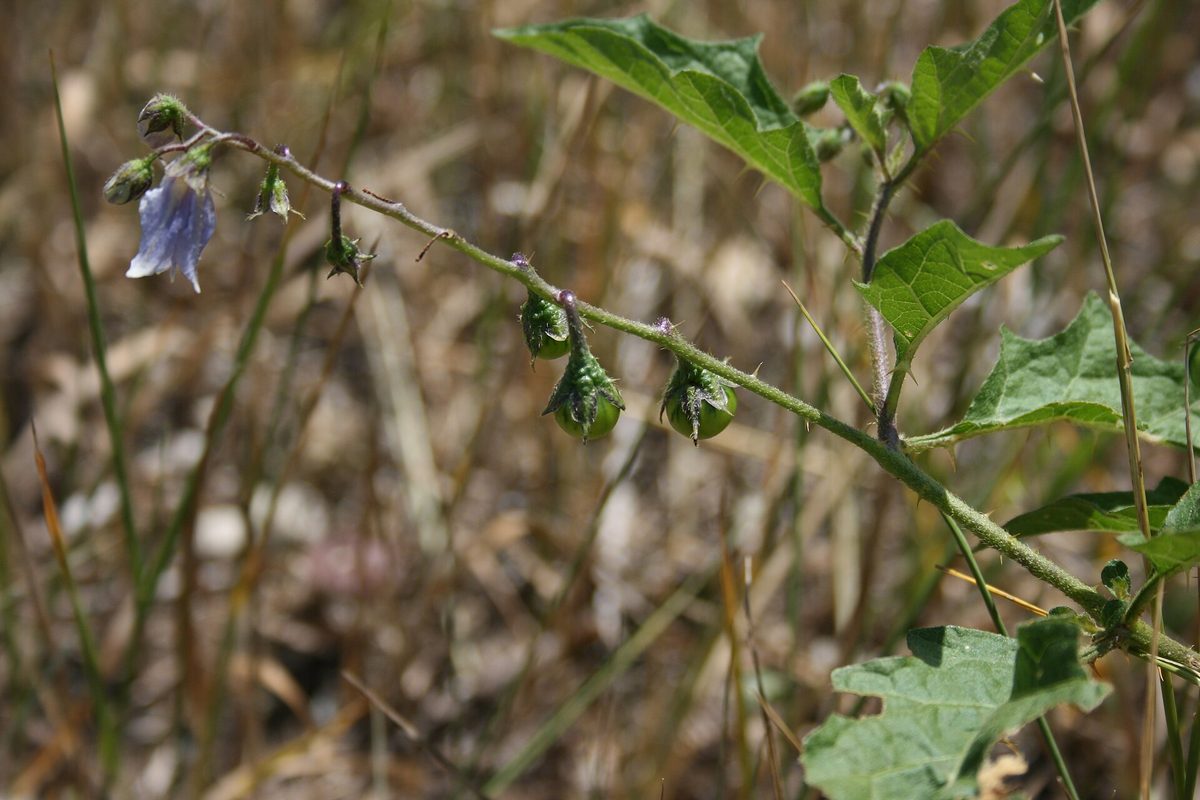
Photo: Cody Hough, CC BY-SA 3.0 via Wikimedia Commons

Quick facts
| Light: | Full sun11 source |
|---|---|
| Soil: | Well drained, moist, occasionally dry and occasionally wet11 source |
| Hardiness: | Zones 7a–10b11 source |
| Size: | 3–3.9 ft (0.91–1.2 m)21 |
| Bloom: | May–Oct, Purple and white211 source |
| Cats: | Toxic to cats (1 source) 1 |
| Dogs: | Toxic to dogs (1 source) 1 |
| Native range: | ALA, ARK, CNT, DEL, FLA, GEO, ILL, INI, IOW, KAN, KTY, LOU, MAI, MAS, MIC, MIN, MRY, MSI, MSO, MXE, MXN, NCA, NEB, NWH, NWJ, NWY, OHI, OKL, PEN, RHO, SCA, SDA, TEN, TEX, VER, VRG, WDC, WIS, WVA3 |
| Family: | Solanaceae |
How much light does a Carolina Horsenettle need?
Full sun suits this plant. The source defines full sun as 6 or more hours of direct sunlight a day. Full sun is the only outdoor light level listed for it. Choose a spot that gets direct sun for at least those 6 hours. No shade tolerance is recorded for it.
- Light: Full sun1
Best soil for a Carolina Horsenettle
The soil record lists four conditions: well drained, moist, occasionally dry and occasionally wet. The source describes the plant as tolerant to wet and dry conditions. A well drained spot suits it, and so does moist ground. It also grows where the soil is occasionally dry or occasionally wet. No cited source records a soil pH range for this plant.
- Soil drainage: Well drained, moist, occasionally dry and occasionally wet1
Hardiness and temperature
USDA zones 7a to 10b are the range listed for Solanum carolinense. That range covers 7a, 7b, 8a, 8b, 9a, 9b, 10a and 10b. Zone 7a is the cold end of the listed range, and 10b is the warm end. No cited source records a minimum temperature for it. No humidity preference is documented either. Check your own zone against 7a–10b before you choose a site.
- Hardiness: Zones 7a–10b1
How to plant a Carolina Horsenettle
Choose it for gardens in USDA zones 7a through 10b. Its US native status is listed as native in the lower 48 states. Allow for a mature height of about 3 to 4 feet (0.91–1.2 m). The plant spreads by rhizomes and seeds. The flowers are light violet or white and star-shaped, and they appear in summer and fall. The listed bloom window runs from May to October.
- Hardiness: Zones 7a–10b1
Winter care
As a herbaceous perennial, this plant is rated for zones 7a to 10b. Zone 7a is the coldest zone listed. A garden colder than zone 7a falls outside the listed range. Zone 10b is the warmest zone listed. No cited source records a minimum temperature for it. No winter protection steps are documented.
- Hardiness: Zones 7a–10b1
How to propagate a Carolina Horsenettle
You can propagate Solanum carolinense by seed or by division. The source says the plant spreads by rhizomes and seeds. Seed and division are the only two propagation methods recorded for it. It is a herbaceous perennial. No cited source gives sowing depth, seed treatment or a division method. Any propagation plan should stay within those two methods.
- Propagation: Seed and division1
Common problems
The Colorado potato beetle, eggplant flea beetle and tobacco hornworm feed on this plant. Southern bacterial wilt is the disease listed for it. The insect list has three entries, and the disease list has one. No cited source gives treatment or control methods for either.
| Problem | Kind |
|---|---|
| Colorado potato beetle | Pest |
| Eggplant flea beetle | Pest |
| Tobacco hornworm | Pest |
| Southern bacterial wilt | Disease |
Is Carolina Horsenettle toxic to cats and dogs?
The NC State Extension Gardener Plant Toolbox lists Solanum carolinense as a problem for cats. It lists the plant as a problem for dogs as well. The position is the same for both animals: toxic. No severity is recorded for cats or dogs. No cited source here names which plant parts cause the problem. Treat the plant as toxic to both cats and dogs.
Pet-safe alternatives
Recommended supplies
- Soil: a free-draining mix, and a pot with a drainage hole.
Questions and answers
- Is this plant toxic to cats and dogs?
- The NC State Extension Gardener Plant Toolbox lists it as a problem for both cats and dogs. No severity is recorded here for either animal. Treat the plant as toxic to both.
- How much sun does it need?
- It grows in full sun, which the source defines as 6 or more hours of direct sunlight a day. Full sun is the only outdoor light level listed for it.
- Which zones can it grow in?
- It is rated for USDA zones 7a to 10b. That range includes 7a, 7b, 8a, 8b, 9a, 9b, 10a and 10b. No minimum temperature is recorded for it.
Sources
- NC State Extension Gardener Plant Toolbox. https://plants.ces.ncsu.edu/plants/solanum-carolinense/. Accessed 21 October 2026.
- Lady Bird Johnson Wildflower Center (Native Plant Database). https://www.wildflower.org/plants/result.php?id_plant=soca3. Accessed 21 October 2026.
- Royal Botanic Gardens, Kew (World Checklist of Vascular Plants). https://sftp.kew.org/pub/data-repositories/WCVP/wcvp.zip. Accessed 4 June 2026.
How this page was made
- Written with AI assistance from the sources listed on this page. AI is never the source of a fact.