Holy Basil (Ocimum tenuiflorum)
Formerly Ocimum sanctum, Moschosma tenuiflorum, Geniosporum tenuiflorum
Holy basil, Ocimum tenuiflorum, prefers full sun in moist, well drained soil. It is listed as an annual and herbaceous perennial that grows rapidly to about 3 ft (0.91 m). No cited source records an indoor light need, and none records a toxicity position for cats or dogs, so both are not documented here.
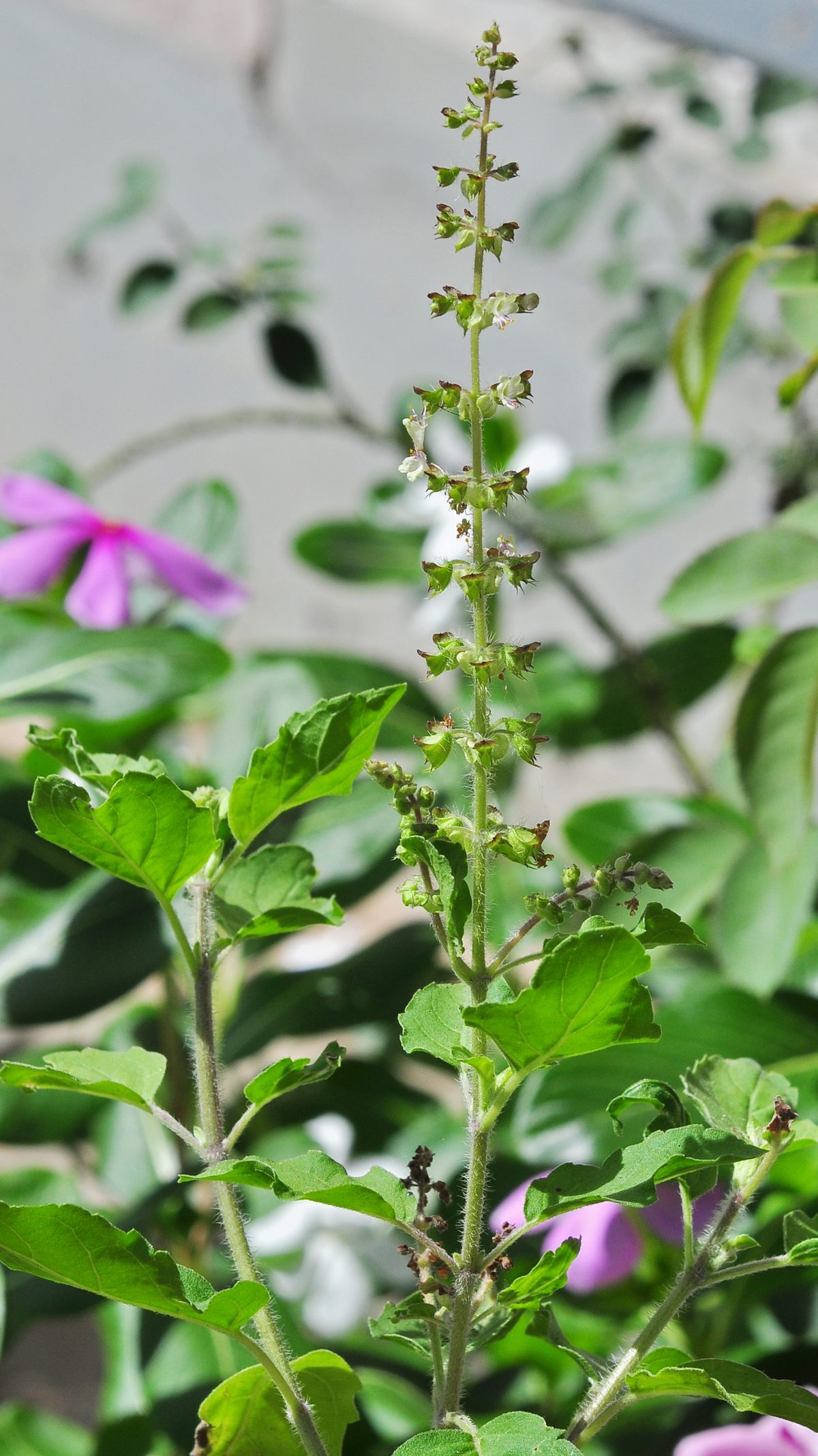
Photo: Joydeep, CC BY-SA 3.0 via Wikimedia Commons

Quick facts
| Water: | Medium11 source |
|---|---|
| Soil: | Well drained and moist; pH 3.5–921 source |
| Size: | 3 ft (0.91 m) × 2 ft (0.61 m)251 source |
| Growth rate: | Rapid221 source |
| Bloom: | White, pink and purple121 source |
| Cats: | Not documented by major sources |
| Dogs: | Not documented by major sources |
| Native range: | AND, ASS, BAN, BIS, BOR, CBD, CHC, CHH, CHS, CRL, EHM, IND, JAW, LAO, LSI, MOL, MRN, MRS, MYA, NCB, NEP, NWG, PAK, PHI, QLD, SCS, SOL, SRL, SUL, SUM, TAI, THA, VAN, VIE, WHM6 |
| Family: | Lamiaceae |
How often to water a Holy Basil
Holy basil has a medium water need, with medium recorded as both the minimum and the maximum. The source describes its preferred conditions as full sun in moist, well drained soil. Full sun means six or more hours of direct sunlight a day. No cited source gives a watering schedule in days, and none describes how the plant responds to too much or too little water.
- Water: Medium1
Best soil for a Holy Basil
The soil drainage recorded for holy basil is well drained and moist, and the source lists good drainage. The same source pairs that soil with full sun. No cited source records a soil pH range, so that value is not documented here. The plant reaches about 3 ft (0.91 m) tall and about 2 ft (0.61 m) wide at maturity. It is listed for USDA zones 9a–11b.
Pruning a Holy Basil
The pruning type recorded for holy basil is light shaping. A Clemson Cooperative Extension source advises you to prune herbs regularly to encourage more growth. The same source says never to take more than one third of the plant at one time. The growth habit is erect, and the growth rate is rapid.
- Pruning: Light shaping3
How to propagate a Holy Basil
Seed is the propagation method on record for holy basil. The source says the plant easily propagates itself by seed. No cited source records cuttings, division or any other method, so none is described here. Seed timing, depth and germination conditions are also not documented.
- Propagation: Seed2
Common problems
Recorded pests include Aleurodicus dispersus, Corythauma ayyari, Icerya purchasi, Parasaissetia nigra, Poophilus costalis, Thrips palmi, Cochlochila bullita and the Japanese beetle. Japanese beetles can skeletonize and defoliate leaves. The EPPO Global Database lists the disease Peronospora belbahrii on Ocimum. No cited source describes treatment for any of these.
| Problem | Kind |
|---|---|
| Aleurodicus dispersus | Pest |
| Corythauma ayyari | Pest |
| Icerya purchasi | Pest |
| Parasaissetia nigra | Pest |
| Poophilus costalis | Pest |
| Thrips palmi | Pest |
| Cochlochila bullita | Pest |
| Japanese beetle | Pest |
| Peronospora belbahrii | Disease |
Is Holy Basil toxic to cats and dogs?
Recommended supplies
- Soil: a free-draining mix, and a pot with a drainage hole.
Questions and answers
- How much sun does holy basil need?
- Holy basil prefers full sun, which the source defines as six or more hours of direct sunlight a day. It also prefers moist, well drained soil. No cited source gives an indoor light need.
- How big does holy basil get?
- It grows rapidly to a height of about 3 ft (0.91 m) with a spread of about 2 ft (0.61 m). Its habit is erect. The flowers are white, pink and purple. It is listed for USDA zones 9a–11b.
- Is holy basil toxic to cats and dogs?
- No cited source on file for this page records a toxicity position for cats, and none records one for dogs. That gap is not a statement that the plant is safe for either animal.
Sources
- NC State Extension Gardener Plant Toolbox. https://plants.ces.ncsu.edu/plants/ocimum-tenuiflorum/common-name/tulsi/. Accessed 24 September 2026.
- NC State Extension Gardener Plant Toolbox. https://plants.ces.ncsu.edu/plants/ocimum-tenuiflorum/. Accessed 24 September 2026.
- Clemson Cooperative Extension Home & Garden Information Center. https://hgic.clemson.edu/planting-an-herbal-tea-garden-in-south-carolina/. Accessed 24 September 2026.
- EPPO Global Database. https://gd.eppo.int/taxon/OCISA/pests. Accessed 24 September 2026.
- University of Florida IFAS Extension (EDIS). https://ask.ifas.ufl.edu/publication/EP618. Accessed 27 October 2026.
- Royal Botanic Gardens, Kew (World Checklist of Vascular Plants). https://sftp.kew.org/pub/data-repositories/WCVP/wcvp.zip. Accessed 4 June 2026.
How this page was made
- Written with AI assistance from the sources listed on this page. AI is never the source of a fact.