Cherry Plum (Prunus cerasifera)
Formerly Prunus divaricata, Prunus sogdiana, Prunus myrobalana
Give cherry plum full sun, though it also accepts part shade, and a medium amount of water. It is rated for USDA zones 5a–8b. It is a deciduous tree that reaches 15–30 ft (4.57–9.14 m) tall. The ASPCA lists it as toxic to both cats and dogs.
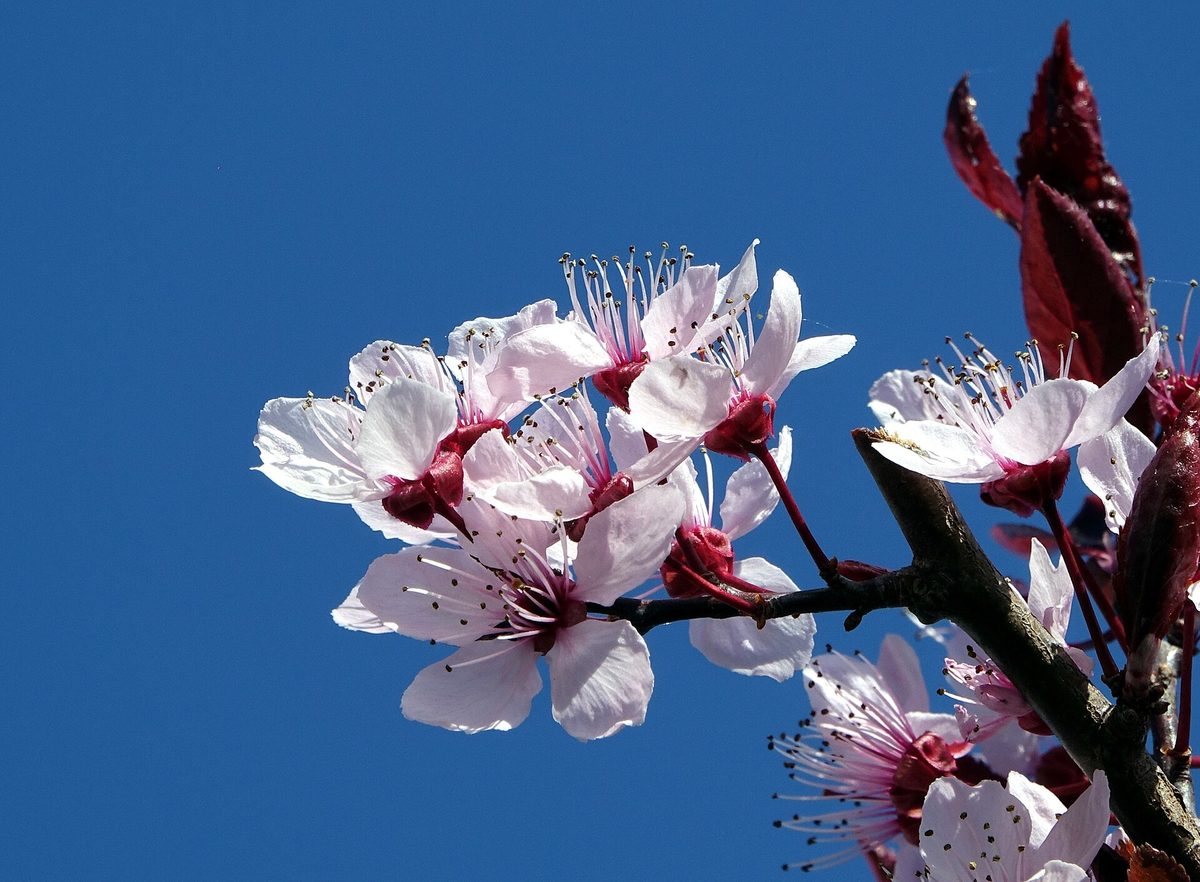
Photo: Gzen92, CC BY-SA 4.0 via Wikimedia Commons

Quick facts
| Light: | Full sun and part shade (full sun preferred)11 source |
|---|---|
| Water: | Medium11 source |
| Soil: | Well drained and moist; pH 5–8121 source |
| Hardiness: | Zones 5a–8b11 source |
| Size: | 15–30 ft (4.57–9.14 m) × 15–25 ft (4.57–7.62 m)21 source |
| Growth rate: | Moderate11 source |
| Bloom: | Apr, White and pink11 source |
| Cats: | Toxic to cats (1 source) 3 |
| Dogs: | Toxic to dogs (1 source) 3 |
| Native range: | AFG, ALB, BUL, CHX, EAI, EHM, GRC, IRN, IRQ, KAZ, KGZ, KRY, LBS, NCS, NEP, PAK, ROM, TCS, TKM, TUE, TUR, TZK, UKR, UZB, WHM, YUG4 |
| Family: | Rosaceae |
How much light does a Cherry Plum need?
Cherry plum does best in full sun, which the source defines as six or more hours of direct sunlight a day. Part shade is also listed, and full sun is the preferred setting. At maturity it reaches 15–30 ft (4.57–9.14 m) tall, with a spread of 15–25 ft (4.57–7.62 m).
- Light: Full sun and part shade (full sun preferred)1
How often to water a Cherry Plum
Cherry plum is listed with a medium water need, and the source describes its moisture preference as moist. Its soil is listed as both well drained and moist. The record lists medium as both the minimum and the maximum, and it says nothing about dry or wet spells.
- Water: Medium1
Best soil for a Cherry Plum
Cherry plum is listed for well drained and moist soil. The cited range for soil pH runs from acid to alkaline, from pH 5 to 8. Medium water is the listed moisture need that goes with these soil conditions. The record does not name a soil texture such as sand, loam or clay. A reading outside pH 5 to 8 is outside the listed range.
Hardiness and temperature
Cherry plum is rated for USDA hardiness zones 5a–8b. That spans zone 5a at the cold end to zone 8b at the warm end. No cited source records a minimum temperature for this tree, so a figure in degrees is not given here. Humidity needs are also not documented. Compare your own zone with this range to see whether the tree is rated for your area.
- Hardiness: Zones 5a–8b1
How to plant a Cherry Plum
Before you plant, check that your USDA zone falls within 5a–8b. Leave room for a mature spread of 15–25 ft (4.57–7.62 m) and a height of 15–30 ft (4.57–9.14 m). Cherry plum is a tree, and it is deciduous. The records list full sun as preferred, along with well drained and moist soil. No cited source gives a planting depth or a planting time, so none is stated here.
- Hardiness: Zones 5a–8b1
Winter care
Winter hardiness for cherry plum is recorded as USDA zones 5a to 8b. The tree is deciduous. No cited source records a minimum temperature, so the coldest conditions it survives, in degrees, are not documented. Winter protection, mulching and wrapping are also not documented. Zone 4 and colder, and zone 9 and warmer, are outside the listed range.
- Hardiness: Zones 5a–8b1
How to propagate a Cherry Plum
Cherry plum can be propagated by grafting, by seed or by stem cuttings. Those three methods are the ones the record lists. It gives no timing, no rooting medium and no success rates for any of them. Details such as when to take a cutting or which rootstock to graft onto are not documented. Because the record is that limited, treat this as a list of options rather than a method.
- Propagation: Grafting, seed and stem cuttings1
Common problems
Recorded pests of cherry plum include borers, aphids, scale insects, leafhoppers, caterpillars, tent caterpillars, Japanese beetles and spider mites. Recorded diseases include black knot, leaf spot, dieback, leaf curl, powdery mildew, root rot and fire blight. The record lists these problems but gives no treatment for any of them.
| Problem | Kind |
|---|---|
| Borers | Pest |
| Aphids | Pest |
| Scale insects | Pest |
| Leafhoppers | Pest |
| Caterpillars | Pest |
| Tent caterpillars | Pest |
| Japanese beetles | Pest |
| Spider mites | Pest |
| Black knot | Disease |
| Leaf spot | Disease |
| Dieback | Disease |
| Curling leaves | Symptom |
| Powdery mildew | Disease |
| Root rot | Disease |
| Fire blight | Disease |
Is Cherry Plum toxic to cats and dogs?
The ASPCA lists cherry plum as toxic to cats. It also lists the plant as toxic to dogs. The two animals are recorded separately, and both entries say toxic. The facts on this page do not name which parts of the plant are affected, and they give no severity or list of symptoms. This site covers pet toxicity for cats and dogs only. Treat the cat entry and the dog entry as two separate records, each marked toxic.
Pet-safe alternatives
Recommended supplies
- Soil: a free-draining mix, and a pot with a drainage hole.
Questions and answers
- Is cherry plum toxic to cats and dogs?
- The ASPCA lists cherry plum as toxic to cats and also as toxic to dogs. The record used for this page does not state which parts are affected or how severe the effects are.
- How much sun does cherry plum need?
- Cherry plum prefers full sun, meaning six or more hours of direct sunlight a day. It also tolerates part shade. Shade deeper than part shade is not covered by the record.
- Which hardiness zones suit cherry plum?
- Cherry plum is rated for USDA zones 5a to 8b. No cited source records a minimum temperature, so there is no figure in degrees to give. Compare your own zone with that range.
Sources
- NC State Extension Gardener Plant Toolbox. https://plants.ces.ncsu.edu/plants/prunus-cerasifera/. Accessed 14 October 2026.
- Cornell University CALS Woody Plants Database. https://woodyplants.cals.cornell.edu/plant/190. Accessed 24 October 2026.
- ASPCA. https://www.aspca.org/pet-care/aspca-poison-control/toxic-and-non-toxic-plants/plum. Accessed 14 October 2026.
- Royal Botanic Gardens, Kew (World Checklist of Vascular Plants). https://sftp.kew.org/pub/data-repositories/WCVP/wcvp.zip. Accessed 4 June 2026.
How this page was made
- Written with AI assistance from the sources listed on this page. AI is never the source of a fact.