Red Spider Lily (Lycoris radiata)
Formerly Nerine japonica, Nerine radiata, Amaryllis radiata
Give red spider lily full sun, or part shade, and plant it in rich, moist, well-drained soil. Watering needs are not documented on this page. It is listed as toxic to both cats and dogs, so plan its place in the garden with pets in mind.
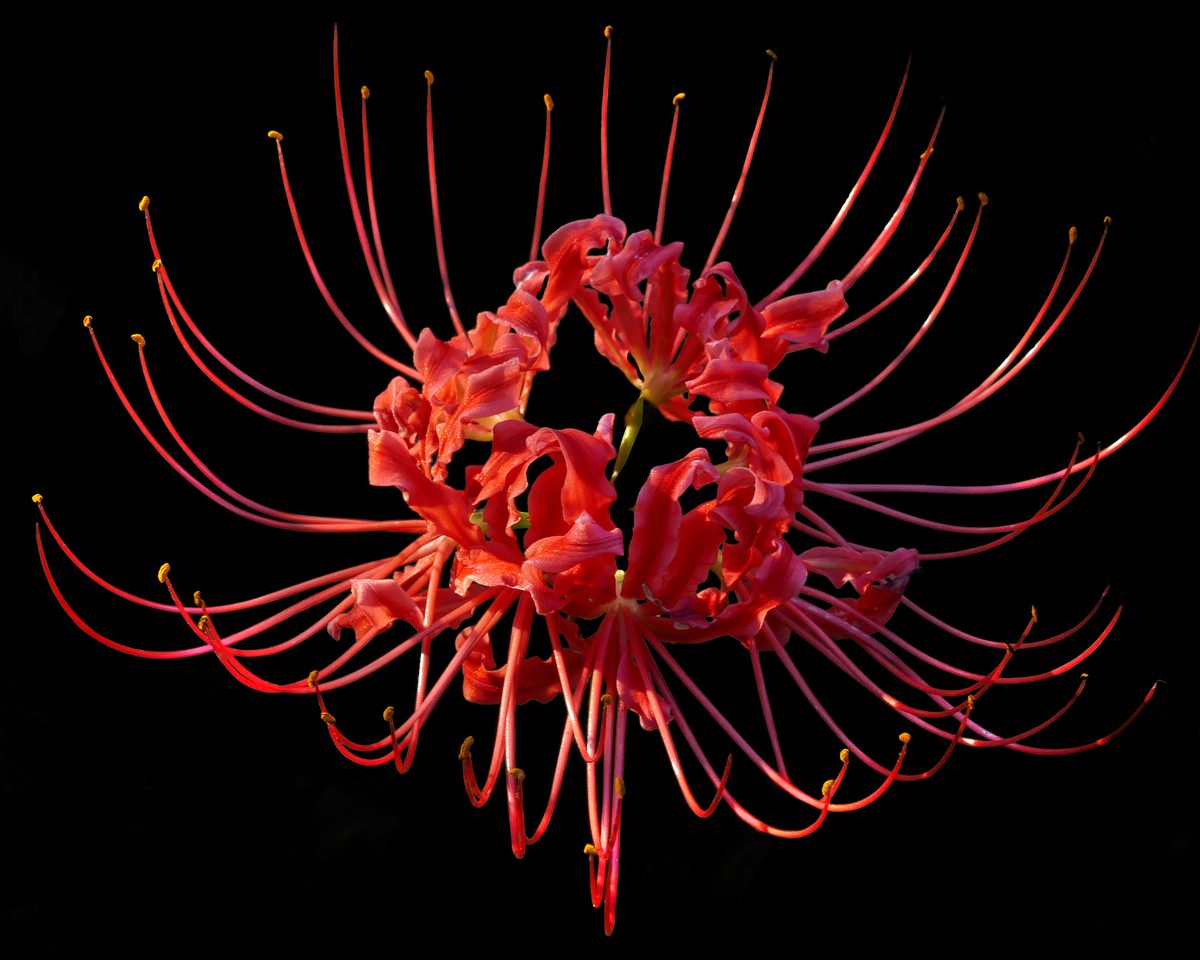
Photo: Jim Evans, CC BY-SA 4.0 via Wikimedia Commons

Quick facts
| Light: | Full sun and part shade (full sun preferred)11 source |
|---|---|
| Soil: | Well drained and moist21 source |
| Hardiness: | Zones 6a–10b21 source |
| Size: | 1–2 ft (0.3–0.6 m) × 1–2 ft (0.3–0.6 m)21 source |
| Bloom: | Aug–Sep, Red21 source |
| Cats: | Toxic to cats (1 source) 3 |
| Dogs: | Toxic to dogs (1 source) 3 |
| Native range: | CHC, CHN, CHS, JAP, KOR, NEP4 |
| Family: | Amaryllidaceae |
How much light does a Red Spider Lily need?
Red spider lily is a bulb that does best in full sun, and part shade is also within its listed range. For the best blooms, give it at least 4 hours of full sun. Plants in part shade will still grow, though they will not bloom as well as those in more sun. The preferred setting is full sun.
- Light: Full sun and part shade (full sun preferred)1
Best soil for a Red Spider Lily
Red spider lily grows in rich, moist, well-drained soil. The drainage record lists two conditions for this bulb: well drained and moist. Rich soil is also part of the description of where this plant grows. No cited source records a soil pH range for this plant, so that value is not documented. This page can only describe the soil by its richness, moisture and drainage.
- Soil drainage: Well drained and moist2
Hardiness and temperature
Zones 6a–10b are the listed hardiness range for red spider lily. Zones colder than 6a fall outside that range, and so do zones warmer than 10b. The source describes the plant as semi-hardy, with damage below 28 °F (-2 °C), to hardy, with injury below 5 °F (-15 °C). The lowest figure on record is 5 °F (-15 °C). Humidity is not documented for this plant.
Pruning a Red Spider Lily
For red spider lily, the pruning record says to remove dead growth only. Let the foliage die back naturally; this builds up the stored food supply in the bulbs. Dead growth is the only kind the record says to remove. Nothing in the record calls for trimming healthy leaves or shaping the plant.
- Pruning: Remove dead growth only1
How to plant a Red Spider Lily
Choose a site in USDA zones 6a to 10b, the range listed for red spider lily. Allow for a mature spread of 1–2 ft (0.3–0.6 m) when you space plants. Mature height is also 1–2 ft (0.3–0.6 m). In the lower 48 US states, its native status is recorded as introduced. Its native range is recorded as China, Japan, Korea and Nepal.
- Hardiness: Zones 6a–10b2
Winter care
Check your USDA zone against the listed range of 6a to 10b. At the semi-hardy end of its range, damage is recorded below 28 °F (-2 °C). At the hardy end, injury is recorded below 5 °F (-15 °C). Dead growth is the only growth to remove, and the foliage should die back naturally. No cited source records a mulching or covering method for winter, so none is given here.
Care calendar
| Task | Jan | Feb | Mar | Apr | May | Jun | Jul | Aug | Sep | Oct | Nov | Dec |
|---|---|---|---|---|---|---|---|---|---|---|---|---|
| Repot | Repot in Mar | |||||||||||
| Bloom | Bloom in Aug | Bloom in Sep |
How to propagate a Red Spider Lily
Division is the propagation method recorded for red spider lily on this page. The timing given is early spring, as the foliage turns yellow. Yellowing foliage is the cue to look for before you divide. The plant type is recorded as a bulb. No cited source records seed, cuttings or any other method for this plant.
- Propagation: Division2
Common problems
No serious insect or disease problems are recorded for red spider lily. Narcissus bulb fly occasionally feeds on this species. Stem and bulb nematode is also listed among its pests. The disease list is empty, with no named diseases recorded. These two pests are the ones named for this bulb, and no named disease accompanies them.
| Problem | Kind |
|---|---|
| Narcissus bulb fly | Pest |
| Stem and bulb nematode | Pest |
Is Red Spider Lily toxic to cats and dogs?
Red spider lily is recorded as toxic to dogs. It is also recorded as toxic to cats. The source says that pets eating large amounts can develop vomiting, diarrhea, convulsions, and potentially death. That passage covers pets in general, and this page applies it to both cats and dogs. The record does not say which parts of the plant carry this risk.
Pet-safe alternatives
Recommended supplies
- Soil: a free-draining mix, and a pot with a drainage hole.
Questions and answers
- Is red spider lily toxic to cats and dogs?
- Red spider lily is recorded as toxic to both cats and dogs. The source says that large amounts eaten by pets can cause vomiting, diarrhea, convulsions, and potentially death. The record does not say which plant parts are involved.
- How much sun does red spider lily need?
- Full sun is preferred, though the plant also grows in part shade. It blooms best with at least 4 hours of full sun. The bright red flowers sit in an umbel of 4 to 7 tubed blooms.
- When does red spider lily bloom, and how tall does it get?
- The flower appears on tall naked stems from August to September. The blooms are red. Mature height is 1–2 ft (0.3–0.6 m), with the same spread.
Sources
- Clemson Cooperative Extension Home & Garden Information Center. https://hgic.clemson.edu/spider-lilies/. Accessed 23 September 2026.
- NC State Extension Gardener Plant Toolbox. https://plants.ces.ncsu.edu/plants/lycoris-radiata/. Accessed 31 October 2026.
- NC State Extension Gardener Plant Toolbox. https://plants.ces.ncsu.edu/plants/lycoris/. Accessed 24 September 2026.
- Royal Botanic Gardens, Kew (World Checklist of Vascular Plants). https://sftp.kew.org/pub/data-repositories/WCVP/wcvp.zip. Accessed 4 June 2026.
How this page was made
- Written with AI assistance from the sources listed on this page. AI is never the source of a fact.