Autumn Crocus (Colchicum autumnale)
Formerly Colchicum vernum, Colchicum borisii, Colchicum praecox
Grow this plant outdoors in full sun to part shade, with full sun as the stronger preference, and give it a medium amount of water. This plant is toxic to both cats and dogs. Its flowers open in shades of pink, purple, or white.
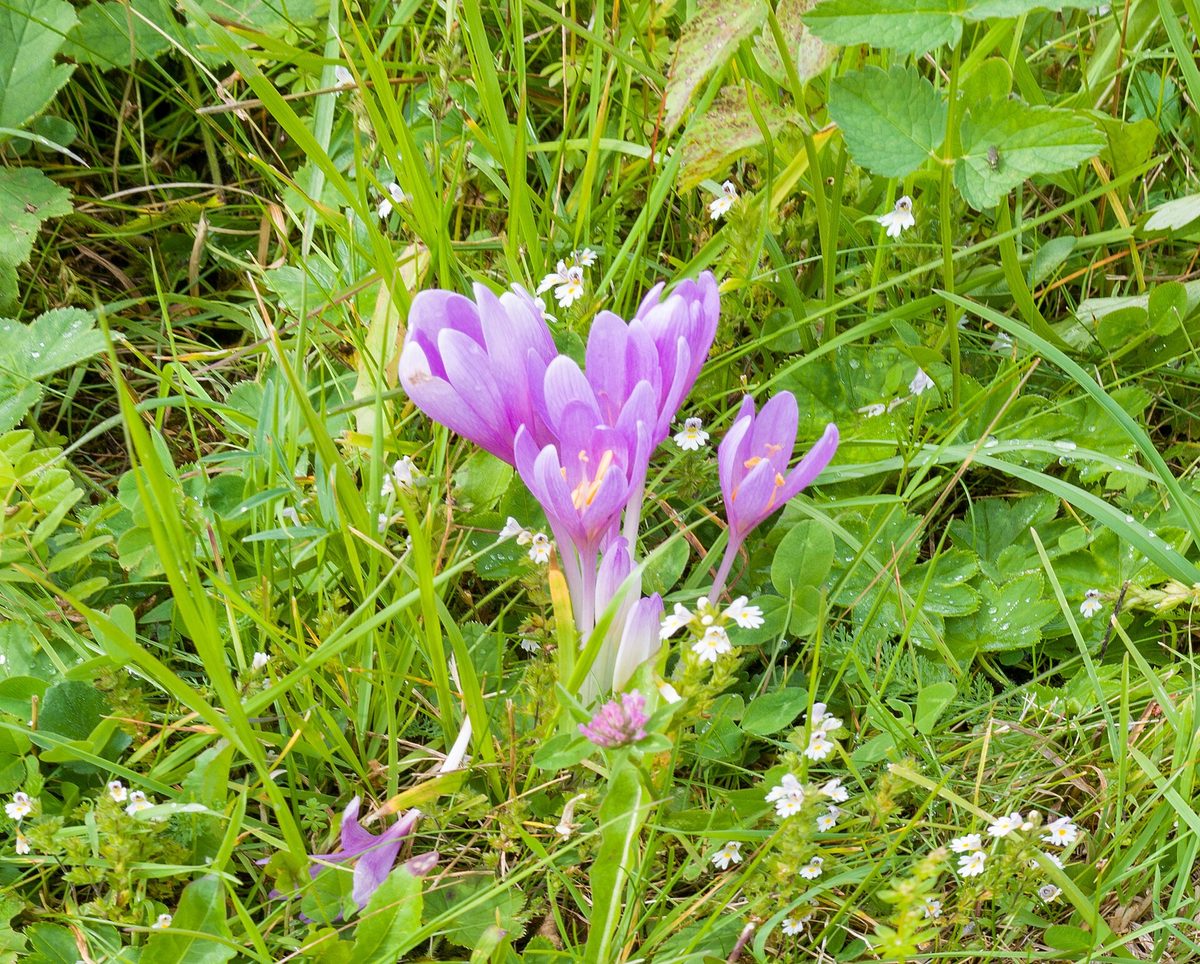
Photo: Wikimedia Commons contributor, CC BY-SA 3.0 via Wikimedia Commons

Quick facts
| Light: | Full sun and part shade (full sun preferred)123 |
|---|---|
| Water: | Medium41 source |
| Soil: | Well drained and moist; pH 4.5–7.5142 |
| Hardiness: | Zones 4a–9b11 source |
| Size: | 0.5–1.2 ft (0.15–0.36 m) × 0.5–0.7 ft (0.15–0.2 m)124 |
| Growth rate: | Moderate111 source |
| Bloom: | Pink, purple and white142 |
| Cats: | Toxic to cats 61 |
| Dogs: | Toxic to dogs 61 |
| Native range: | ALB, AUT, BGM, BUL, CZE, FRA, GER, GRB, GRC, HUN, IRE, ITA, NET, POL, ROM, SPA, SWI, UKR, YUG7 |
| Family: | Colchicaceae |
How much light does an Autumn Crocus need?
This plant's light needs run from full sun to part shade, with full sun listed as the preferred option. Full sun means six hours or more of direct sunlight each day, the brighter end of the range this plant will accept. Part shade also works outdoors, though full sun remains the stronger choice.
How often to water an Autumn Crocus
This plant's water need is listed as medium, meaning it should get a regular supply without heavy watering or drought-level dryness. That medium level comes from its preference for well-drained soil that doesn't dry out in summer. The soil itself should be well drained and moist.
- Water: Medium4
Best soil for an Autumn Crocus
This plant grows best in rich, well-drained loam that still holds some moisture rather than drying out completely. Soil pH matters too: this plant tolerates a fairly wide range, from 4.5 up to 7.5. That pH window runs from somewhat acidic at 4.5 to mildly alkaline at 7.5. Its soil should also stay moist enough that it doesn't dry out completely during summer, in addition to draining well.
Hardiness and temperature
This plant grows outdoors in USDA hardiness zones 4a through 9b. In the coldest parts of that range, this plant can survive winter temperatures down to about -4°F (-20°C). Zone 9b marks the warmer end of its hardiness range, while zone 4a marks the colder end of that span. That span covers twelve numbered half-zones in total, from the lowest, 4a, up through the highest, 9b.
How to plant an Autumn Crocus
This plant grows well outdoors in USDA hardiness zones 4a through 9b. At maturity it stands about 0.5 to 1.2 ft (0.15-0.36 m) tall, with a spread of roughly 0.5 to 0.7 ft (0.15-0.2 m). When planting, space new plants about that same distance apart. This plant grows from a bulb. In the lower 48 US states, this plant's status is listed as introduced.
- Hardiness: Zones 4a–9b1
Winter care
This plant is hardy outdoors through USDA zone 4a, the coldest zone in its range. In that zone and the others up to 9b, it can tolerate winter temperatures down to about -4°F (-20°C). Gardeners in colder zones than 4a fall outside the range this cold tolerance covers. That same -4°F (-20°C) figure is the lowest winter temperature this plant can survive outdoors.
How to propagate an Autumn Crocus
You can propagate this plant from seed, or you can increase your stock of it through division. Divide the plants in summer, after the leaves have died back, if you want to move or split them. Growing new plants from seed is the other option available to gardeners who prefer not to divide established clumps.
Common problems
Slugs are a common pest, and they may attack the corms of this plant. The stem and bulb nematode, Ditylenchus dipsaci, is another pest recorded on this plant. Fungal smut can affect the leaves as well. This plant is also reported to resist drought, rabbits, and deer.
| Problem | Kind |
|---|---|
| Slugs and snails | Pest |
| Stem and bulb nematode | Pest |
| Smut | Disease |
Is Autumn Crocus toxic to cats and dogs?
This plant is toxic to both cats and dogs alike. It poses a particular threat specifically to cats. Dogs are also clearly at risk from this plant, since it is separately listed as a problem for dogs as well. That means the same caution about this plant's toxicity applies whether the pet sharing your home is a cat or a dog.
Pet-safe alternatives
Recommended supplies
- Soil: a free-draining mix, and a pot with a drainage hole.
Questions and answers
- Is this plant toxic to cats and dogs?
- This plant is toxic to both cats and dogs. It poses a particular threat specifically to cats. Dogs are also listed separately as being at risk from this plant.
- How much sun does this plant need?
- This plant does best in full sun, which means six or more hours of direct sunlight a day. It also tolerates part shade, though full sun remains its stronger preference.
- What hardiness zones can this plant grow in?
- This plant grows outdoors in USDA hardiness zones 4a through 9b. In the coldest of those zones, it can survive winter temperatures down to about -4°F (-20°C).
Sources
- NC State Extension Gardener Plant Toolbox. https://plants.ces.ncsu.edu/plants/colchicum-autumnale/. Accessed 14 October 2026.
- Clemson Cooperative Extension Home & Garden Information Center. https://hgic.clemson.edu/factsheet/summer-and-fall-flowering-bulbs/. Accessed 14 October 2026.
- Penn State Extension. https://extension.psu.edu/the-unexpected-delight-of-fall-blooming-bulbs. Accessed 14 October 2026.
- University of Wisconsin-Madison Division of Extension (Wisconsin Horticulture). https://hort.extension.wisc.edu/articles/autumn-crocus-colchicum-spp/. Accessed 14 October 2026.
- EPPO Global Database. https://gd.eppo.int/taxon/CXHAU/pests. Accessed 14 October 2026.
- ASPCA Animal Poison Control Center. https://www.aspca.org/pet-care/aspca-poison-control/toxic-and-non-toxic-plants/autumn-crocus. Accessed 14 October 2026.
- Royal Botanic Gardens, Kew (World Checklist of Vascular Plants). https://sftp.kew.org/pub/data-repositories/WCVP/wcvp.zip. Accessed 4 June 2026.
How this page was made
- Written with AI assistance from the sources listed on this page. AI is never the source of a fact.