Calla Lily (Zantedeschia aethiopica)
Formerly Calla aethiopica, Otosma aethiopica, Colocasia aethiopica
Your calla lily, Zantedeschia aethiopica, needs bright, indirect light indoors and water that runs from medium to wet. Kept too wet, the rhizomes will develop root rot. The ASPCA lists the plant as toxic to cats and toxic to dogs.
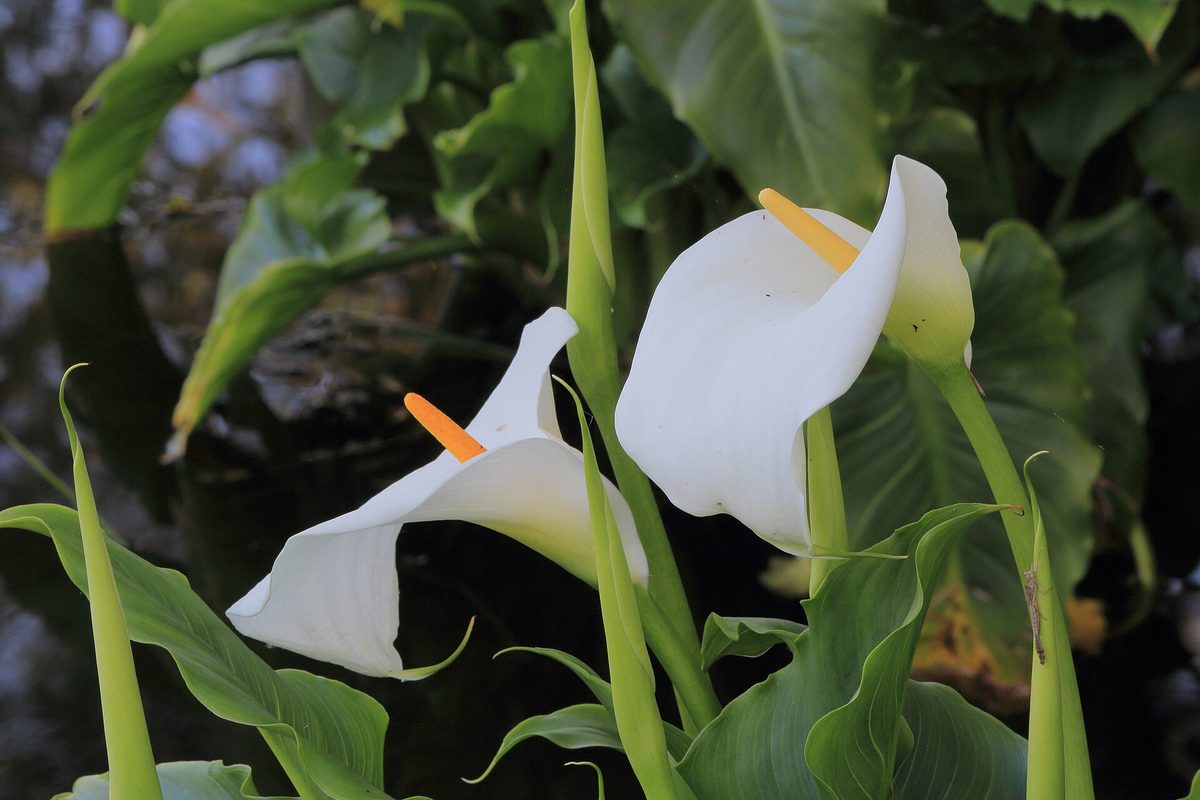
Photo: Dominicus Johannes Bergsma, CC BY-SA 3.0 via Wikimedia Commons

Quick facts
| Light: | Bright, indirect light11 source |
|---|---|
| Water: | Medium to wet21 source |
| Soil: | Moist, occasionally wet and poorly drained31 source |
| Size: | 2–3.2 ft (0.61–0.99 m) × 1–2 ft (0.3–0.61 m)321 source |
| Growth rate: | Moderate331 source |
| Bloom: | Jun–Jul, White, orange, pink, purple, red and yellow321 source |
| Cats: | Toxic to cats 63 |
| Dogs: | Toxic to dogs 63 |
| Native range: | CPP, LES, NAT, OFS, SWZ, TVL7 |
| Family: | Araceae |
How much light does a Calla Lily need?
Bright, indirect light is the indoor setting listed for this calla lily. Pair that light with soil that stays damp but not drenched. Outdoors, the plant takes full sun or part shade, and full sun is preferred. For garden planting, full morning sun with filtered shade in the afternoon is described as the way to grow it.
- Light: Bright, indirect light1
How often to water a Calla Lily
Water needs for this plant run from medium to wet. Medium is the lowest water level listed. Letting it stay too wet is the problem to avoid, because the rhizomes will develop root rot. Indoors, keep the soil consistently damp but not drenched. The soil conditions listed for the plant include moist, occasionally wet and poorly drained ground.
- Water: Medium to wet2
Best soil for a Calla Lily
This calla lily is listed for soils that are moist, occasionally wet or poorly drained. A preferred soil pH range is not documented for it, so no figure is given here. Medium to wet is the water range listed for the plant. Wetness still has a limit, because rhizomes kept too wet will develop root rot. Rhizome rot is recorded as an occasional disease problem. Indoors, the soil should stay damp but not drenched. The plant type is listed as bulb.
- Soil drainage: Moist, occasionally wet and poorly drained3
Pruning a Calla Lily
Cut the flower stems as the blooms fade. Doing so prevents the plants from setting seeds. Deadheading is the pruning type recorded for this plant. Mature plants are upright and reach 2 to 3.2 ft (0.61 to 0.99 m) tall. They spread about 1 to 2 ft (0.3 to 0.61 m) wide.
- Pruning: Deadheading4
How to propagate a Calla Lily
You can propagate calla lily easily by division in the early spring. Division is the propagation method recorded for this plant. Mature plants are 1 to 2 ft (0.3 to 0.61 m) wide. The growth rate is moderate. The plant type is listed as bulb. Its rhizomes develop root rot if kept too wet.
- Propagation: Division3
Common problems
Recorded pests include thrips palmi, yellowstriped armyworm, root lesion nematode and burrowing nematode. Four pests are recorded in total for this species. Rhizome rot is listed as an occasional disease problem. Rhizomes develop root rot if kept too wet. Deer are less of a worry, since calla lilies are described as deer resistant.
| Problem | Kind |
|---|---|
| Thrips palmi | Pest |
| Yellowstriped armyworm | Pest |
| Root lesion nematode | Pest |
| Burrowing nematode | Pest |
| Rhizome rot | Disease |
Is Calla Lily toxic to cats and dogs?
The ASPCA lists this plant as toxic to dogs and toxic to cats. For cats, the position is toxic. For dogs, the position is also toxic. It is also flagged as a problem for cats and a problem for dogs. Both listings use the same word, toxic, for each animal. Zantedeschia aethiopica carries this listing for both animals. Severity and the affected plant parts are not documented in the facts for this page.
Pet-safe alternatives
Recommended supplies
- Light: bright, indirect light, such as near an east window; a full-spectrum grow light substitutes where no window does.
- Soil: a mix that holds moisture without staying wet.
Questions and answers
- How much light does a calla lily need?
- Indoors, bright, indirect light is the setting listed for this plant. Outdoors it takes full sun or part shade, and full sun is preferred. Full morning sun with filtered shade in the afternoon is described as a way to grow it.
- Which USDA zones can a calla lily grow in outdoors?
- The listed range is zones 8a to 10b. In the lower 48 states, Hawaii and Puerto Rico, its native status is introduced. Plants are upright and reach 2 to 3.2 ft (0.61 to 0.99 m) tall.
- Is a calla lily poisonous to cats and dogs?
- The ASPCA lists this plant as toxic to cats and toxic to dogs. It is also flagged as a problem for cats and a problem for dogs. Severity and the affected plant parts are not documented in the facts for this page.
Sources
- University of Illinois Extension. https://extension.illinois.edu/blogs/flowers-fruits-and-frass/2022-02-11-gift-flowering-houseplant-valentines-day. Accessed 14 October 2026.
- Clemson Cooperative Extension HGIC. https://hgic.clemson.edu/calla-lily/. Accessed 14 October 2026.
- NC State Extension Gardener Plant Toolbox. https://plants.ces.ncsu.edu/plants/zantedeschia-aethiopica/. Accessed 14 October 2026.
- Penn State Extension. https://extension.psu.edu/summer-and-fall-blooming-bulbs. Accessed 14 October 2026.
- EPPO Global Database. https://gd.eppo.int/taxon/ZNTAE/pests. Accessed 14 October 2026.
- ASPCA Animal Poison Control Center. https://www.aspca.org/pet-care/aspca-poison-control/toxic-and-non-toxic-plants/calla-lily. Accessed 14 October 2026.
- Royal Botanic Gardens, Kew (World Checklist of Vascular Plants). https://sftp.kew.org/pub/data-repositories/WCVP/wcvp.zip. Accessed 4 June 2026.
How this page was made
- Written with AI assistance from the sources listed on this page. AI is never the source of a fact.